


The architecture of Madrid, Community of Madrid, Spain, is the set of architectural and construction styles that have appeared in the city throughout the history of Madrid. Madrid’s architecture is an important part of Spanish architecture and reflects relevant aspects of its evolution.
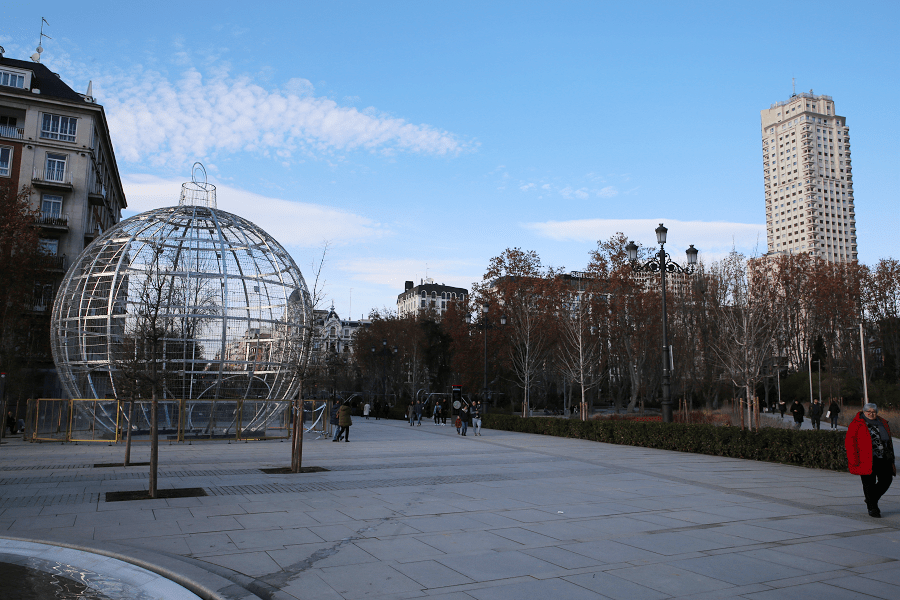
The distinctive character of Madrid’s architectural styles began during the 15th century, with the beginning of the city as a separate entity. Previously, the municipality was made up of an architecture very similar to that of any defensive town from the medieval period of Castile. The final decision of Philip II of Spain to make it the capital of Spain turned the city into a constructive space where the court, state power and various religious orders could be installed.

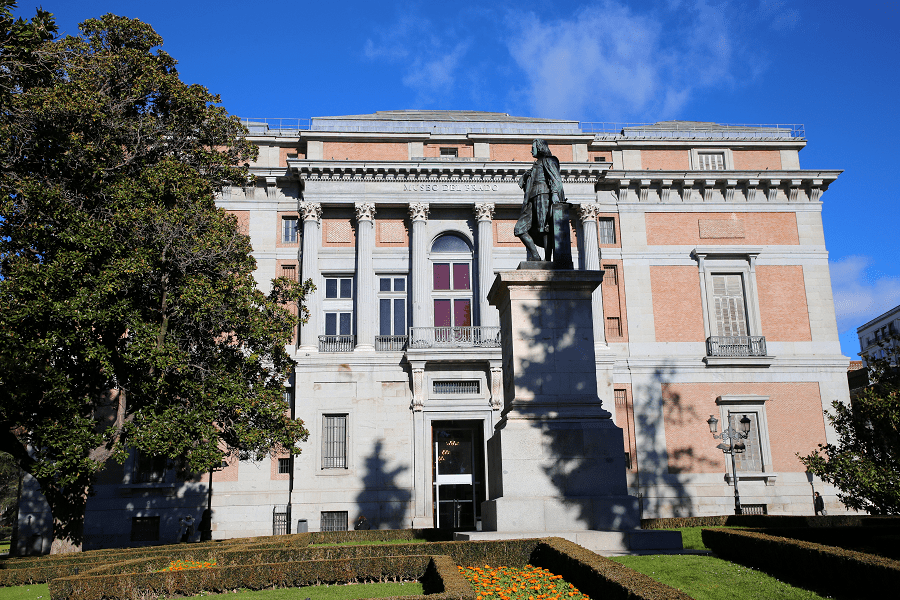
Architecture is a way of expressing the political ambitions of the time, and it is at this moment that the first palaces, convents and other constructions of state power appeared. In its first moments as the Spanish capital, Madrid assumed the style that would be marked by the Austrias (Herrerian architecture). Examples of this period are the Casa de la Villa, the bridge of Segovia or the Casa de la Panadería. The arrival of the Bourbons and their close relationship with French and Italian architects brought about changes in architectural trends, leading to the introduction of the Baroque in Madrid and its progressive transformation into a neoclassical architecture that would remain in force until the beginning of the 18th century. Representatives of the Baroque are the Toledo bridge, the Conde-Duque barracks or the Royal Palace of Madrid, while the Liria palace, the Puerta de Alcalá or the Prado Museum are examples of neoclassicism.
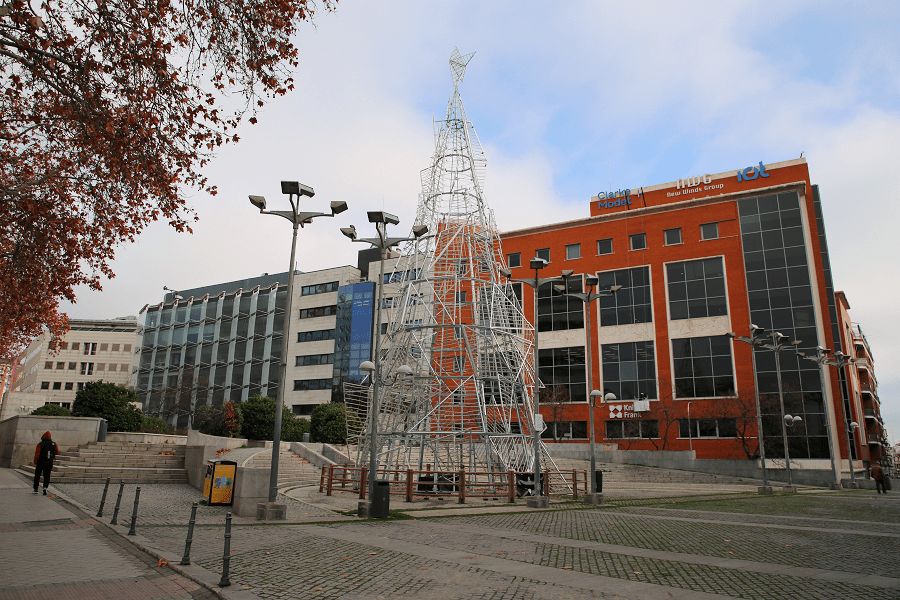
At the end of the 19th century and beginning of the 20th century, there was no architectural style of its own, giving rise to eclectic architecture, unlike other Spanish cities such as Barcelona, where the so-called Catalan modernism emerged with force. The emergence of new architectural needs at the beginning of the 20th century, with the massive increase in population and the appearance of large stores, offices, banks and new communication systems (tram, metro, telephone) led to the emergence of buildings for this purpose in the streets of Madrid.

From the beginning of the 20th century, examples of historicist architecture spread through the streets until the 1950s, with the Brussels Expo (1958). Contrary to the prevailing historicism, colonies were built in peripheral neighborhoods such as El Viso and the city began to project itself towards its periphery. At this time, the so-called ‘modern architecture’ and its various proposals emerged. From 1956 to 1970, the so-called ‘Madrid School’ was created. In the mid-sixties, the city was projected to a radius of twelve kilometers, promoting the development of Leganés, Getafe, Alcorcón, Alcobendas, Parla and Alcalá de Henares.
Periods
Medieval and Renaissance period
Very little medieval architecture is preserved in Madrid, and most of it is located inside the Almendra Central. Historical documents show that the city was walled and had a castle (the Alcázar) in the same place where the Royal Palace now stands. Among the few preserved medieval buildings are the mudejar towers of San Nicolás and San Pedro el Viejo churches, the palace of Luján family (located in the Plaza de la Villa), the Gothic church of St. Jerome, part of a monastery built by the Catholic Monarchs in the 15th century, and the Bishop’s Chapel.

House of Habsburg
When Philip II moved his court to Madrid in 1561, a series of reforms began, reforms that aimed to transform the town into a capital city worthy of the name. These reforms were embodied in the Plaza Mayor, designed by Juan de Herrera (author of El Escorial) and Juan Gómez de Mora, characterized by its symmetry and austerity, as well as the new Alcázar, who would become the second most impressive royal palace of the kingdom.
Many of the historic buildings of Madrid were built during the reign of the Habsburgs. The material used was mostly brick and the humble façades contrast with the elaborate interiors. Juan Gómez de Mora built notable buildings such as Casa de la Villa, Prison of the Court, the Palace of the Councils and Royal Convent of La Encarnación. The Buen Retiro Palace was a vanished work by Alonso Carbonel, today on the grounds of the Buen Retiro Park, with beautiful rooms decorated by the best artists in times of Philip IV (Velázquez, Carducci, Zurbarán). Imperial College become an important institution run by the Jesuits, and the model dome of the church would be imitated in all Spain, thanks to the cheap materials used in its construction.

House of Bourbon
The arrival of the Bourbons marked a new era in the city. Ruins of the burned Alcazar of Madrid was replaced by the grand Royal Palace of Madrid commissioned by the first Spanish Bourbon, Philip V of Spain, a palace more in line with the French taste.
Filippo Juvarra, an architect specializing in the construction of royal palaces, was chosen to design the new palace. His design was inspired by Bernini’s design rejected for the Louvre Palace in Paris. Juvarra died before the work began, and the project was substantially modified by his disciple Giovainni Battista Sacchetti. Philip V tried to complete the vision of urbanization of Madrid initiated by King Philip II, which included a bridge spanning a large ravine, linking The Royal Alcázar to the southern part of town. Philip V would never see the bridge even begin and neither would several of his successors. It wasn’t built until the 19th century and is called the Segovia Viaduct. Other buildings of the time were the St. Michael’s Basilica and the Church of Santa Bárbara.

19th century and later
From the late 19th century until the Civil War, Madrid modernized and built new neighborhoods and monuments, both in the capital and in neighboring towns. In the mid-19th century the expansion of Madrid developed under the Plan Castro, resulting in the districts of Salamanca and Chamberí.
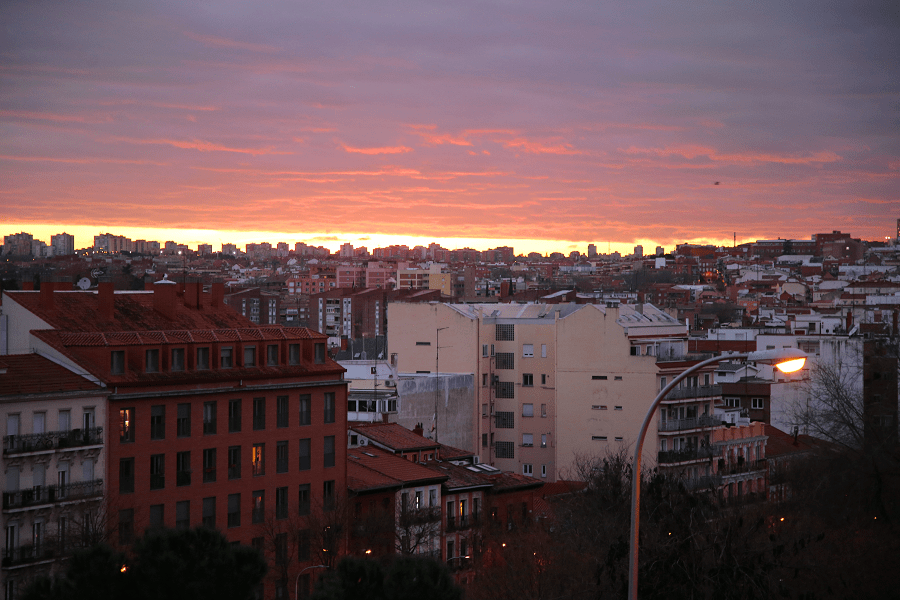
Arturo Soria y Mata conceived the linear city and built the first few kilometers of the road that bears his name, which embodies the idea. Ricardo Velázquez Bosco designed the Crystal Palace and the Palace of Velázquez in the Retiro Park. Secundino Zuazo Ugalde built the Palace of Music and the Casa de las Flores. The Bank of Spain was designed by Eduardo Adaro Magro and Severiano Sainz de la Lastra. Meanwhile, the Marquis of Cubas began the Almudena Cathedral project, which was to be a neo-Gothic church with neo-Romanesque cloister. Alberto de Palacio y Elissague designed Atocha Station. Las Ventas Bullring was built in the early 20th century, as the Market of San Miguel (Cast-Iron style).

Francisco Franco
In the first years of the Franco regime, the government adhered to some elements of the totalitarian architectural language, with a folkish mythification of the works of Juan de Herrera and Juan de Villanueva, captured in buildings such as the Luis Gutiérrez Soto’s Ministry of the Air, reminiscent of El Escorial. During these years, in the Spanish case the reactionary and Catholic conservative matrix largely prevailed over a purely Fascist architecture in the sense of the Roger Griffin’s established link between modernity and Fascism.
The neo-herrerian style developed in the 1940s adapted in Spain the monumentality espoused by German and Italian fascist architectural styles, but it strayed from them in the sense that this style, very much looking to the past, remained far from the avant-garde. The Teatro Clara Eugenia, a building strikingly following the style of Nazi’s official architect Albert Speer was nonetheless erected in 1943 on the current day district of Hortaleza.
End of the 20th century
1992 was a marked year for Spain. However, the Capital of Culture Madrid celebrated in 1992 did not have the meaning the Universal Exposition and the Summer Olympics had for Seville and Barcelona, respectively, and the city was left with no lasting icon of the year. The most outstanding projects in the early 1990s were the reopening of the Museo Nacional Centro de Arte Reina Sofía (project by Antonio Fernández Alba) and the renovation of the Atocha Train Station (by José Rafael Moneo Vallés).
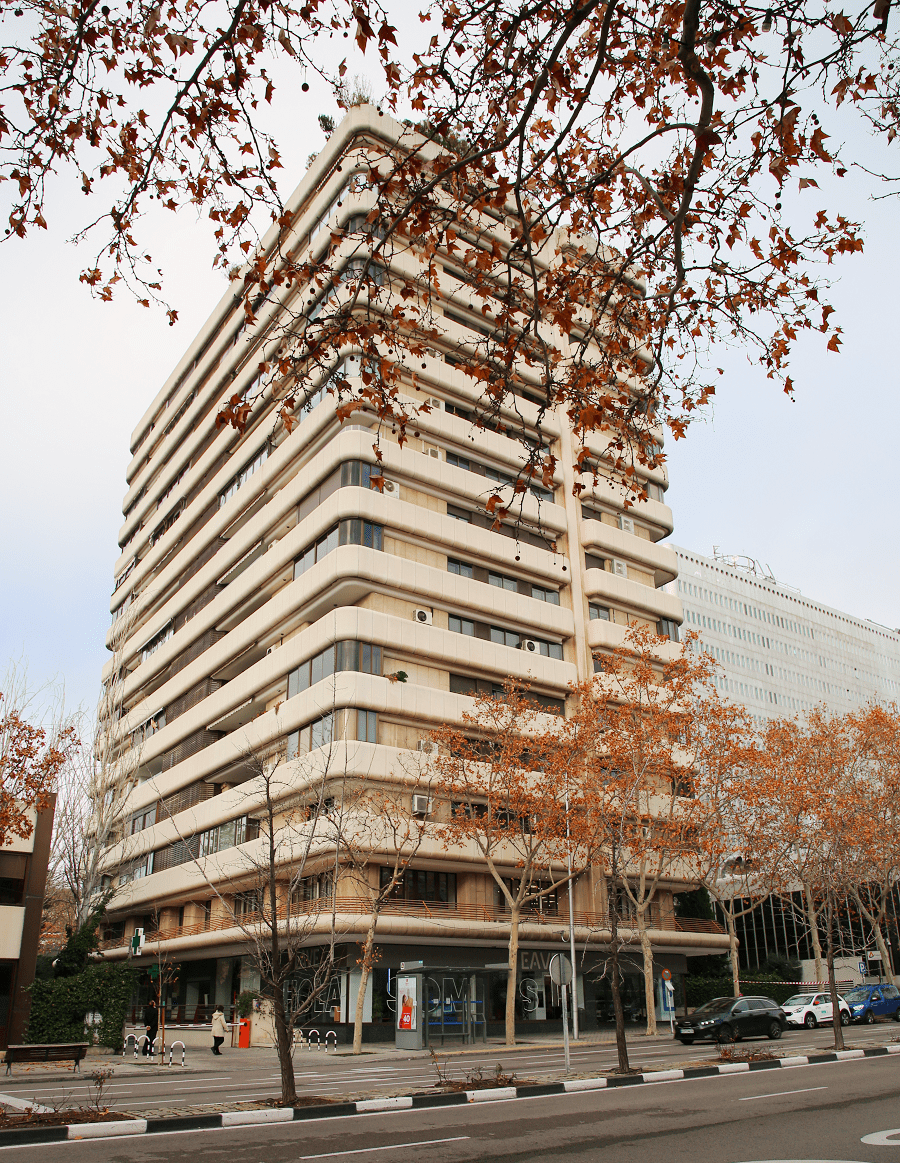
In the last quarter of the 20th century skyscrapers appeared in the city such as Torre Picasso, designed by Minoru Yamasaki; Torres Blancas and Torre BBVA (both by Francisco Javier Sáenz de Oiza) and in the 1990s, the Gate of Europe, architects Philip Johnson and John Burgee. Moreover, in the 1990s construction was completed of the Cathedral of the Almudena. The National Auditorium of Music is a work of 1988.

21st century
In the 21st century, Madrid faces new challenges in its architecture. An old industrial warehouse is the Interpretation Centre of New Technologies, and the CaixaForum Madrid (Herzog & de Meuron) was a former power station.
Under the government of Alberto Ruiz-Gallardón the four tallest skyscrapers in Spain were built, and together form the Cuatro Torres Business Area (CTBA). The Manzanares river is crossed by new edge bridges, and work started on the International Convention Centre (Mansilla+Tuñón), an original round building, whose works remain paralyzed by the crisis. Caja Mágica (Dominique Perrault) sport centre was also built and the Reina Sofía Museum has been expanded with the help of Jean Nouvel.

Madrid Barajas International Airport Terminal 4, designed by Antonio Lamela Martínez, Richard George Rogers and TPS Engineers, was inaugurated on 5 February 2006. Terminal 4 is one of the world’s largest terminal areas, with an area of 760,000 square metres (8,180,572 square feet) in two separate terminals: a main building, T4 (470,000 square metres), and satellite building, T4S (290,000 square metres), which are separated by approximately 2.5 km (2 mi).

Religious architecture
Madrid has a considerable number of Catholic churches, some of which are among the most important Spanish religious artworks.
The oldest church that survives today is San Nicolás de los Servitas, whose oldest item is the bell tower (12th century), in Mudéjar style. The next oldest church is San Pedro el Real, with its high brick tower.
St. Jerome Church is a gothic church next to El Prado Museum. The Catholic Monarchs ordered its construction in the beginning of the 16th century, as part of a vanished monastery. The monastery’s cloister is preserved. It has recently been renovated by Rafael Moneo, with the goal to house the neoclassical collection of El Prado Museum, and also sculptures by Leone Leoni and Pompeo Leoni.
The Bishop Chapel is a gothic chapel built in the 16th century by order of the Bishop of Plasencia, Gutierre de Vargas. It was originally built to house the remains of Saint Isidore Laborer (Madrid’s patron saint), but it was used as the Vargas family mausoleum. Inside are the altarpiece and the tombs of the Vargas family, which were the work of Francisco Giralte, a disciple of Alonso Berruguete. They are considered masterpieces of Spanish Renaissance sculpture.

List of the most famous civil buildings and objects of Madrid (in alphabetical order)
- Arco de la Victoria
- Arganzuela Footbridge
- Ateneo de Madrid
- Auditorio Nacional de Música
- AZCA
- Bank of Spain
- Biblioteca Nacional de España
- Casa de Allende
- Casa de la Villa
- Casino de Madrid
- Casón del Buen Retiro
- Castillo de La Alameda
- Caryatid Building
- Charles III University of Madrid
- Círculo de Bellas Artes
- Complutense University of Madrid
- Congress of Deputies
- Cybele Palace
- Cuatro Torres Business Area
- Edificio Metrópolis
- Escuelas Pías de San Fernando
- Faro de Moncloa
- Gate of Europe
- General Headquarters of the Air and Space Force
- Government of the Community of Madrid
- Junta Municipal del Distrito de Moncloa-Aravaca
- Las Ventas bullring
- Longoria Palace
- Madrid Planetarium
- Madrid Royal Conservatory
- Matadero Madrid
- Nuevos Ministerios
- Palace of la Bolsa de Madrid
- Palacio de Cristal del Retiro
- Palacio de Fernán Núñez
- Palacio del Marqués de Perales
- Palacio de los Vargas
- Palacio de Velázquez
- Principe Pío
- Puerta de Alcalá
- Puerta de San Vicente
- Puerta de Toledo
- Real Academia de Bellas Artes de San Fernando
- Royal Observatory of Madrid
- Royal Palace of Madrid
- Royal Spanish Academy
- Royal Tapestry Factory
- Santiago Bernabéu Stadium
- Seminario Conciliar de Madrid
- Senate of Spain
- Sobrino de Botín
- Spanish Council of State
- Supreme Court of Spain
- Technical University of Madrid
- Toledo bridge
- Torre Europa
- Torrespaña
- Templo de Debod
- Torres Blancas

List of the most famous religious buildings in Madrid (in alphabetical order)
- Almudena Cathedral
- Asilo de Convalecientes
- Basilica of Jesus de Medinaceli
- Basílica pontificia de San Miguel
- Church of La Concepción
- Church of las Calatravas
- Church of Saint Anthony of the Germans
- Church of Saint Manuel and Saint Benedict
- Church of Saint Jerome the Royal
- Church of Santa Teresa y San José
- Church of the Monastery of the Salesas Reales
- Church of the Holy Cross
- Colegiata de San Isidro
- Convent of las Comendadoras de Santiago
- Convent of Las Descalzas Reales
- Convento de Don Juan de Alarcón
- Convent of the Barefoot Trinitarians
- Iglesia de la Paloma
- Iglesia de Nuestra Señora de los Ángeles
- Iglesia del Sacramento
- Iglesia de San Andrés
- Iglesia de San Francisco de Borja
- Iglesia de San Ginés de Arlés
- Iglesia de San Ildefonso
- Iglesia de San Lorenzo
- Iglesia de San Salvador y San Nicolás
- Iglesia de Santa Teresa y Santa Isabel
- M-30 Mosque
- Nuestra Señora de la Paz parish church
- Oratorio del Olivar
- Our Lady of Montserrat Church
- Pantheon of Illustrious Men
- Real basílica de Nuestra Señora de Atocha
- Royal Basilica of Saint Francis the Great
- Royal Monastery of Santa Isabel
- San Cayetano Church
- San Pedro el Real
- St Sebastian’s Church

Madrid: full guide
- Administrative structure
- Entertainment
- Monuments
- Museums
- Parks and gardens
- Restaurants
- Shopping and markets
- Squares
- Streets
- Transport

See here Pyrenees travel guide
See here France travel guide
See here Spain travel guide




