

Best monuments of Madrid, Community of Madrid, Spain
TOP 20

Tribute statue to the Mexican composer Agustín Lara by Humberto Peraza y Ojeda, who composed the beautiful chotis “Madrid, Madrid, Madrid”. Address: Arturo Barea square, Lavapiés neighborhood.

Admiral Blas de Lezo y Olavarrieta monument. He was born in Pasajes in 1689. His military career began in the Navy in 1704 during the War of Succession. In the Battle of Vélez-Málaga he was hit by a cane and lost one of his legs. Address: Plaza de Colón, 1, Salamanca, 28001.

Pedro Calderón de la Barca monument by Juan Figueras y Vila. Pedro Calderón was a Spanish dramatist, poet, and writer. He is known as one of the most distinguished poets and writers of the Spanish Golden Age. Address: Plaza de Santa Ana.

Clara del Rey Calvo monument. Clara del Rey Calvo (1765 – 1808) was a Spanish war heroine. She was married to a soldier, Manuel González Blanco, and participated with her husband in the street fight battle of the Dos de Mayo Uprising in Madrid, where she was killed. The bust is the work of the sculptor César Orrico. Address: Plaza de las Comendadoras.

The Statue “El Lector” Carlos Cambronero is in honor of Carlos Cambronero y Martínez (1849-1913), who was a renowned historian and writer who documented the history of Madrid. The statue is the work of sculptor Félix Hernando García. Address: C. de San Justo, 5, Centro.

The equestrian statue of Charles III of Spain, located in the Puerta del Sol, is a bronze reproduction by Miguel Ángel Rodríguez, Eduardo Zancada and Tomás Bañuelos Ramón of a model by Manuel Francisco Álvarez de la Peña preserved in the Royal Academy of Fine Arts of San Fernando.

The Monument to Federico García Lorca is located at the Plaza de Santa Ana, in front of the Teatro Español, it consists of a bronze statue of the aforementioned poet and playwright. A work by Julio López Hernández, its inception took place between 1984 and 1986.

The Equestrian Monument to Philip III of Spain in the Plaza Mayor in Madrid (by Pietro Tacca) is made up of a Mannerist bronze sculpture.

La Fuentecilla (or monument to Ferdinand VII) is the popular name of a small monumental fountain in Madrid, located at the confluence of Arganzuela Street and Toledo Street. It was built at the beginning of the 19th century. Mesonero Romanos described it as an “unfortunate fountain” that no one would dare to call a monument unless it were a “funeral monument of good taste”. A similar opinion was expressed by Hilario Peñasco and Carlos Cambronero in their book Las calles de Madrid.

Accidente aéreo ‘Air Crash’, a work by Miguel Ángel Ruiz Beato, was installed in 2005 on the corner of a building on Milaneses Street. “This is a guy who crashes and that’s it,” says its author.

The monument to Hispanicism is located in front of the Museum of America in the University City. Inaugurated on June 5, 1971 with the presence of the then prince Don Juan Carlos de Borbón, it was created by Agustín de la Herrán Matorras, a Spanish sculptor who also made, among other works, the Virgen del Panecillo in Quito.

A Man Sitting in the plaza de la Paja (1997). The author is Félix Hernando, a student at the School of Arts and Crafts of La Palma. Address: Pl. de la Paja, 14, Centro, 28005 Madrid, Spain

In 1868, a statue of Isabel II, commissioned by Manuel López Santaella, and made by sculptor José Piquer Duart, was placed in the center of the square. A year later, the statue was taken down and placed in the Royal Theater. It was replaced by an allegorical sculpture of Comedy by sculptor Francisco Elías Vallejo. The statue of Isabel II was returned to the square in 1905. Address: Plaza de Isabel II, 4, Centro, 28013 Madrid,

Jesús desamparado. The figure represents Jesus, wrapped in a light blanket, with only his feet showing, marked by the nails of the crucifixion. For this reason, it is also known as the “Beggar Jesus” or “Homeless Jesus”. Made of bronze, it is the size of an average man and is signed by the sculptor Timothy Schmalz, with the year 2016. Address: Calle de Bailén, 8, Centro, 28013

The Torchbearers is an aluminium sculpture by the American artist Anna Hyatt Huntington and donated to the city of Madrid. Since its inauguration on 15 May 1955, it has been located in the Plaza de Ramón y Cajal, on the Moncloa campus of the Complutense University of Madrid “La Docta”. The inauguration was attended by the author and her husband Archer Milton Huntington, founder of the Hispanic Society of America.

A lifelike bronze sculpture dedicated to the famous bullfighter Luis Miguel González Lucas. Created by renowned artist Ramón Aymerich, it was donated in 2008 by a group of friends and admirers of Dominguín, including the bullfighter Miguel Báez ‘Litri’ and ranchers including Álvaro Domecq, Fermín Bohórquez or Samuel Flores. Address: Las Ventas, Salamanca, 28028.

Miguel de Cervantes or the Statue of Cervantes is an instance of public art, erected in 1835, it is dedicated to Miguel de Cervantes Saavedra. It lies on the Plaza de las Cortes, in front of the Congress of Deputies.

Madrid street sweeper (2001) by Félix Hernando García. Madrid pays tribute to the street sweepers, public employees who are closely linked to the life of the city; for this reason, this sculpture was intended to commemorate this group. The statue was installed in the Plaza de Jacinto Benavente in 2001, after the remodelling works there.

The monument to Philip IV, or fountain of Philip IV of Spain, is a sculptural ensemble located in the centre of the Plaza de Oriente. It was erected at the request of Queen Isabel II in the first half of the 19th century, although its most important piece, the equestrian statue of King Philip IV, dates from the 17th century. This is due to the sculptor Pietro Tacca, who made it in Italy using a design by Diego Velázquez and with the scientific advice of Galileo Galilei to ensure its stability.

A painter for the Prado. 1988 – 1989. Bronze. In this work, Francisco López Hernández wanted to represent the artist in search of his training. It is located outside the Prado Museum, on the way up to the Church of the Jerónimos.
Address: C. de Ruiz de Alarcón, 20, Retiro, 28014 Madrid, Spain
Other monuments
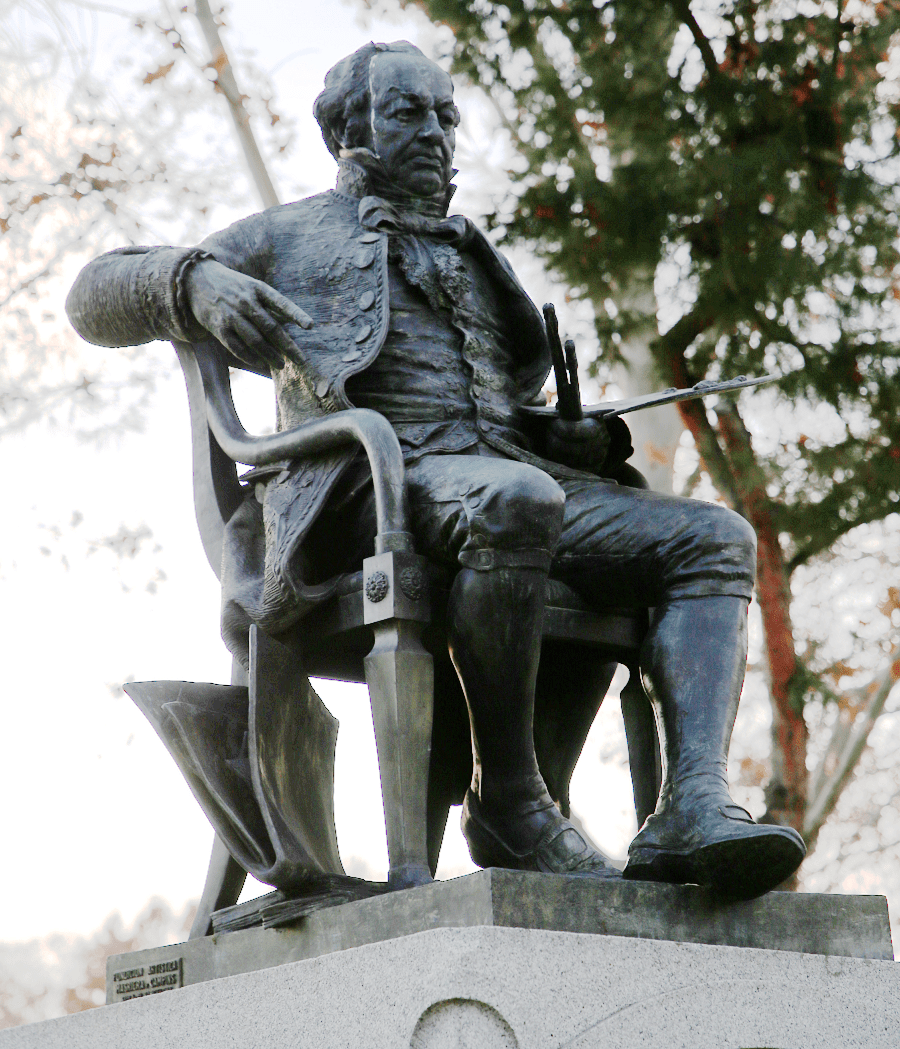
The statue of Francisco de Goya, created by José Llaneces in 1890 and donated to the Spanish State in 1904, has undergone several relocations throughout its existence. Initially installed on the north staircase of the Prado Museum, it was moved to the Casa de la Villa in 1925 after being ceded to the Madrid City Council.
In 1986, during an inauguration led by Mayor Juan Barranco, the statue was repositioned to its current location at the San Antonio de la Florida roundabout, facing the hermitages that feature Goya’s renowned frescoes. This move replaced the original Goya head of Juan Cristóbal, which is now situated in the gardens of San Isidro Park in Carabanchel.
Address: Gta. de San Antonio de la Florida, 3, Moncloa – Aravaca, 28008 Madrid, Spain

In the Las Letras neighborhood, at the intersection of Calle del Prado and Calle San Agustín, a sculpture honors “Fortunato,” a lottery coupon seller for ONCE (Spanish National Organisation for the Blind). The bronze sculpture, created by sculptor Santiago de Santiago, pays tribute to the individuals who have sold lottery coupons over the past 75 years since the organization’s establishment. These sellers have become iconic figures in various streets and squares across Spain, symbolizing luck and hope for many.
Address: Pl. de las Cortes, 9, Centro, 28014 Madrid, Spain.




