


The Teatro Real (Royal Opera of Madrid) is an opera house in Madrid, Community of Madrid, Spain. Located at the Plaza de Oriente, opposite the Royal Palace (Centro district), and known colloquially as El Real, it is considered the top institution of the performing and musical arts in the country and one of the most prestigious opera houses in Europe.

The groundbreaking of the Teatro Real was on 23 April 1818, under the reign of King Ferdinand VII, and it was formally opened by his daughter Queen Isabella II on 19 November 1850. It closed in 1925 due to damage to the building and reopened on 13 October 1966 as a symphonic music venue. Beginning in 1991, it underwent major refurbishment and renovation works and finally reopened as an opera house on 11 October 1997. It has a floor area of 78,210 square metres (841,800 sq ft) and a maximum capacity of 1,958 seats.
Since 1995, the theatre is managed by a public foundation in whose Board of Trustees are represented the Ministry of Culture of the Government of Spain, the Government of the Community of Madrid and the City Council of Madrid. Since 1998, its principal orchestra is the Orquesta Sinfónica de Madrid.
In addition to its regular annual program of opera, dance, concerts and recitals, the theatre has hosted other special events throughout its history, such as the 14th Eurovision Song Contest in 1969, the 25th Goya Awards in 2011 or the Lotería Nacional’s Christmas special draw since 2012. The Royal Opera received the “Opera Company of the Year” award at the 2020/21 International Opera Awards. The building is listed as a Bien de Interés Cultural since 1993.

In December 1925 a Royal Order ordered its activities to be discontinued owing to the damage that the construction of the Madrid Metro had caused to the building. The government set out to restore it and ordered numerous projects to be drawn out for its renovation, such as that from architect Antonio Flórez Urdapilleta, who proposed a monumental remodeling of the building. However, the Civil War and the post-war financial difficulties prevented the completion of these projects and led to a simple restoration, sponsored by the Juan March Institute, and carried out first by the architect José Manuel González Valcárcel, and later by architects Miguel Verdú Belmonte and Francisco Rodriguez Partearroyo.
The theatre reopened on 13 October 1966 as a concert hall as well as the main concert venue for the Spanish National Orchestra and the RTVE Symphony Orchestra. The reopening was celebrated with a concert of the Spanish National Orchestra, conducted by Rafael Frühbeck de Burgos, in which it was performed Beethoven’s Symphony No. 9 –together with the Orfeón Donostiarra– and Manuel de Falla’s Homenajes. The venue closed for renovations with a last concert by the Spanish National Orchestra on 13 October 1988.
From 1867 to 1925 and from 1966 to 1990, the Royal Opera also housed the Madrid Royal Conservatory and the Royal Higher College of Performing Arts.
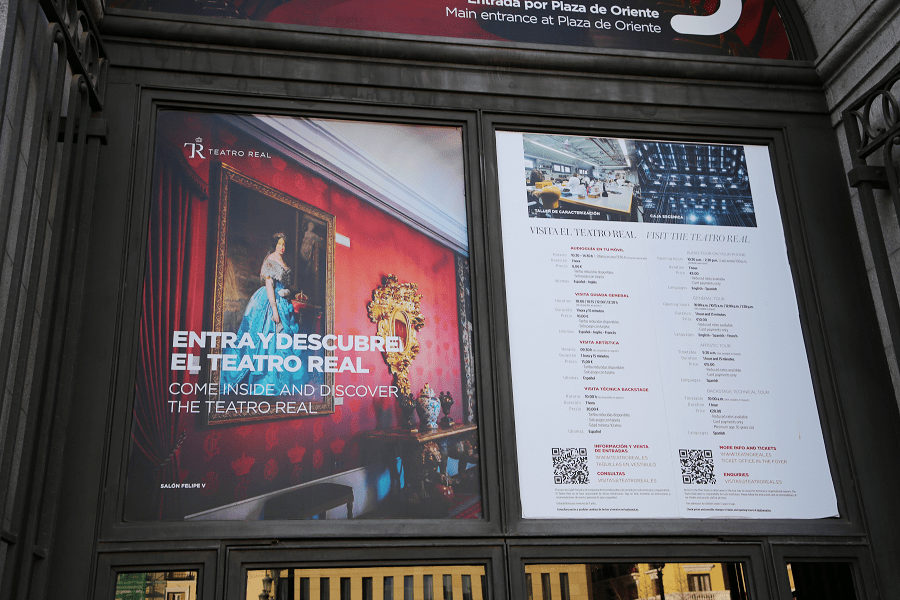
Tickets and schedule
Opening hours: 10:30 a.m – 2:30 p.m (last access: 1:30 p.m) – Just three days per week
Recommended duration: 50 minutes – 1 hour.
Prices:
General: 8 euros
Reduced: 7 euros (over 65s, under 26s and large families)
Children under 5: free admission.

Madrid: full guide
- Administrative structure
- Architecture
- Churches and Cathedrals
- Entertainment
- Monuments
- Museums
- Parks and gardens
- Restaurants
- Shopping and markets
- Squares
- Streets
- Transport
See here Pyrenees travel guide
See here France travel guide
See here Spain travel guide




