

Madrid Metro is the metropolitan railway network of Madrid, Community of Madrid, Spain, and its metropolitan area. It was inaugurated on 17 October 1919 by King Alfonso XIII. It is the largest metro network in Spain, and the third in Europe (behind only the Moscow and London metros), with 293.91 kilometres in 2024.
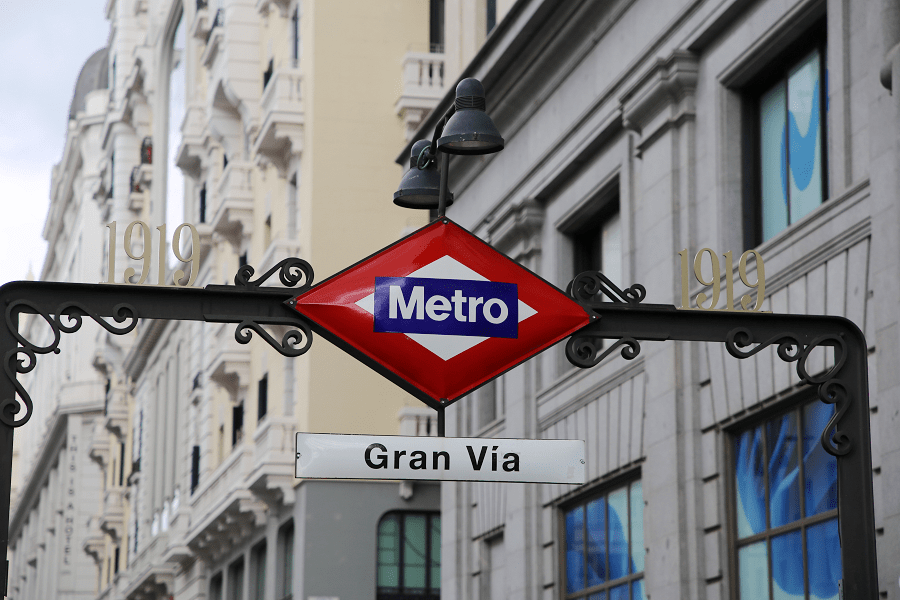
With a total of 302 stations, it is the third in Europe by kilometres, after those of Moscow and London, and the eighth in the world, after the metros of Shanghai, Beijing, London, New York, Seoul, Moscow, and Guangzhou. It is also the second oldest metro network in the Spanish-speaking world, after the Buenos Aires Subway. It was also one of the fastest expanding between 1995 and 2007. In 2023, 662.3 million journeys were made.

Of the 302 current stations, a line passes through 237 (34 of them, Metro Ligero), two lines change at 27, three lines have a stop at 11 and four lines coincide at Avenida de América station. At 3 stations without transfers (Tres Olivos, Estadio Metropolitano and Puerta de Arganda) trains are changed within the same line and at 25 stops there is a connection with the Renfe Cercanías Madrid network. These 276 stations account for a total of 328 stops if the total of each line is added up instead of counting the stations individually, a counting system used in most reports and documents.

The Madrid metro network is made up of 12 conventional lines and the branch that connects Ópera and Príncipe Pío. In addition, there are three light rail lines that total 27.78 km and have 38 stations. Of these three lines, only line 1 is operated by Metro de Madrid, S.A., the other two being operated by Metro Ligero Oeste, S. A.

A light rail system feeding the metro opened in 2007 called Metro Ligero (“light metro”). The Cercanías system works in conjunction with the metro, with a majority of its stations providing access to the underground network.

As of January 2024, the Madrid Metro has 1,710 escalators and 559 elevators.

History
1919: construction and inauguration
The first phase of construction was finished in 1919. It was constructed in a narrow section and the stations had 60 m (200 ft) platforms. The enlargement of this line and the construction of two others followed shortly after 1919. The Madrid metro was inaugurated on 17 October 1919 by King Alfonso XIII.
At the time of inauguration, the metro had just one line, which ran for 3.48 kilometres (2.16 mi) between Puerta del Sol and Cuatro Caminos, with eight stops.

Characteristics
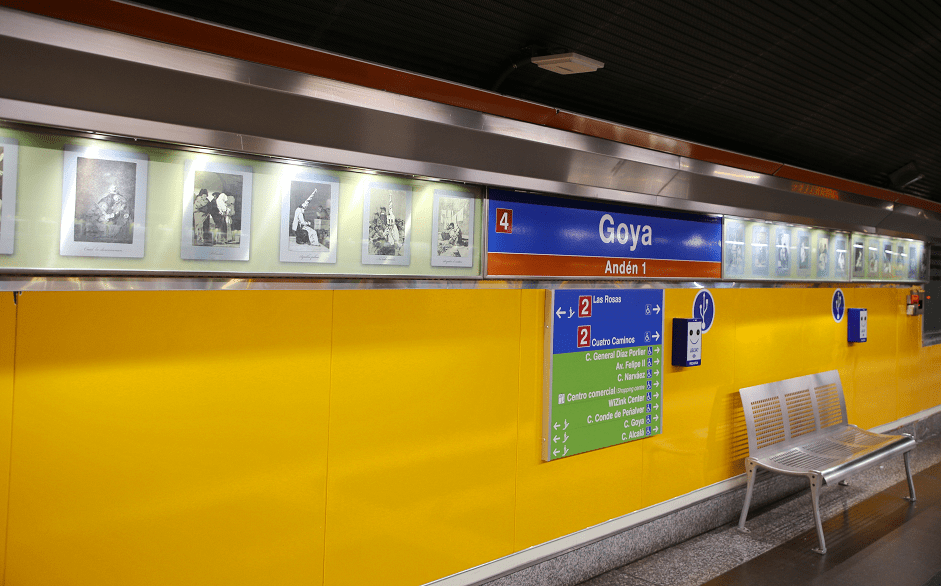
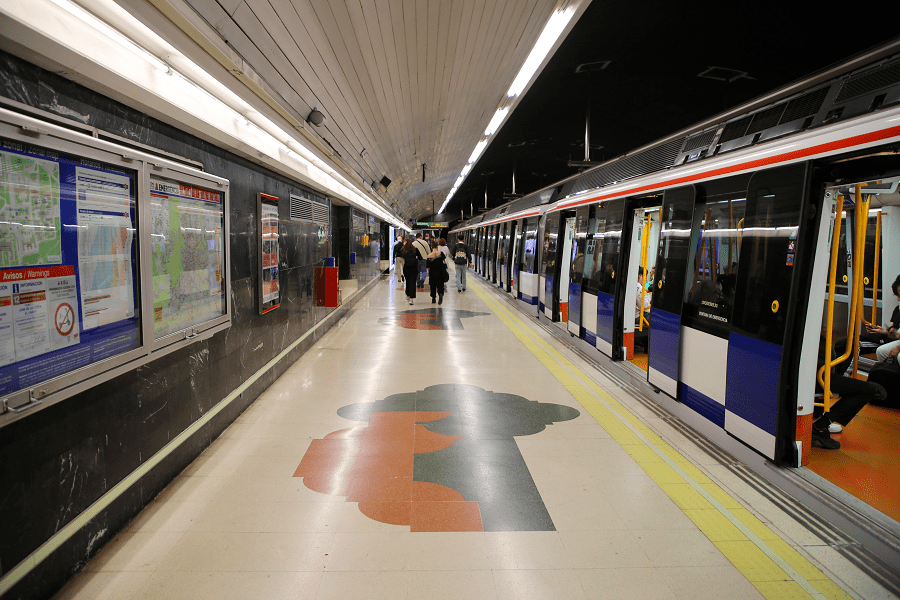
The age of many Madrid Metro stations is evident by their design: Older stations on the narrow lines are often quite compact, similar to stations of the Paris Métro. Among the most beautiful metro stations of Madrid are Tirso de Molina, Plaza de España, Retiro, Sevilla, and many others.
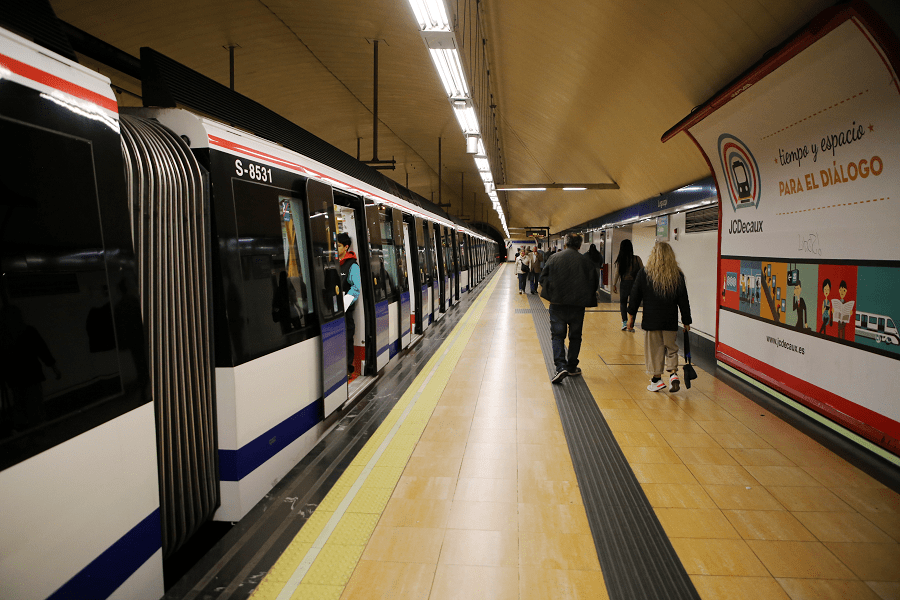
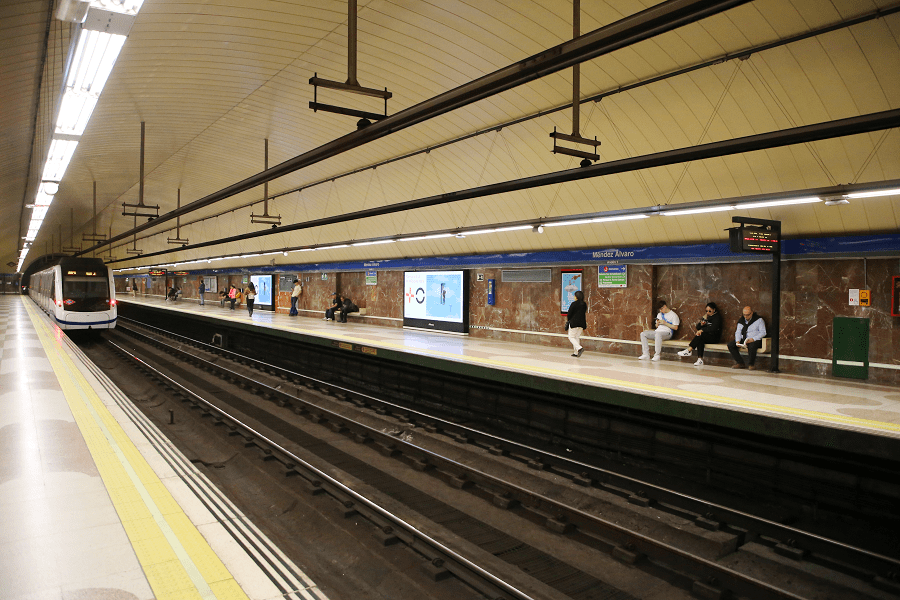
Most stations are built with two side platforms, but a handful of them (the busiest transfers) have a central island platform in addition to the side platforms theoretically dedicated to exits. This system was originally used on the Barcelona Metro and is called the Spanish solution.

Lines
The Metro conventional network has 242 stations on 12 lines plus one branch line, totalling 294 kilometres (183 mi), of which approximately 96% of stations are underground. The only surface parts are between Empalme and west of Eugenia de Montijo; between Lago and north of Casa de Campo; and between south of Puerta de Arganda and Arganda del Rey, for a total of 8 aboveground stations. Additionally, some 30 km (19 mi) of Metro Ligero (light rail) lines across serve the various regions of the metropolitan area which have been deemed not populated enough to justify the extraordinary spending of new Metro lines.

Traditionally, the Madrid metro was restricted to the city proper, but today nearly one third of its track length runs outside the border of the Madrid municipality. Today, the Metro network is divided in six regions:
MetroMadrid (zone A): the core network inside the Madrid city borders, with over two-thirds of the overall length. Also includes light rail line 1.
MetroSur (zones B1 and B2): line 12 and the last two stations of line 10, Joaquín Vilumbrales and Puerta del Sur. Runs through the southern cities of Alcorcón, Leganés, Getafe, Fuenlabrada and Móstoles.
MetroEste (zone B1): a prolongation of line 7 from Estadio Metropolitano to Hospital del Henares through the municipalities of Coslada and San Fernando de Henares.
MetroNorte (zone B1): opened in 2007, includes the stretch of line 10 from La Granja to Hospital Infanta Sofía. Serves the northern outskirts of Madrid and the towns of Alcobendas and San Sebastián de los Reyes. There is a train interchange inside the line at Tres Olivos station.
MLO (zones B1 and B2): comprised by light rail lines 2 and 3. Connects the towns of Pozuelo de Alarcón and Boadilla del Monte to line 10 at Colonia Jardín station.
TFM (zones B1, B2 and B3): a prolongation of line 9 from Puerta de Arganda, the first ever outside the borders of Madrid, services the cities of Rivas-Vacíamadrid and Arganda del Rey.

At most of the borders between the regions, one has to switch trains even when staying in the same line, because the train frequency is higher in the core MetroMadrid than in the outer regions.
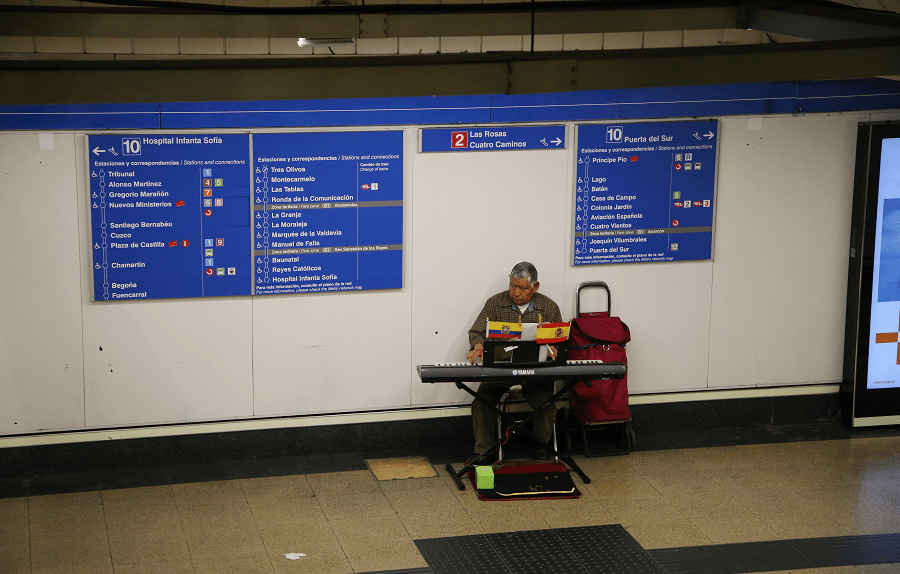
Madrid also has an extensive commuter train (Cercanías) network operated by Renfe, the national rail line, which is intermodal with the metro network. In fact, 22 Cercanías stations have connections to the Metro network, which is indicated on the official map by the Cercanías logo.
Rolling stock
Traditionally, the trains operating in the Madrid Metro have been built and supplied by the Spanish company Construcciones y Auxiliar de Ferrocarriles (CAF). This was particularly true under Francisco Franco’s dictatorship, due to the politic of autarky his administration initially pursued. However, despite CAF still working for the Metro, in recent years the Italian AnsaldoBreda has also provided trains for the wide-profile lines.
List of rolling stock:
Light rail (named Metro Ligero)
Alstom Citadis 302: The vehicles serving the light rail lines are low-floor articulated trams in a five-section “boa” configuration, which allows for a maximum of about 200 passengers per tram (60 seated). They can reach a top speed of 100 km/h (65 mph), but in practice they are limited to 70 km/h (45 mph) in most track stretches, and even less in urban sprawls.
Tariffs
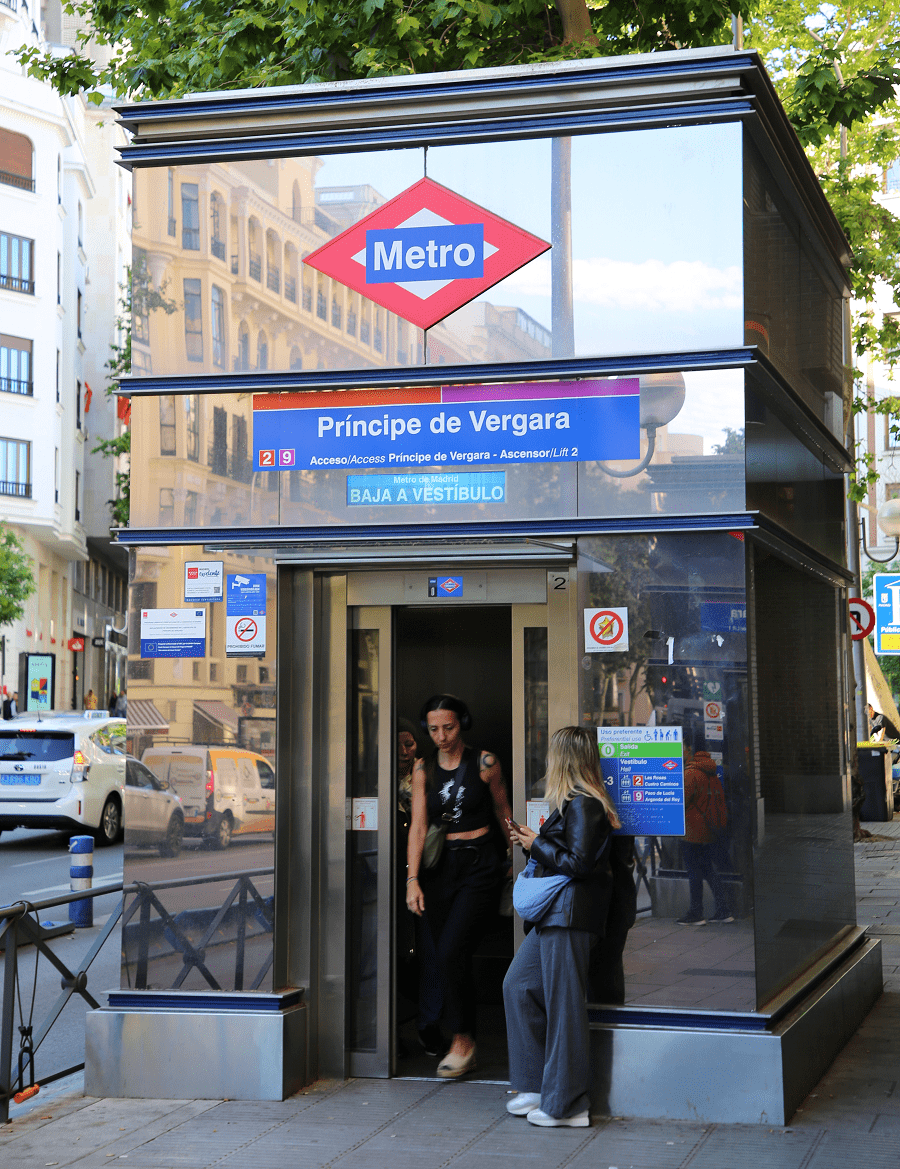
Madrid Metro fares are set by the Consortium for Transport and include personal and non-personal tickets. In 2017, single-use tickets were discontinued. Now, to travel, you need to buy a card and top it up with the desired fare.
“Multi” is a rechargeable red transport card used to pay for travel on public transport in Madrid and some neighboring municipalities. It is sold at all metro stations for €2.50. Tickets for routes up to five stations cost €1.50. For every six to nine stations, €0.10 is added. If there are nine or more stations, the ticket will cost €2.00. In ticket machines, you need to enter your destination, and the system will automatically calculate the shortest route and its cost.
A trip from or to the airport will cost €4.50 for a single trip up to 5 stations and €5.00 for a trip from 9 stations.
Tourists are advised to buy a “Multi” card and pay for 10 trips. The card itself costs €2.50, and 10 trips cost €6.10. Thus, one trip, regardless of the number of stations, will cost only €0.61.
You can also purchase a 30-day pass. Prices depend on the zone: zone A – €21.80, B1 – €25.40, B2 – €28.80, B3 and C – €32.80, E1 – €44.20, E2 – €52.70. Children under four and pensioners can use this travel card for free.
Tourist rates are also available. For zone A (almost all of Madrid) the prices are: €10 for one day, €17 for two days, €27 for three days and €42 for seven days. In zone T (adjacent municipalities or outlying areas of the city) the cost increases by about €5.

Madrid: full guide
- Administrative structure
- Architecture
- Churches and Cathedrals
- Entertainment
- Monuments
- Museums
- Parks and gardens
- Restaurants
- Shopping and markets
- Squares
- Streets
- Transport
See here Pyrenees travel guide
See here France travel guide
See here Spain travel guide