


Plaza Mayor is located in the center of Madrid, Community of Madrid, Spain, Centro district, in the Sol neighborhood, next to Calle Mayor and 300 meters from Puerta del Sol.
History
The origins of the square date back to the 16th century, when the main market of the town was held at the confluence of the Toledo and Atocha streets, on the outskirts of the medieval town. This site, known as the Plaza del Arrabal, was the site of the town’s main market. At that time, a first porticoed house, or market, was built to regulate trade in the square.
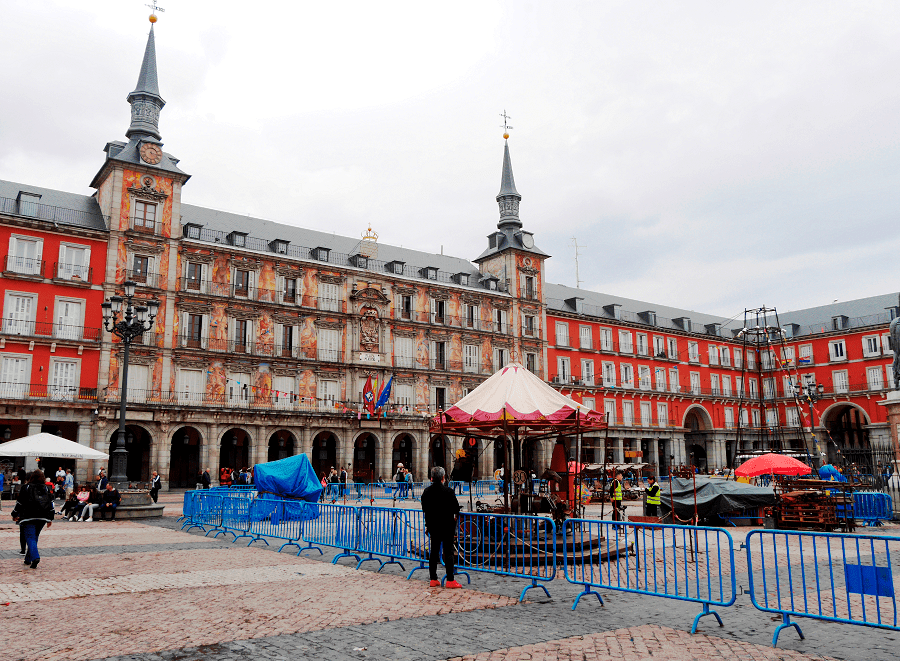
In 1560, after having moved the court to Madrid in 1561, Philip II of Spain commissioned the project to remodel the square to Juan de Herrera. That same year, the demolition of the “apple houses” of the old square began. The construction of the first building of the new square, the Casa de la Panadería, would begin in 1590 under the direction of Diego Sillero, on the site of the old market. In 1617, Philip III of Spain commissioned the completion of the works to Juan Gómez de Mora, who would finish the square in 1619.

The Plaza Mayor has suffered 3 major fires in its history. The first was in 1631. Juan Gómez de Mora took on the reconstructions of the plaza following this fire.

The second of the fires occurred in 1670, with the architect Tomás Román in charge of the reconstruction. The last fire consumed a third of the square and took place in 1790. Today, the Plaza Mayor’s architecture is credited to Juan de Villanueva.

He handled the reconstruction following the massive fire in 1790. Prior to this, the buildings that enclosed the square were five stories. Juan de Villanueva lowered the square’s surrounding buildings to three stories, closed the corners and created large entrances into the squares. Construction continued after Juan de Villanueva’s death by Antonio López Aguado and Custodio Moreno, and was finished in 1854.

Today, the Plaza Mayor is rectangular in shape and highlights the uniformity of the architecture. The Plaza measures 129 m x 94 m (423 ft x 308 ft). 237 balconies are present on the three-story residential buildings that face inward towards the Plaza. To enter or exit The Plaza Mayor, there are ten entrances to choose from. The entrances are named: 7 de Julio, Arco de Triunfo and Felipe III to the North; Sal, Zaragoza and Gerona to the East; Botoneras, Toledo and Cuchilleros to the South; Ciudad Rodrigo to the West.

In the center of the square stands the statue of Philip III on a horse, which was placed in 1848. The Plaza Mayor has been the scene of multitudinous events. It has hosted executions in history. Today, it is the location of the annual Christmas market. It has also hosted bullfights and soccer games. Every Sunday and holidays it hosts stamp collecting and coin collecting market in the mornings.

Casa de la Panadería
In 1880, the Casa de la Panadería was restored by Joaquín María de la Vega. The Casa de la Panadería is the piece of the façade framed by two two-angled towers. It has been used for many different purposes in history. Its name originates from its original use of the main city bakery.

In 1921 the farmhouse was reformed, and then again in 1935 by Fernando García de Mercadal. In 1960s, the plaza closed itself to road traffic and added underground parking below the plaza. The last of the performances in the Plaza Mayor, held in 1992, consisted of mural decoration, the work of Carlos Franco, of the Casa de la Panadería, which represents mythological figures such as the goddess Cibeles. Today, the Plaza Mayor is a major tourist spot, but is also celebrated by the citizens of Madrid and has become a piece of Spanish culture. Next to the Plaza Mayor at Arco de Cuchilleros Street is the Botin, the oldest restaurant of the world.

Madrid: full guide
- Administrative structure
- Architecture
- Churches and Cathedrals
- Entertainment
- Monuments
- Museums
- Parks and gardens
- Restaurants
- Shopping and markets
- Squares
- Streets
- Transport
See here Pyrenees travel guide
See here France travel guide
See here Spain travel guide




