


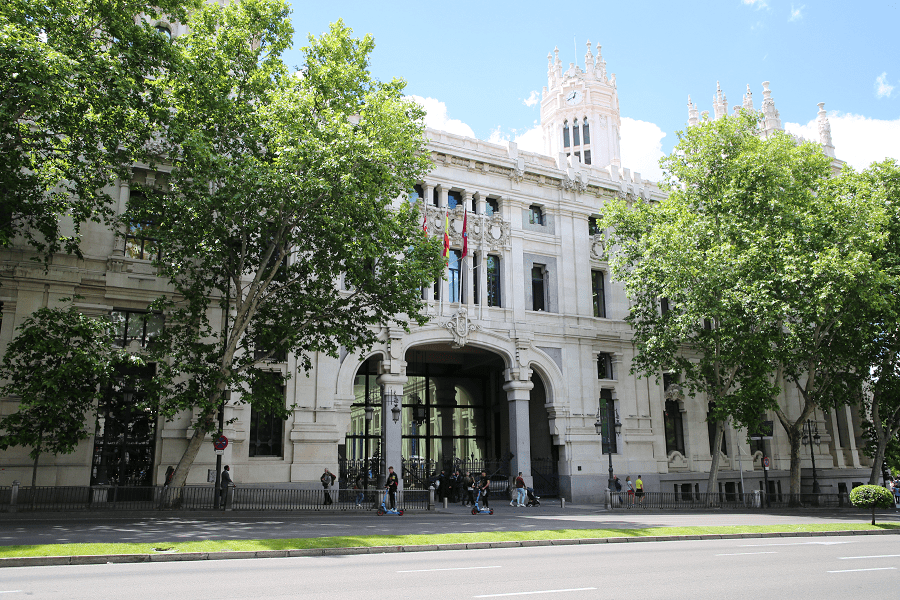
The Cibeles Palace is a complex consisting of two white-façade buildings located in one of the centers of historic Madrid, Community of Madrid, Spain.
They stand on one side of the Plaza de Cibeles in the Jerónimos neighborhood (Retiro district) and occupy around 30,000 square meters of what were the old Buen Retiro Park. The choice of the site generated some controversy at the time for depriving Madrid of a place of recreation.
The first stone of the building was laid in 1907 and it would be officially inaugurated on March 14, 1919, beginning its operation as a modern distribution center for mail, telegraphs and telephones. After some architectural changes to the exterior of the building – such as the extension of two floors towards the street and passage of Montalbán – it began to house the municipal offices of the Madrid City Council at the end of 2007, moving its offices from the Casa de la Villa and Casa de Cisneros, both located in the Plaza de la Villa. This reform of the early 21st century in the building also included a cultural area called “CentroCentro”.
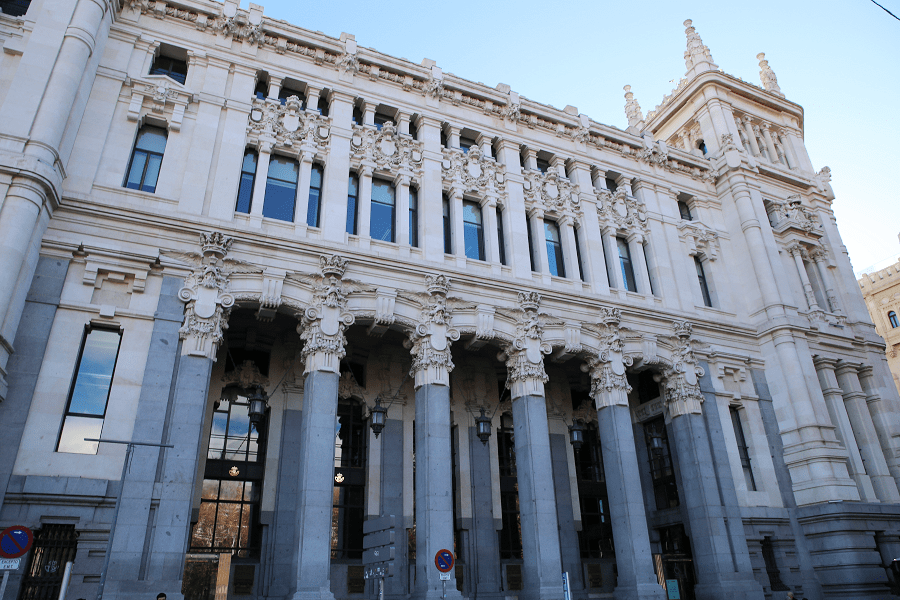
The complex is from the point of view of Spanish architecture one of the first examples of modernist architecture, and most representative, erected in the center of Madrid, with its facade evocative of neo-plateresque and Salamanca baroque.
The building, through a municipal competition, was designed by the young Spanish architects Antonio Palacios Ramilo and Joaquín Otamendi Machimbarrena as the headquarters for the Spanish Post and Telegraph Society, they were also the authors of the projects for the Bilbao bridge, the Madrid casino and the San Sebastián bridge. This work was the start of the brilliant construction career of both architects. The decorative motifs on the façade and the interior were created by the romantic sculptor Ángel García Díaz, a regular collaborator of Antonio Palacios. One of the objectives of the design was to build “a building for the public”.
The buildings, after their construction and due to their normal operation, gradually showed signs of the modifications made, so new reforms were carried out to improve the communication systems. Thus, modifications were carried out on both buildings in the 1960s, directed by Alejandro de la Sota Martínez, and repair and renovation work was carried out between 1980 and 1992 by Antonio de Sala-Navarro and Reverter. The decline in the use of postal mail at the end of the 20th century gradually took its toll on the functions of the complex of buildings, as a result of which it lost prominence. In 1993 it was declared a Site of Cultural Interest, with the category of Monument.

At the beginning of the 21st century it was incorporated into the municipal heritage and became a cultural center and headquarters of the Madrid City Council.
City Council of Madrid
The City Council of Madrid (Spanish: Ayuntamiento de Madrid) is the top-tier administrative and governing body of the Madrid, the capital and biggest city of Spain.
The city council is composed by three bodies; the mayor who leads the city council and the executive branch of it, the governing council (Junta de Gobierno) which is the main body of the executive branch composed by the mayor and the councillors appointed by him and the Plenary, a democratically elected assembly which represents the people of Madrid.
Madrid: full guide
- Administrative structure
- Architecture
- Churches and Cathedrals
- Entertainment
- Monuments
- Museums
- Parks and gardens
- Restaurants
- Shopping and markets
- Squares
- Streets
- Transport
See here Pyrenees travel guide
See here France travel guide
See here Spain travel guide




