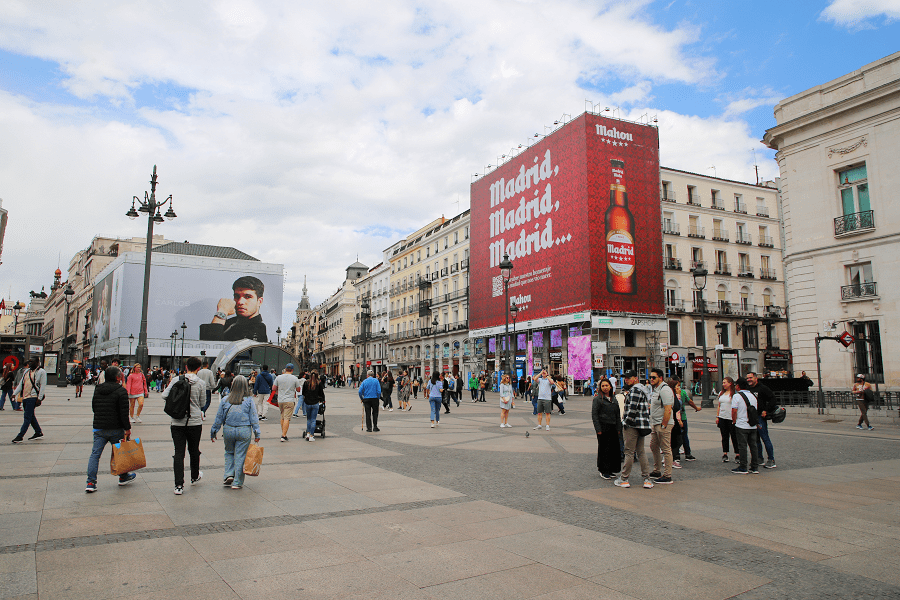
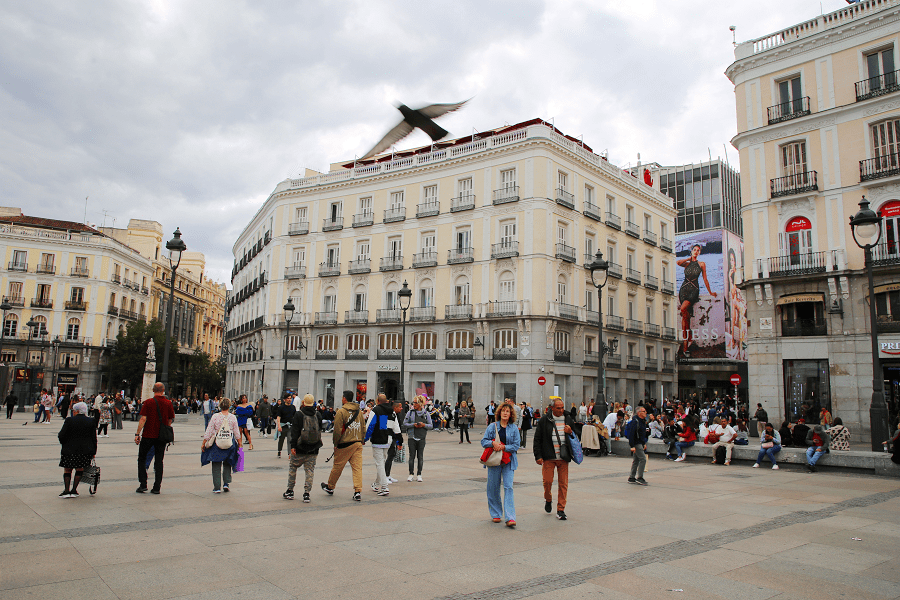
Puerta del Sol is a public square in Madrid, Community of Madrid, Spain, Centro district. Since 1950, it has been the site of the so-called kilometre zero of the country’s radial roads.
The oldest building in Puerta del Sol is the Real Casa de Correos, and its tower clock stands out. It was built and donated in the 19th century by José Rodríguez de Losada. The chimes at midnight on 31 December mark the traditional eating of the twelve grapes for the vast majority of Spaniards. These chimes began to be televised in 1962 on La 1 of TVE, and since that year they have been broadcast continuously on various television channels. Puerta del Sol is a meeting place, a place of passage between different parts of Madrid.
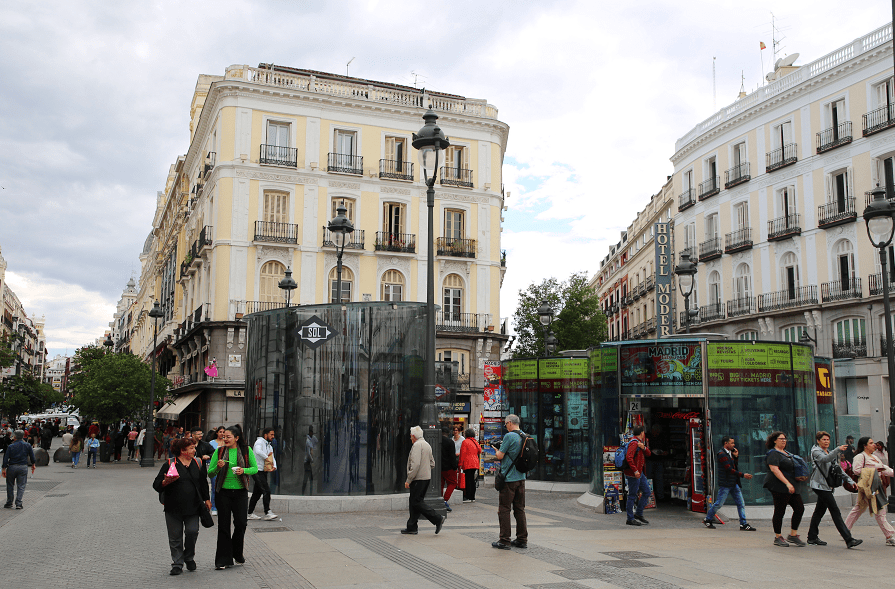
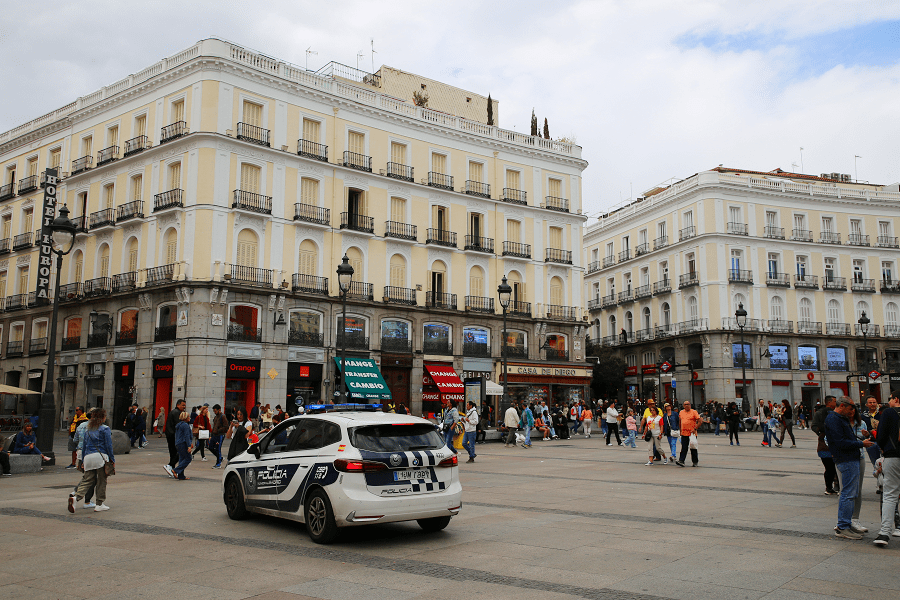
Despite once being the meeting point of the six major radial roads of Spain, in 2020 the square was pedestrianized and closed to most traffic. Exceptions are made for supplies to shops, emergency services and blood donation campaigns.
Main attractions
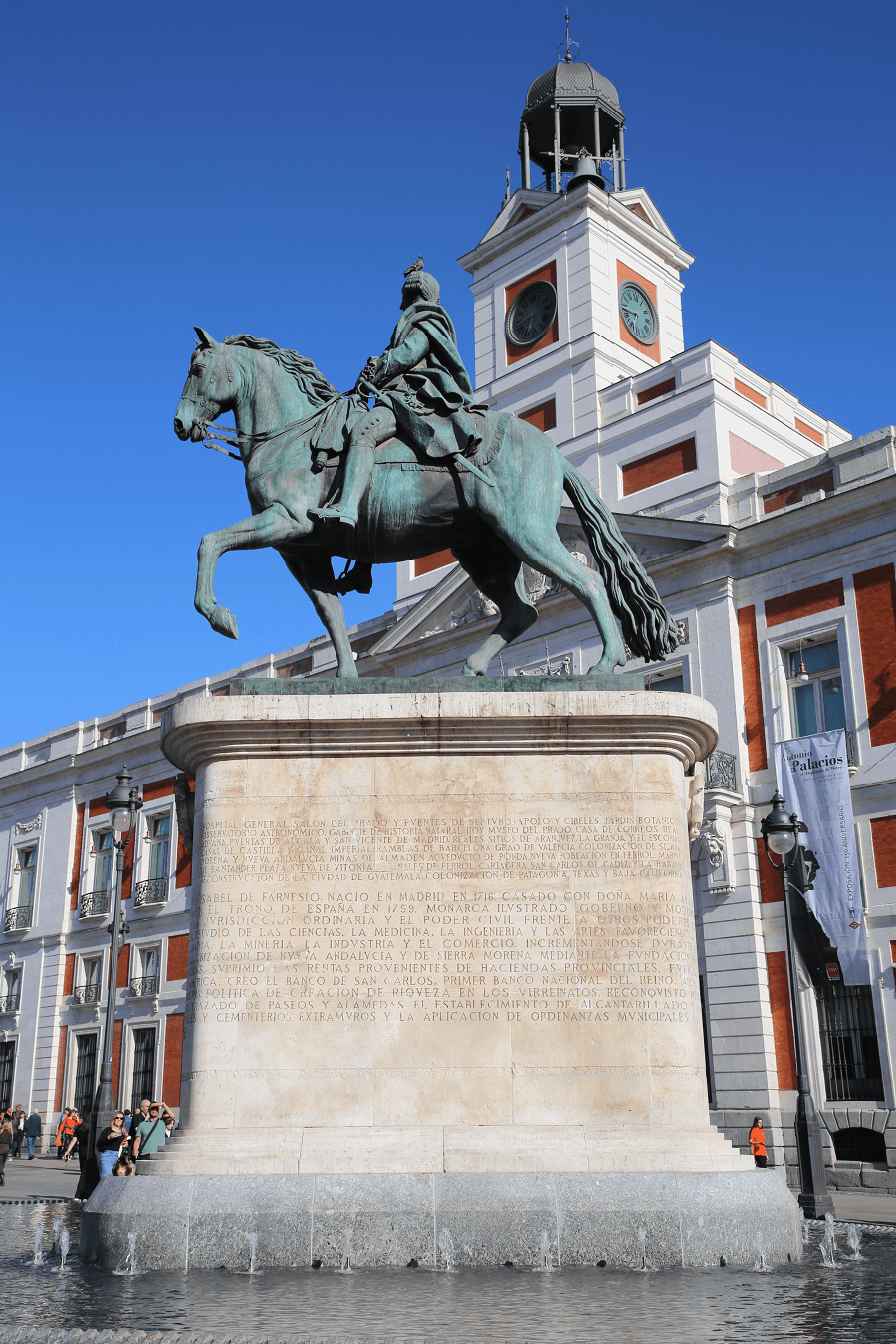
The Puerta del Sol contains a number of well known sights both domestically and internationally associated with Spain. On the south side, the old Post Office was the headquarters of the Ministry of Interior and State Security in Francoist Spain. The basement of the DGS (Spanish: Dirección General de Seguridad, lit. ’General Directorate of Security’) was infamous for being a place where Dissidents to the regime were subjected to torture. The building now serves as the office of the President of Madrid, the head of the regional government of the Autonomous Community of Madrid (not to be confused with the Madrid City Council, which is housed in the Palacio de Cibeles). There are two commemorative plaques in the front of the Royal House of the Post Office: one is devoted to the neighbours of Madrid who rose up against the Napoleonic invasion of Spain on May 2, 1808; the other one is a memorial of the victims of the March 11th, 2004 terrorist attacks.
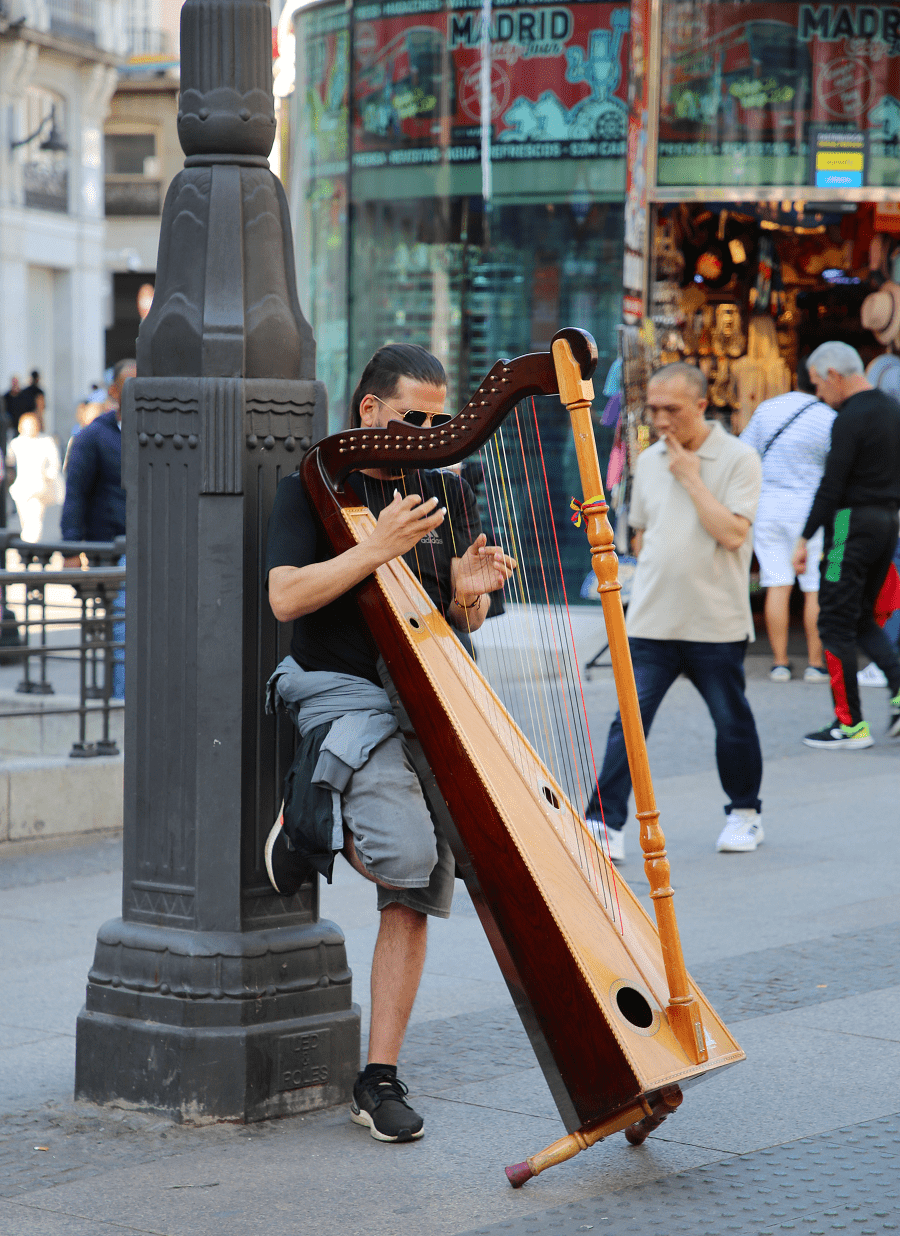
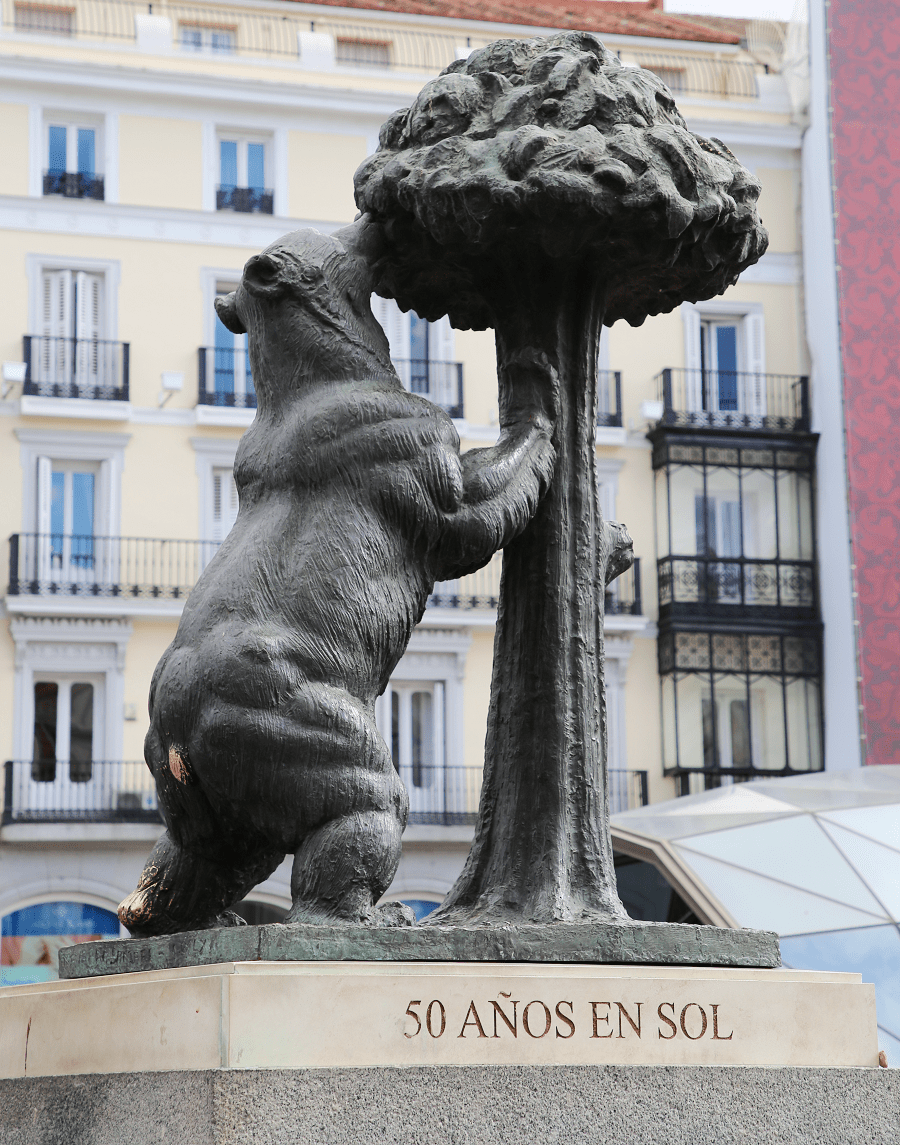
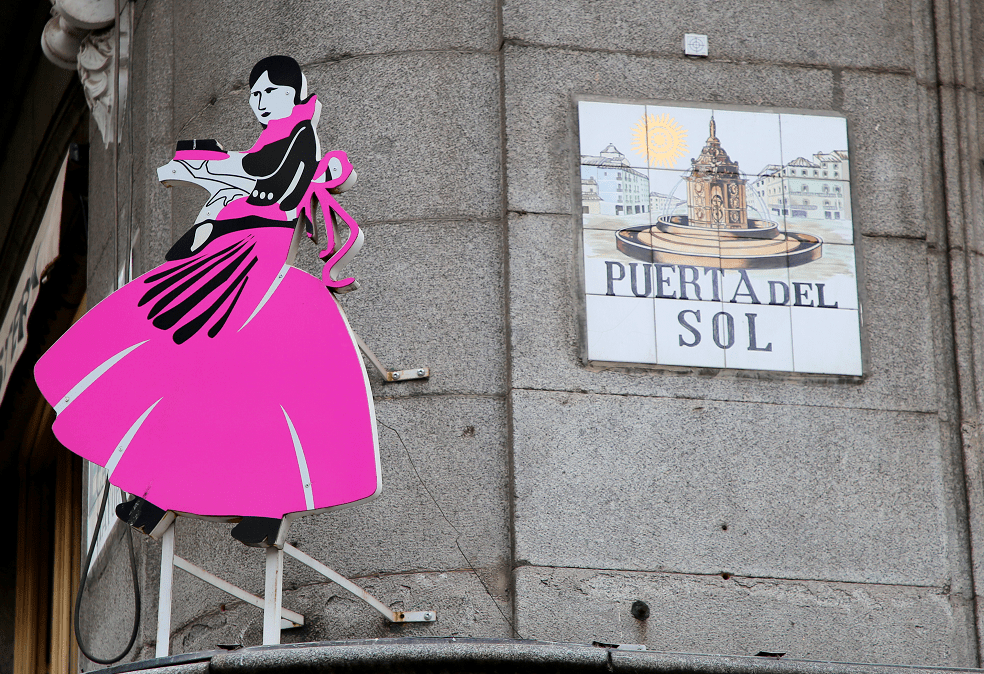
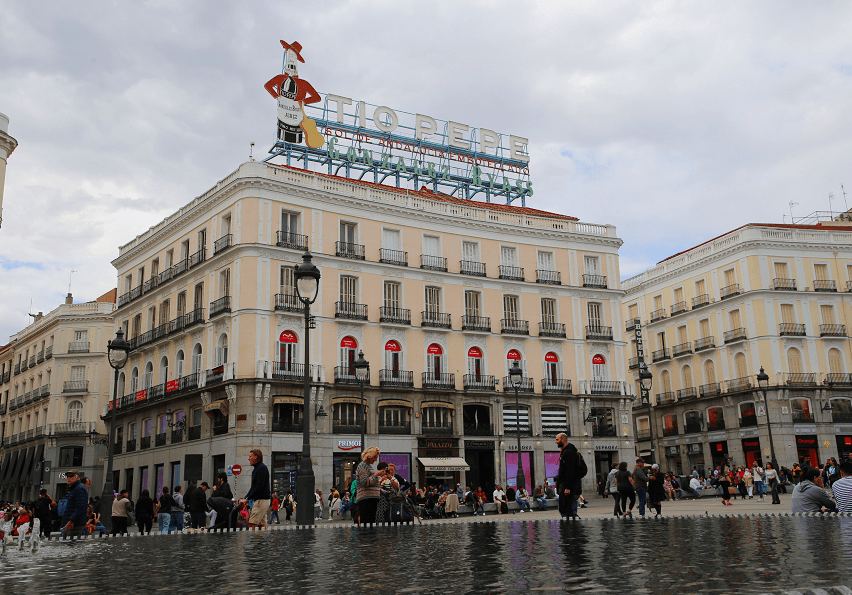
Also on its south side, the square holds a mounted statue of Charles III of Spain, nicknamed “el rey alcalde” (“the mayor-king”) due to the extensive public works program he set in motion. The famous Tío Pepe lighted sign was above the square’s eastern building between the Calle de Alcalá and the Carrera de San Jerónimo (Apple Store today) for a long time, now is on top of the former Paris Hotel. Also on the east side lies the statue of The Bear and the Strawberry Tree (in Spanish, el Oso y el Madroño), the heraldic symbol of Madrid. Until 2009, the statue stood on the north side at the entrance to Calle del Carmen. The Mariblanca (a female figure named for its white marble) is a copy of a statue (possibly of Venus, and so the restored pedestal claims), which marks the place of a former fountain displaying that figure.
The kilómetro cero is a plaque on the ground directly north of the Post Office serving as the symbolic center of Spain, and the point from which kilometer distances are numbered in the Spanish road system.
Roads
The Puerta is located in the very heart of Madrid. It serves as the kilometre zero from which all radial roads in Spain are measured. This is demonstrated by a plaque on the floor of the square, marking the exact point of Km.0. This was established in 1857, setting six major radial roads, clockwise:
- N-1 (Northern Road) to Irun, border town with France, via Burgos, starting from Calle de la Montera and continuing through Calle de Fuencarral.
- N-2 (Northeastern Road) to La Jonquera, border town with France, via Zaragoza and Barcelona, starting from Calle de Alcalá.
- N-3 (Eastern Road) to Valencia, starting from Carrera de San Jerónimo, where the Congress of Deputies is located, and continuing through Paseo del Prado.
- N-4 (Southern Road) to Córdoba, Seville and Cádiz, starting from Calle de Carretas, Calle de la Concepción Jerónima and Calle de Toledo.
- N-5 (Southwestern Road) to Badajoz, border town with Portugal, starting from Calle Mayor.
- N-6 (Northwestern Road) to A Coruña, starting from Calle de Preciados, continuing through Gran Vía and Calle de la Princesa.
The old plaque was replaced in 2009, as it had become faded after years of foot traffic. It is also the reference for street numbers in Madrid, which begin at the street-end that is closest to Puerta del Sol.
Transport
At Sol station in the square, numerous Madrid Buses EMT lines have their terminus (diverted due to the works of the Ministry of Public Works), three Madrid Metro lines converge: Line 1, Line 2, Line 3.
Since 2009, two suburban railway lines have been in operation: C-3, C-4, which put Sol in direct communication with the Atocha station and Chamartín station.
Madrid: full guide
- Administrative structure
- Architecture
- Churches and Cathedrals
- Entertainment
- Monuments
- Museums
- Parks and gardens
- Restaurants
- Shopping and markets
- Squares
- Streets
- Transport

See here Pyrenees travel guide
See here France travel guide
See here Spain travel guide