


Calle de la Montera is an old urban road in Madrid, Community of Madrid, Spain, in the Sol neighborhood of the Centro district. It is located between the Puerta del Sol (it is one of the ten streets that start in this square) and the so-called Red de San Luis (intersection with Gran Vía).
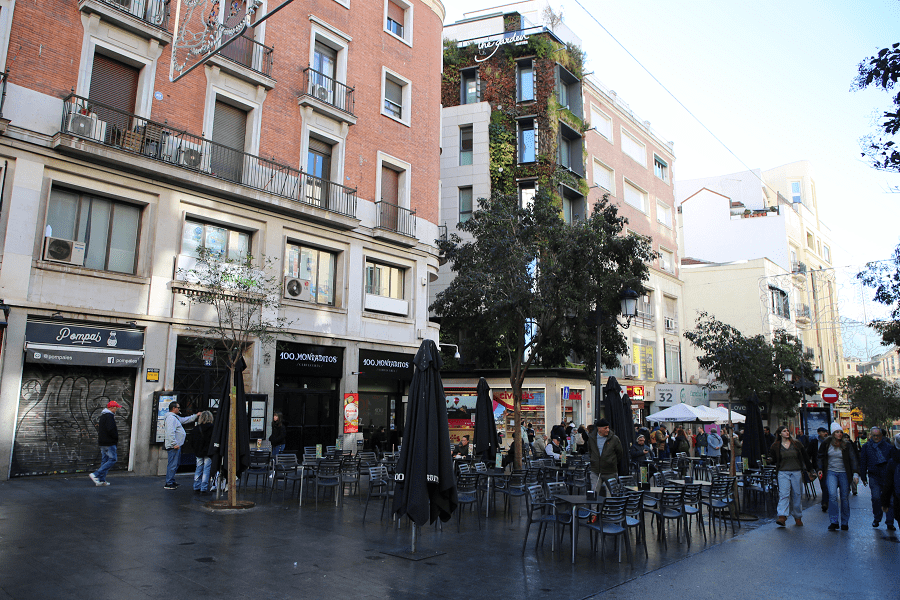
It is a street that goes uphill, its upper part ending in Gran Vía. Since the beginning of the 20th century, the upper part of the street has been known for the prostitution visible in adjacent streets and both sidewalks of the street. At number 33 of the street is the Pasaje del Comercio (Pasaje de Murga) which was built as a bazaar for Mateo de Murga. At the beginning of the street, on the corner with Sol, Casa de Diego is preserved, a shop selling umbrellas and other traditional accessories that previously had its premises on Montera corner with San Alberto.

The popular folklore is fertile in bringing explanations for the name of the street. However the reason for the name is the house of Juan Carlos and Francisco Lamontera, documented to exist in the area by the mid 16th century.
During the 18th century Montera was a luxury street. The writer Valle Inclán set in 1920 an scene of his play Bohemian Lights in the street; the place where the “taberna Pica Lagartos” was located. The onset of the 20th century saw the street becoming one of the main commercial streets in the city centre, with a plethora of merceries, shirt-shops, other textile stores, jewellery and shoe-stores. Parts of the street were affected by the construction of the Gran Vía, whose works started in 1910. During the 20th century the upper segment of the street also became known by the visible street prostitution, gaining a long-lasting reputation in that regard.

The Church of San Luis Obispo suffered a fire in March 1936 that led to its destruction, with the complete demolition taking place in 1943.
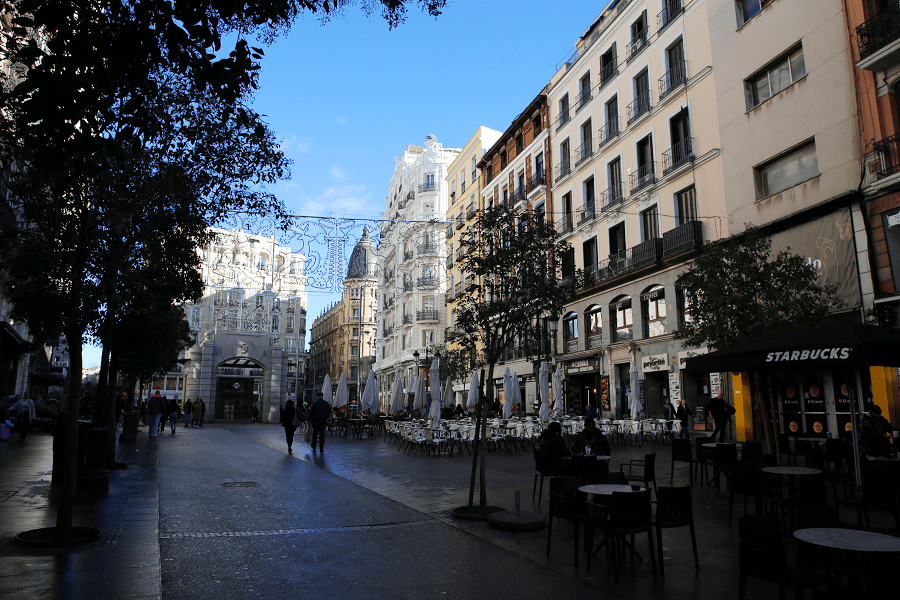
More recently CCTV control was installed in the area. The street was pedestrianised in two steps: first the segment between the Puerta del Sol to Aduana Street in 2006. The process was completed in 2009. With the street having several business premises closed during the 21st century, by the end of the decade of 2010 the impending gentrification of the city-centre began to considerably increase the interest for real estate in the street.

A rare surviving example of work by the pioneering flechero artist Muelle was restored in 2016 and can be seen on a wall of the street.

In August 2018 works towards the creation of a pedestrian underground connection between the Madrid Metro stations of Sol and Gran Vía passing below the street started.
Madrid: full guide
- Administrative structure
- Architecture
- Churches and Cathedrals
- Entertainment
- Museums
- Parks and gardens
- Restaurants
- Shopping and markets
- Squares
- Streets
- Transport
See here Pyrenees travel guide
See here France travel guide
See here Spain travel guide




