

Cercanías Madrid is the railway service operated by Renfe Cercanías, a division of Renfe Operadora, on an Adif infrastructure, which connects the city of Madrid, Community of Madrid, Spain, with its metropolitan area and the main towns in the Community of Madrid and some nearby towns in the bordering provinces.
Its network extends across a large part of the region, also including various towns in provinces bordering Madrid such as Azuqueca and Guadalajara in the province of Guadalajara and the Puerto de Cotos station, in Segovia. Cercanías Madrid therefore reaches the vast majority of the population of the Community of Madrid.

The network, with a workforce of around 1,300 employees, has ten lines in operation, running along 370 km of railway tracks, with 90 stations of which more than 20 offer connections with the Madrid Metro and Madrid buses EMT, two with the Madrid Light Rail and one of them with the Parla Tram. The network thus connects with all metro and light rail lines, except for lines L4, L11 and ML3. On weekdays, there are approximately 1,385 daily journeys, capable of transporting a total of 880,000 passengers.

History
The first railroad line departing from Madrid (the second in Spain and the third in the Iberian Peninsula) was built in 1851 between Madrid and Aranjuez. Soon the growing Spanish railway system was dominated by two large companies: the Compañía del Norte (Northern Company), who operated the lines between Madrid and the Atlantic North of Spain from the Estación del Norte (now Príncipe Pío), the Madrid, Zaragoza and Alicante railway (MZA) who operated the lines between the capital and the Mediterranean and Andalusian cities from the Atocha station. Another station, Delicias, served the line to Lisbon.
Destinations
The Henares Corridor
The main Madrid-Zaragoza-Barcelona line followed the valley of the Henares river, going through the important town of Alcalá de Henares to Guadalajara and Zaragoza. The towns around the line (Coslada, San Fernando de Henares, Torrejón de Ardoz, Alcalá itself) and some suburbs within the city of Madrid (Vallecas Villa, Vicálvaro) started to grow large bedroom communities, which relied heavily in the railway for commuting to Madrid.

The South-Southwestern Area
At the same time, the former rural towns of Alcorcón, Móstoles, Leganés, Fuenlabrada and Getafe (and some others) started to grow as bedroom communities. These bedroom communities were less rail-oriented and relied more in bus services and private transportation, but soon the rail services were enlarged: in the Madrid-Toledo line for the towns of Getafe and Parla, in the Madrid-Talavera de la Reina line for Leganés and Fuenlabrada, and in 1976 a wide Iberian gauge line between Madrid and Móstoles was built, substituting the narrow gauge line closed in 1970.
Lines
Nine lines serve the Cercanías network. There are three kinds of lines:
suburb-to-Madrid lines
these lines make a direct link between the suburbs with downtown Madrid: lines C-2, C-7, and C-10.
suburb-to-suburb lines, passing through Madrid
these lines link two suburbs, but most passengers only go from one of the suburbs to Madrid or vice versa; indeed, some of these lines have special services suburb-to-Madrid only, specially in rush hours, early in the morning or late at night. Suburb-to-suburb lines are the C-3, C-4, C-5 and C-8.
intra-city line
C-1, only runs through the city of Madrid from Príncipe Pío to the Madrid Airport.
tourist line
C-9, from the village of Cercedilla (terminus of C-8) to the ski resorts of Navacerrada Pass and Cotos. Runs from December to March.
Operation schedule
Rather strangely for such a night-living city as Madrid, trains do not operate late at night, mostly for union and safety reasons. The first train to operate on weekdays is the 5:07 C-5 train from Móstoles/El Soto; the rest of the lines (except C-9) start to operate around 5:30 am. Line C-9, being a branch line located far away from central Madrid in the Sierra de Guadarrama, operates from 9:30 am to 10:30 pm.
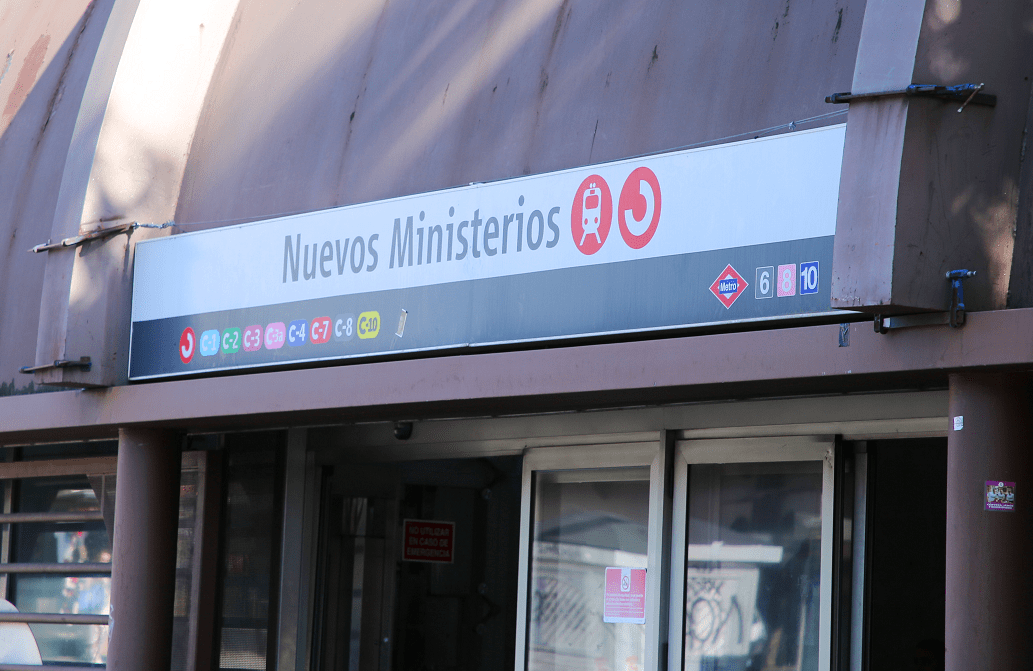
The frequency of the trains depends on the size of the towns served and the traffic on the line. The central section of the network, from Atocha to Chamartín, through Recoletos and Nuevos Ministerios, has trains every 3–4 minutes (of various lines) on weekday peak hours; the farther branches of the C-8 line have trains every two hours on weekends.
All lines (except C-9) finish their operations around midnight.
Rolling stock

Tickets
Cercanias is part of the Madrid Regional Transport Consortium (Consorcio Regional de Transportes de Madrid) and follows its zoning system, based in concentric zones around Madrid. The price of the trips inside the network depends on the number of zones crossed. Prices start from 1.70 euro for 1st and 2d zones.

Madrid: full guide
- Administrative structure
- Architecture
- Churches and Cathedrals
- Entertainment
- Monuments
- Museums
- Parks and gardens
- Restaurants
- Shopping and markets
- Squares
- Streets
- Transport
See here Pyrenees travel guide
See here France travel guide
See here Spain travel guide