

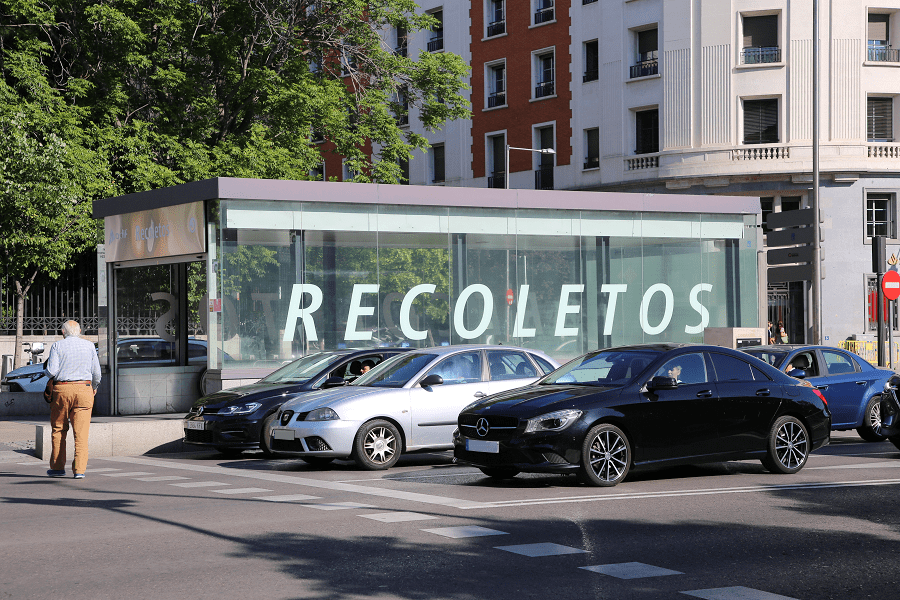
The Paseo de Recoletos is an avenue in the city of Madrid, Community of Madrid, Spain, whose 700 meters ascend very slightly, from south to north, from the Plaza de Cibeles to the Plaza de Colón.
It is part of the boulevards of the central axis of the city, which extends to the north as Paseo de la Castellana, and to the south as Paseo del Prado. It owes its name to a convent of Recollect friars that existed since the 16th century in the place where the National Library and the Archaeological Museum were later built, and throughout its existence it has also been known as “Prado de Recoletos”, “Prado Nuevo” and “Paseo de Copacabana”. It was part of the Catalogue of Historic Parks and Gardens of Interest of the Madrid City Council, in the General Urban Planning Plan of 1997, due to its historical-artistic interest.

History
By the end of the 18th century architect José de Hermosilla was entrusted by Charles III of Spainto urbanize the area of the old Bajo Abroñigal (or Valnegral) river, which flowed from Chamartín to Plaza Atocha. This gave birth to Paseo del Prado as well to Paseo de Recoletos. The name “Recoletos” was taken from an old convent of Augustinian Recollect friars built in 1592 in the area.
The boulevard originally ended in the old Puerta de Recoletos, a baroque gate built under Ferdinand VI in 1756 and dismantled in 1863. During the Peninsular War this gate (and others of the area) was fortified to fend off the Napoleonic troops. On 3 December 1808 Napoleon I personally directed the attacks against Madrid from the Fuente Castellana (today Plaza de Emilio Castelar). The Batería de Veterinaria (commanded by artillery official Vasallo) held off the troops that were trying to breach Recoletos Gate to surround the Alcalá Gate defenders. The French troops managed to break through El Retiro, outflanking the gates of Recoletos, Alcalá and Atocha, leading to Madrid’s capitulation the following day.
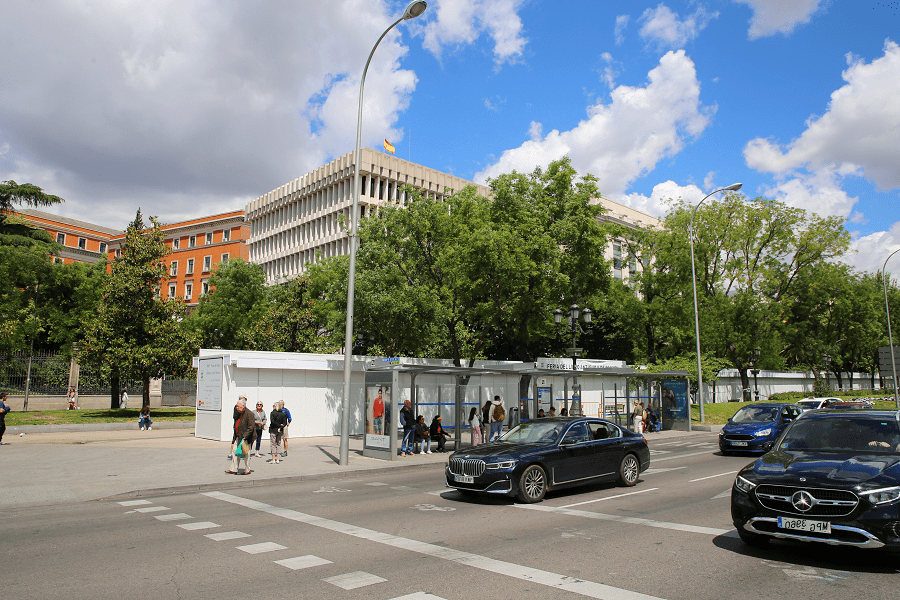
During the Civil War the statues and fountains along the Paseo de Recoletos and El Prado were hidden under protection sacks, which led the area to be nicknamed “of the twilight of the gods”.
Main attractions
- The Linares Palace or Palace of the Marquis of Linares, next to Cibeles, built in 1873 by the architect Carlos Colubí. It is currently the headquarters of the Casa de América.
- The National Library and Museums Palace, completed in 1892, where the National Library is located on the façade facing Paseo de Recoletos. On the opposite façade, on Calle Serrano, is the National Archaeological Museum of Spain.
- The Palace of the Marquis of Salamanca, built between 1846 and 1855 by the architect Narciso Pascual y Colomer
- The convent of San Pascual (or San Pascual Bailón), dating from the 17th century, but demolished and rebuilt in the 19th century.
- The Palace of the Duke of Elduayen, built between 1890 and 1895.
- The Palace of the Duchess of Medina de las Torres, between 1881 and 1884.
- The Palace of López Dóriga y Salaverria, by the architect Francisco de Cubas around 1872.
- The Palace of the Marquis of Alcañices, also known as the Palace of the Duke of Sesto, also by the architect Francisco de Cubas from 1865.
- The Building of the Sociedad de Crédito Mobiliario at number 17, current headquarters of BMN.
- The Restaura Building, formerly the L’Union Insurance Building, at numbers 18-20.
- The La Aurora Insurance Building, at number 4.
Madrid: full guide
- Administrative structure
- Architecture
- Churches and Cathedrals
- Entertainment
- Museums
- Parks and gardens
- Restaurants
- Shopping and markets
- Squares
- Streets
- Transport
See here Pyrenees travel guide
See here France travel guide
See here Spain travel guide




