

Hortaleza is the 16th of the 21 districts that make up Madrid, Community of Madrid, Spain.
Located in the northeast of the municipality, it includes the old municipal district of Hortaleza and part of Canillas, both annexed to the capital by decrees in 1949. The district’s neighborhoods are: Pinar del Rey, Canillas, Valdefuentes, Apóstol Santiago, Piovera and Palomas. The historic center of the Villa de Hortaleza is located in the Pinar del Rey neighborhood.
It has a population of 189,592 inhabitants in an area of 2,801 hectares. Its gentilic is Hortalino and Hortaleceño. It borders the districts of Barajas, San Blas-Canillejas, Ciudad Lineal and Fuencarral-El Pardo, and the municipality of Alcobendas.
History
The current neighborhood of Hortaleza developed from the old town of Hortaleza, located on the hill formed between the Manzanares and Jarama rivers. The village was supplied with water by two streams, the Valdebebas and the Abroñigal. The town was most probably founded in the 13th century, with written attestation of it by 1361. It is believed that the town was founded by Mozarabs from Madrid who used it to spend the summer.
Main attractions
One of the most notable buildings in this town was the Isabel Clara Eugenia Enclosure, originally the summer residence of the Duke of Frías. In the same enclosure of the Isabel Clara Eugenia Home, there is the Old Novitiate of the Holy Family, in neo-Mudejar style, built around 1880.
At the beginning of the street of the Sea of the Antillas, we find the park of the “Huerta de la Salud”. In it, in addition to the old gate of the Quinta of the same name (1749), some buildings of what was an agricultural industry, founded at the beginning of the 20th century by Don Pedro Tovar, chief notary of the Kingdom, are preserved.
The Silo of Hortaleza stands out among all of them. This polygonal tower, together with El Granero and El Palomar (which disappeared in the 1970s), formed a monumental trio that caused great admiration among visitors to the town.
On Liberación Street, which led to the Armed Police Academy, was the House-Palace of the Marquises of Santa Cruz, the house where General Quesada was captured and killed, having fled there after the uprising of La Granja in 1836.
Next to Mar de Bering Street stands the church of San Matías, which was converted into a parish in 1770. It was rebuilt on the initiative of the Princess of Asturias after the collapse of the original temple. By the architect Enrique María Repullés y Vargas, it is in the neo-Mudejar style (late 19th century), completed in 1879. It is a church with a single nave, 29 metres long by 12 metres wide, with a main chapel that occupies 30 m². To the right, in the same square, stands the Convent of the Padres Paules, inaugurated in 1934. It is still active in the 21st century.
On Uría Street, once a separator between Hortaleza and Manoteras, there was a small church that can be considered the predecessor of the current Parish of Virgen del Castillo.
Parque Juan Pablo II
Located between Pinar de Barajas, Av. del Papa Negro, de las Piceas, de los Andes and the M-40, is the Juan Pablo II public park.
The park is made up of 5 integrated areas. On April 10, 2008, three of the five phases that make it up were inaugurated: the Contemplative Area, the Mediterranean Area and the Recreational Area, the three occupying a total of 14 ha.
Transport
The district has two commuter train stations, in Fuente de la Mora and Valdebebas (C-1 and C-10).
The main communication routes in the district are metro lines 4 and 8:
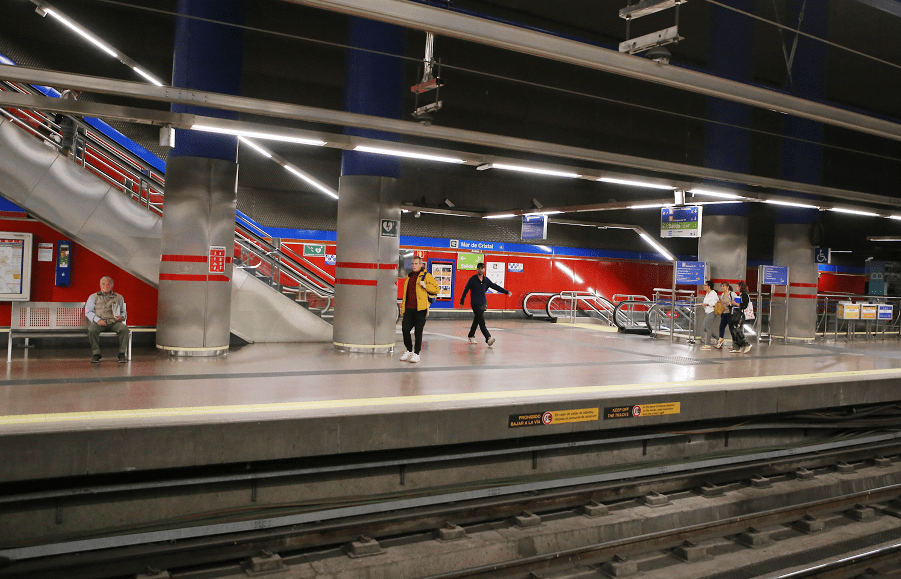
Line 4 runs a fairly long route through the district, serving the stations of Arturo Soria, Esperanza, Canillas, Mar de Cristal, San Lorenzo, Parque de Santa María, Hortaleza and Manoteras.
Line 5 serves the Palomas neighbourhood at the Canillejas station.
Line 8 runs under the Gran Vía de Hortaleza and has stations in Pinar del Rey and Mar de Cristal.
Line ML1 serves Sanchinarro and Virgen del Cortijo with the stops Fuente de la Mora, Virgen del Cortijo, Antonio Saura, Álvarez de Villaamil, Blasco Ibáñez and María Tudor.
Buses are very useful in this district as there are areas that are too far from the metro.
Madrid: full guide
- Administrative structure
- Architecture
- Churches and Cathedrals
- Entertainment
- Monuments
- Museums
- Parks and gardens
- Restaurants
- Shopping and markets
- Squares
- Streets
- Transport
See here Pyrenees travel guide
See here France travel guide
See here Spain travel guide




