The Arenal street is a popular historic street in Madrid, Community of Madrid, Spain, which links the Puerta del Sol and the Plaza de Isabel II (Real Teatro).
Its name comes from the primitive stream that ran through its layout before the area was urbanized, with which it appears labeled in the Teixeira map of 1656 as well as in the successive maps of the Villa de Madrid.

History
A route determined by the orography, the old sandbank formed by the runoff that flowed into it, followed the course of the intermittent Arroyo de la Zarza which, leaving the ravine of the same name (in what would later be the Puerta del Sol in Madrid), reached the Plazuela del Barraco which would later be filled in forming the popularly known as Plaza de Ópera.

From there, taking the abundant flow of the Caños del Peral, the Arenal basin flowed southwards in search of the Leganitos stream, in the vicinity of the so-called Cuesta de San Vicente.

Main attractions
Although renovated on successive occasions, the church of San Ginés continues to occupy the space of which there is the most distant record of a building, and that some chroniclers before Mesonero Romanos considered with Mozarabic precedents and written notice since 1358, although the old layout had to be demolished in 1642 due to its ruinous state, inaugurating the new temple of San Ginés de Arlés on July 25, 1645.

Even in 1861, the former residence of the Lerma family and later the house of the Counts of Torrubia, opposite San Ginés, was still standing at number 22.

According to Hilario Peñasco and Carlos Cambronero, there are records of private constructions since 1654, all of which disappeared to make way for mansions of the nobility of the Villa, such as the one that Mesonero Romanos places blocking by To the west is the entrance to the Arenal, which still belonged to the Marquises of Legarda at the beginning of the 19th century. Of the many palaces that once existed on this street, only that of the Marquis of Casa-Gaviria has been preserved. Another important building is the Casa Palazuelo, at number 3, with the main entrance on Calle Mayor.
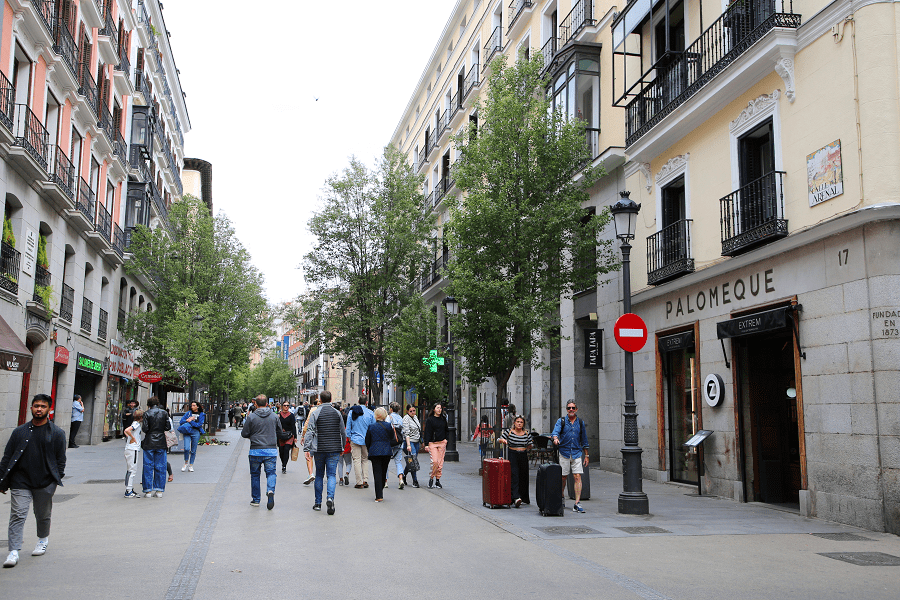
At number 11 is the new Teatro Eslava (Joy Eslava), the historic setting for various chapters in the nocturnal history of Madrid since the 1870s.

Madrid: full guide
- Administrative structure
- Architecture
- Churches and Cathedrals
- Entertainment
- Museums
- Parks and gardens
- Restaurants
- Shopping and markets
- Squares
- Streets
- Transport
See here Pyrenees travel guide
See here France travel guide
See here Spain travel guide