

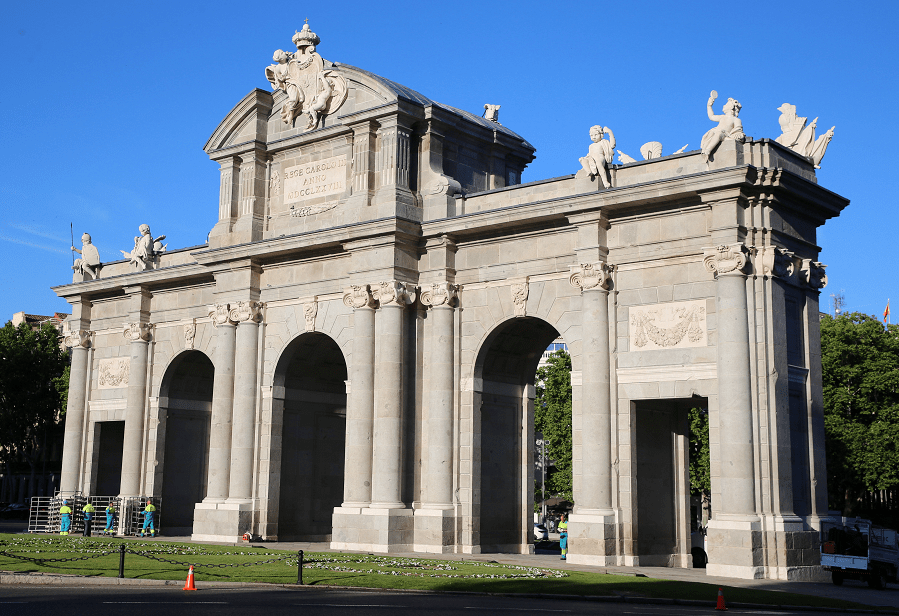
The Puerta de Alcalá is one of the five former royal gates that gave access to Madrid, Community of Madrid, Spain.
It is located in the center of the roundabout of the Plaza de la Independencia. At the intersection of the streets of Alcalá, Alfonso XII, Serrano and Salustiano Olózaga, next to the Retiro park gates: Puerta de España, Puerta de la Independencia (main entrance to the Retiro gardens) and Puerta de Hernani.
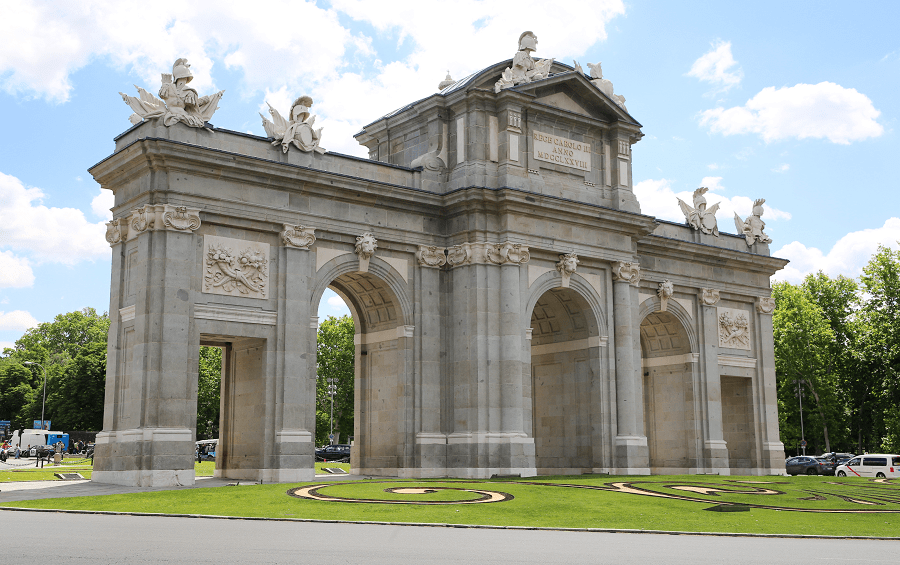
The gate gave access to those travelers who formerly entered the town from the direction of Alcalá de Henares (Aragon or France). Today it is a monumental gate that is located next to the Cibeles Fountain and the Retiro Park. It was built by order of Charles III of Spain to replace a previous gate that had existed since the 16th century. The design and construction belonged to the Italian architect Francesco Sabatini. Other projects by Spanish architects, Ventura Rodríguez and José de Hermosilla, competed with Sabatini, and the King finally chose Sabatini’s design personally.
It is a neoclassical gate with a monumental appearance similar to the Roman Triumphal Arches. It was erected facing east on the outside in 1778.
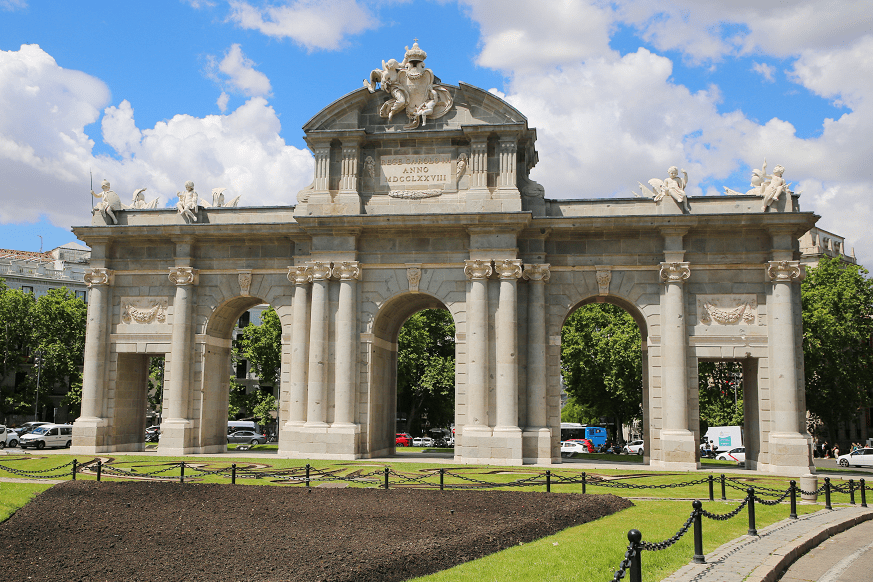
Since its beginnings, it has undergone various urban transformations in its surroundings, going from being the external border of Madrid to a tourist centre that is a must-see, located almost in the middle of the city itself. This change was due to the 19th century expansion of the Serrano neighbourhood and the extension of Calle de Alcalá. It was declared a historical-artistic monument in 1976, extending its category to the Plaza de la Independencia itself.
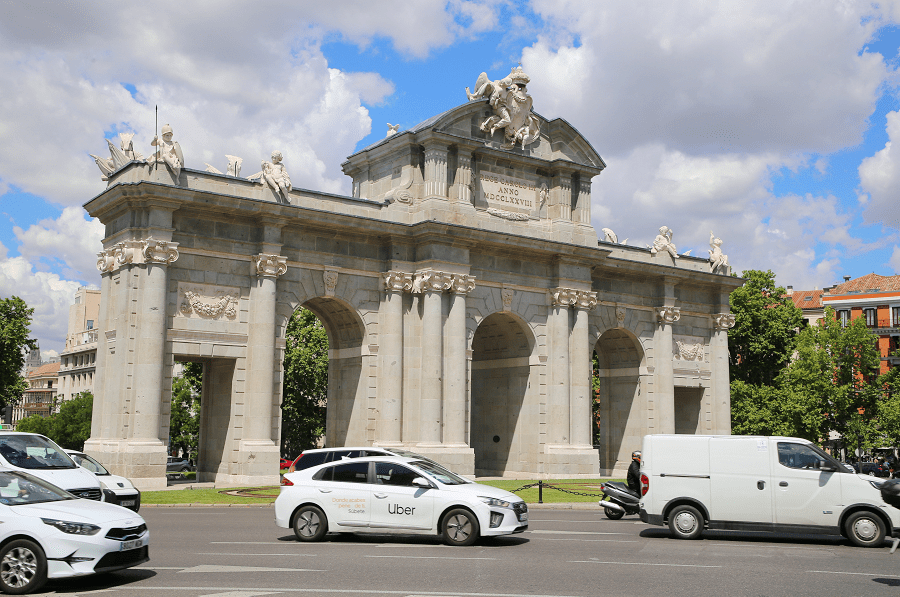
The gate, from its final location, acquired importance in the town of Madrid from the end of the 18th century, and by the end of the 19th century it was already one of its most characteristic icons, appearing in numerous illustrations of the city. Being one of the most representative monuments, in its double condition of looking towards the interior of the city and towards the exterior of it. The Puerta de Alcalá has served as a support for all kinds of political and artistic demonstrations and numerous historical events have taken place in its vicinity.
The ornamental details were sculpted by Francisco Gutiérrez Arribas and Roberto Michel (France), and made of white stone from Colmenar. The architectural elements are chiefly made of granite from Segovia.
Madrid: full guide
- Administrative structure
- Architecture
- Churches and Cathedrals
- Entertainment
- Monuments
- Museums
- Parks and gardens
- Restaurants
- Shopping and markets
- Squares
- Streets
- Transport
See here Pyrenees travel guide
See here France travel guide
See here Spain travel guide




