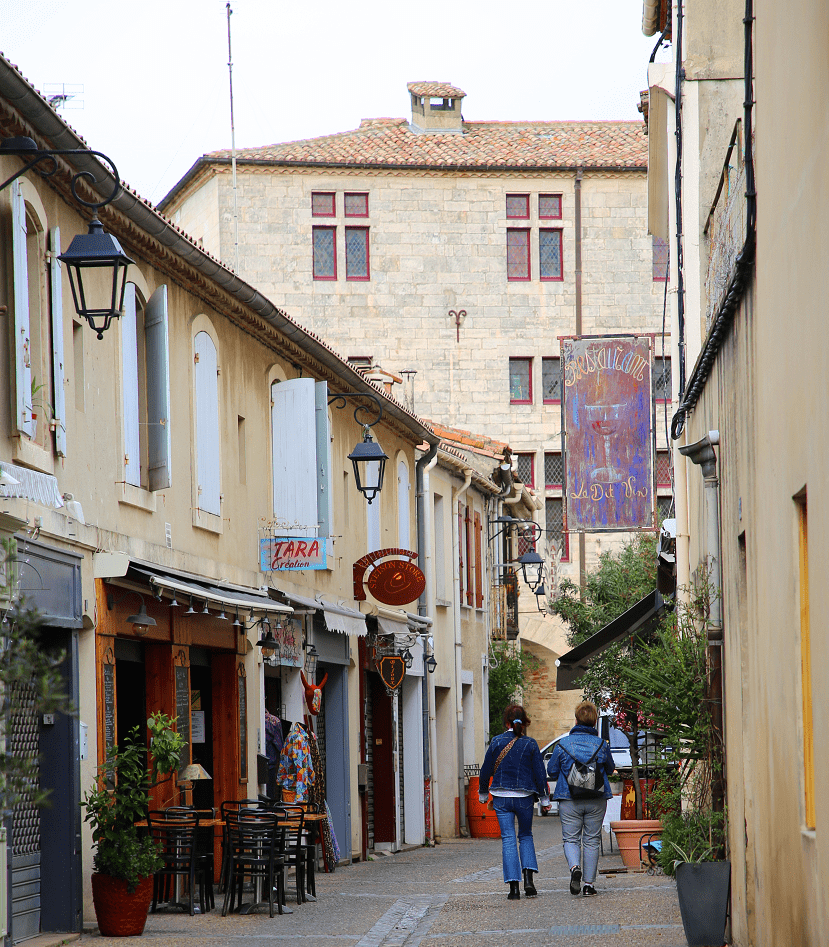


Aigues-Mortes, in Occitan Aigas Mòrtas, is a commune in Petite Camargue, located at the southern tip of the Gard department, in the Occitania region (France).

Exposed to a Mediterranean climate, it is drained by the Vidourle, the Rhône à Sète canal, the Vistre Canal and two other rivers. Included in the Camargue (Rhône delta), the commune has a remarkable natural heritage: three Natura 2000 sites (the “Petite Camargue”, the “Mauguio pond” and the “Petite Camargue Laguno-Marine”), four protected areas (the “Boucanet Wood”, the “Camargue Gardoise,” “Etang de l’Or” and the Petite Camargue) and 12 natural areas of ecological, fauna and flora interest.

Aigues-Mortes is an urban and coastal commune that has 8,685 inhabitants (as of 2021), after having experienced a sharp increase in population since 1968. It is in the urban unit of Aigues-Mortes and is part of the area of attraction of Le Grau-du-Roi. Its inhabitants are called Aigues-Mortais or Aigues-Mortaises.
Tourism and main attractions
It is renowned for its ramparts and its arenas, called the Plan des Théâtres, and intended for Camargue races; it is also infamous following the massacre of the Italians on August 1893. The architectural heritage of the commune includes three protected buildings as historical monuments: the Hôtel de Grailhe, listed in 1994, the chapel of the Château de Roquelaure, listed in 2007, and four houses, listed respectively in 1903, 1949 and 1993.

Others:
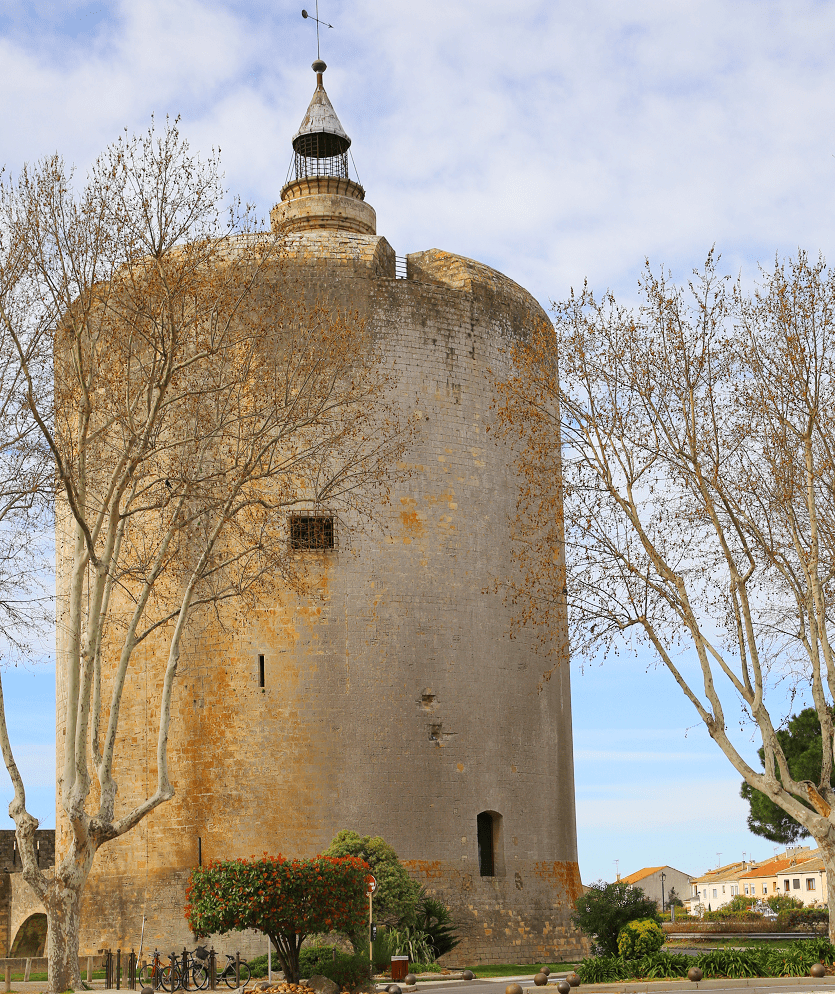
The Tower of Constance was built in 1242 to house the king’s garrison. The Saint-Louis, on the former site of the Matafère Tower, was built by Charlemagne around 790AD. The construction was completed in 1254.
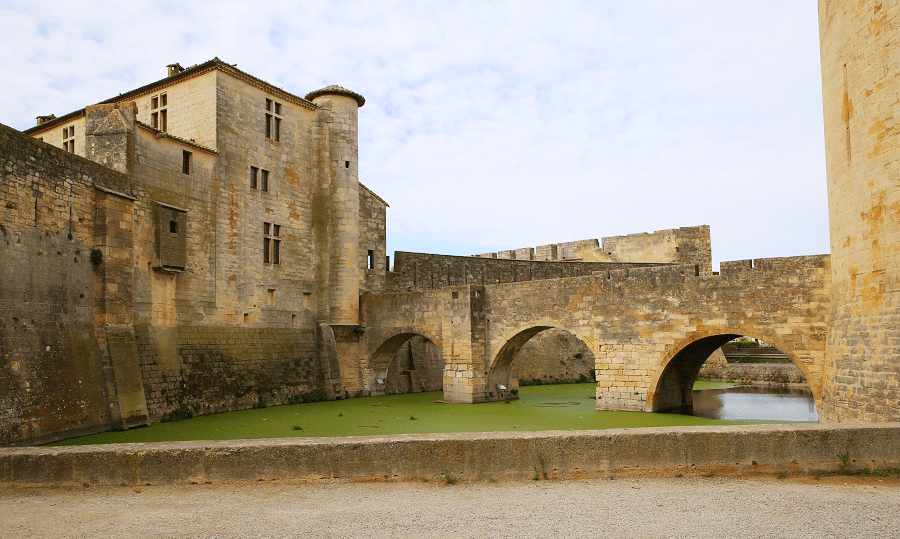
It is 22 metres in diameter and either 33 or 40 metres high, depending on the source. The thickness of the walls at the base is six metres.

The Carbonnière Tower, located in the commune of Saint-Laurent-d’Aigouze, was first referred to in a text from 1346 and specified the function of the structure. It said, “This fortress is the key to the kingdom in this region.”
Surrounded by salt marshes, the fortress was the only passageway into Aigues-Mortes. It was guarded by a garrison comprised of a châtelain and several guards. From the terrace, which could support up to four cannons, there is a panoramic view of Petite Camargue.

The Church of Notre-Dame-des-Sablons is a Gothic-style church, probably built before the ramparts, in the mid-13th century, during the time of Saint-Louis. In 1537, it served as a Collegiate church but was later vandalized, in 1575, by Protestants. After the reconstruction of the bell tower in 1634, it later served as a Temple of Reason during the French Revolution, a barracks, grain merchant and a salt warehouse. It was re-established as a place of worship in 1804, and the building was restored in the neo classical-baroque style. Between 1964 and 1967, all 19th century decor was removed.

Saint-Louis Square is the touristic heart of the city. In the centre, opposite the main entrance of the Porte de la Gardette, stands the statue of Saint-Louis, the work of James Pradier in 1849.
The Plan des Theatres are arenas for the Camargue bullfights. In 1993, they were listed on the inventory of Historic Monuments (MH) for their ethnological and cultural interest. They can accommodate more than 600 people.

The Salins d’Aigues-Mortes, which exploit the Peccais marsh and are emblematic of the production of Camargue salt, are also situated on the territory of the commune.

Gastronomy
The Aigues-Mortes Fougasse
Fougasse was one of the first pastries rise could rise. It can be sweet (sometimes called “tarte au sucre” or sugar tart) or salty (with or without gratillons).

Traditionally, making sweet fougasse in Aigues-Mortes was reserved for Christmas, as part of the Thirteen desserts. Based on brioche dough, sugar, butter and orange blossom, it was made by a baker with ingredients provided by the client. Now, Aigues-Mortes fougasse is available all year round.

How to get to?
From Paris: 7 hr 35 min (759 km) via A6 and A7
From Toulouse: 2 hr 39 min (268 km) via A61 and A9
From Carcassonne: 1 hr 51 min (177 km) via A61 and A9
From Perpignan: 1 hr 50 min (182 km) via A9
From Marseille: 1 hr 50 min (139 km) via A55
From Monaco: 3 hr 39 min (323 km) via A8
From Andorra: 4 hr 25 min (358 km) via A9
From Barcelona: 3 hr 48 min (369 km) via AP-7 and A9
From Madrid: 9 hr 44 min (972 km) via A-2
From Moscow: 34 hr (3,269 km) via E30/M1
From Belgrade: 16 hr 43 min (1,626 km) via E70
From Istanbul: 28 hr (2,575 km) via E70
From Bern: 6 hr 3 min (602 km) via A1

Main information
Area: 57,78 km2
Population: 8 685
Coordinates: : 43°34′03″N 4°11′36″E
Language: French, Occitan
Currency: Euro
Visa: Schengen
Time: Central European UTC +1

See here best sea and ocean resorts of France and Spain
See here France travel guide
See here Spain travel guide
See here Pyrenees travel guide
See here Andorra travel guide