


The Museo Nacional Thyssen-Bornemisza is an art gallery of old and modern artists located in Madrid, Community of Madrid, Spain.
Its existence is due to the lease agreement (1988) and subsequent acquisition by the Spanish Government (1993) of the most valuable core of the private collection amassed over seven decades by the Thyssen-Bornemisza family. This artistic collection complemented the repertoire exhibited in the two main state museums, the Prado and the Reina Sofía.
The opening of the Thyssen-Bornemisza Museum in 1992 gave rise, by joining the two already mentioned, to the so-called Art Triangle of the Paseo del Prado, a museum area in Madrid that houses the most important pictorial collection in Spain, today recognized as a UNESCO World Heritage Site.
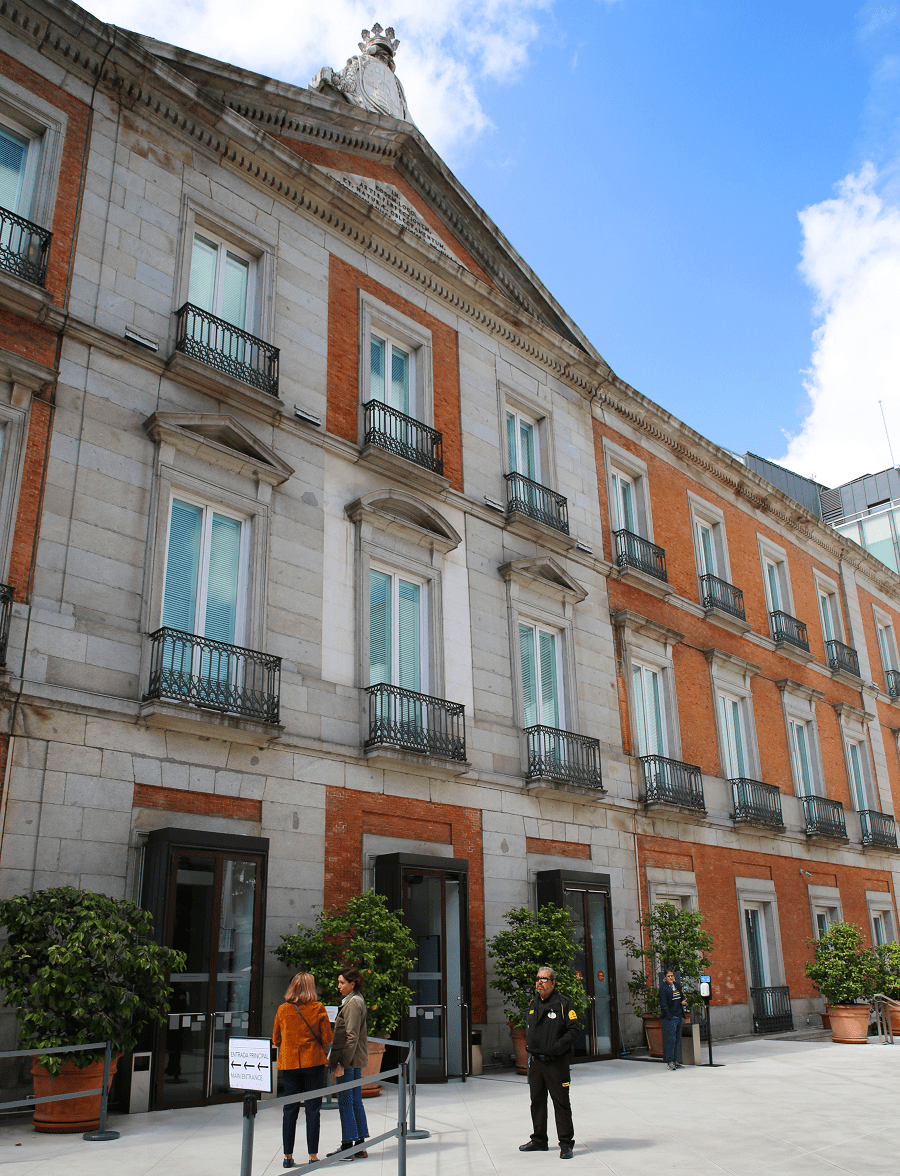
The institution, managed by a foundation that is in turn governed by a board of trustees under state control, has its headquarters in a historic building in Plaza de Neptuno, the Villahermosa palace, where it exhibits the bulk of its collection: more than 700 works (another sixty are on deposit at the National Art Museum of Catalonia (MNAC) in Barcelona). Thanks to an adjoining property added in 2004, it expanded its spaces to display some 240 more paintings, loaned by Carmen Cervera, widow of the second Baron Thyssen. This extension also provided a ground floor for temporary exhibitions and other rooms for internal use.
According to The Art Newspaper, based on data provided by the museums themselves, in 2013 the Thyssen was the fifth most visited museum in Spain, with 944,827 visitors, ranking 61st in its ranking of the 100 most visited art museums in the world. After the acute phase of the COVID-19 pandemic, which drastically reduced the number of visitors to all museums in the world, the Thyssen-Bornemisza was the Spanish museum that experienced the greatest growth, with a total of 671,078 visitors in 2021 and an increase in attendance of 97% compared to 2020. In 2022, the recovery of the public has been consolidated, reaching pre-pandemic figures: more than 1,070,000 visits.
Collection
The Old Masters were mainly bought by the elder Baron, while Hans focused more on the 19th and 20th century, resulting in a collection that spans eight centuries of European painting, without claiming to give an all-encompassing view but rather a series of highlights.

One of the focal points is the early European painting, with a major collection of trecento and quattrocento (i.e. 14th and 15th century) Italian paintings by Duccio, Luca di Tommè, Bernardo Daddi, Paolo Uccello, Benozzo Gozzoli and his contemporaries, and works of the early Flemish and Dutch painters like Jan van Eyck (Diptich of the Annunciation), Petrus Christus (Madonna of the Dry Tree), Robert Campin, Rogier van der Weyden, Gerard David and Hans Memling.
Other highlights include works by leading Renaissance, Baroque and Rococo painters, including Antonello da Messina (Portrait of a Man), Francesco del Cossa, Bramantino (Christus Dolens), Fra Bartolomeo, Giulio Romano, Giovanni Bellini, Palma il Vecchio, Titian, Tintoretto, Veronese, Jacopo Bassano, Sebastiano del Piombo (Portrait of Ferry Carondelet), Bernardino Luini, Agnolo Bronzino, Domenico Beccafumi, Albrecht Dürer (Christ among the Doctors), Hans Baldung Grien, Lucas Cranach the Elder, Hans Holbein (Portrait of Henry VIII), Albrecht Altdorfer, El Greco, Caravaggio (Saint Catherine), Guercino, Sebastiano Ricci, Rubens, Van Dyck, Murillo, Rembrandt.
The display of the European 19th century starts with works by Francisco Goya, Thomas Lawrence, Delacroix, Géricault, Corot and Courbet. There are Impressionist and Post-Impressionist works by the artists Claude Monet, Auguste Renoir, Edgar Degas, Camille Pissarro, Alfred Sisley, Berthe Morisot, Pierre Bonnard, Toulouse-Lautrec, Paul Gauguin, Cézanne, and Vincent van Gogh. The large collection of twentieth century modern art includes Cubist works by Picasso, Braque and Juan Gris, as well as paintings by Edvard Munch, Egon Schiele, James Ensor, Kandinsky, Salvador Dalí, Paul Klee, Chagall, Magritte, Piet Mondrian, Edward Hopper, Jackson Pollock, Mark Rothko, Roy Lichtenstein, Willem de Kooning and Francis Bacon. The selection of German Expressionism is extensive, and includes Emil Nolde, Ernst Ludwig Kirchner, August Macke, Max Beckmann, George Grosz, and Otto Dix.
Address: P.º del Prado, 8, Centro, 28014 Madrid, Spain.
Working hours
Thursday 10 AM–7 PM
Friday 10 AM–7 PM
Saturday 1–7 PM
Sunday 10 AM–7 PM
Monday 12–4 PM
Tuesday 10 AM–7 PM
Wednesday 10 AM–7 PM
Ticket prices
General €13, Reduced for visitors over 65 and pensioners €9, Students €9.
Free: Mondays, for everyone, Saturdays from 21.00 to 23.00, Children and young people under 18, Youth Card holders, Unemployed.

Madrid: full guide
- Administrative structure
- Architecture
- Churches and Cathedrals
- Entertainment
- Monuments
- Museums
- Parks and gardens
- Restaurants
- Shopping and markets
- Squares
- Streets
- Transport
See here Pyrenees travel guide
See here France travel guide
See here Spain travel guide




