

Vaison-la-Romaine is a commune located in the Vaucluse department, in the Provence-Alpes-Côte d’Azur region, France.
Its inhabitants are called the Vaisonnais.
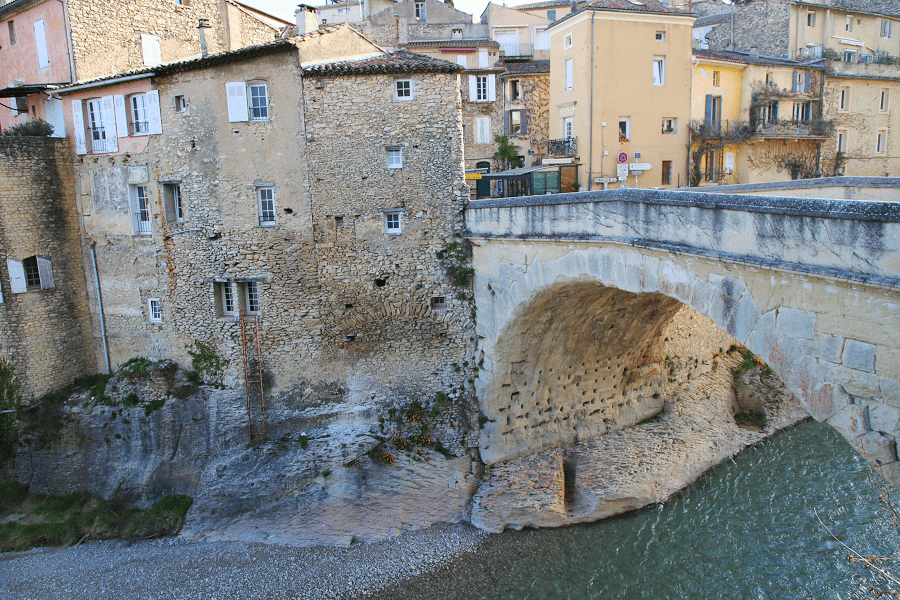
It is known for its particularly rich Roman remains including a single arch bridge, as well as for its medieval city and its cathedral. The city includes ancient, medieval and modern elements.

Vaison-la-Romaine has four theaters and numerous exhibition spaces and galleries. It also hosts cultural events including dance and polyphonic song festivals which have made it to be labeled a “European Choral City”.

Tourism amd main attractions
Civil heritage
- The partially discovered Roman city, it includes the so-called House of the Laureate Apollo, the Portico of Pompey, the House of the Dolphin, the House of the Silver Bust, the street of shops, the forum, the apartment buildings (insula), the Roman theater and thermal complexes: (Villasse site), southern thermal baths from the 2nd century on the right bank of the Ouvèze, northern thermal baths, the best known, built in the middle of the 1st century on 2,000 m2.

- Theo-Desplans Archaeological Museum. Site museum, it presents all the objects found during archaeological excavations.
- Roman bridge spanning the Ouvèze.
- The castle of the counts of Toulouse. Camped at the top of a sheer rock, the castle of Vaison was for centuries a powerful fortress of Comtat Venaissin. Built in 1195 by Raymond V, Count of Toulouse and Marquis of Provence, it replaced a tower destroyed by Bishop Bérenger de Reilhane.

- Upper town. The ramparts surrounding this medieval town were partly built with stones from the Roman town.
- The gates of the upper town.
- The Farm of Arts.
- Villa called “do mi si la do re” or “green villa”.
- Clock tower.

Religious heritage
- Notre-Dame-de-Nazareth Cathedral is a Roman Catholic cathedral. It should not be confused with the city’s other cathedral, the Sainte-Marie-de-l’Assomption Cathedral. It illustrates various phases through which Christian art passed from its origins to the 15th century and suggests a certain grandeur of the city until the Middle Ages. It has been classified as a historic monument since 1840.

- The Sainte-Marie-de-l’Assomption Cathedral or Upper Town Cathedral is a former Catholic cathedral. It has been classified as a historic monument since 1994.
- Chapelle Saint-Quenin.

Shortest distances by car
From Paris: 6 hr 45 min (693 km) via A6
From Marseille: 1 hr 33 min (138 km) via A7

From Nice: 3 hr 2 min (297 km) via A8
From Monaco: 3 hr 29 min (329 km) via A8
From Andorra: 5 hr 23 min (496 km) via A9

From Madrid: 10 hr 8 min (1,075 km) via A-2 and A9
From Moscow: 32 hr (3,183 km) via E30/M1
From Belgrade: 15 hr 41 min (1,596 km) via E70 and A4
From Istanbul: 26 hr (2,572 km) via E70
From Bern: 5 hr 9 min (516 km) via A1

Main information
Area: 27 km2
Population: 5 929
Coordinates: 44°14′32″N 5°04′21″E

Language: French
Currency: Euro
Visa: Schengen
Time: Central European UTC +1

See here France travel guide
See here Spain travel guide
See here Pyrenees travel guide
See here Andorra travel guide




