
Саркана звайгзне «Рига»
“Riga” is a model series of mopeds produced at the Riga motorcycle plant “Sarkanā Zvaigzne” (translated as “Red Star”) from 1958 to 1998.
Model range
Riga-1
In 1958, the first moped “Spriditis” was produced at the plant “Sarkanā Zvaigzne”. The experience was not entirely successful, and the plant’s designers went to the Czech Jawa plant for a detailed acquaintance with the production of small-capacity motorcycles. After that, in 1960, 10 copies of Riga-1 were produced, which were sent for testing. In 50 days, the units traveled 10,000 km, and the following year 5,000 units were produced, in 1962 – 27,000, and in 1965 – more than 90,000 units.
Riga-2
“Gauja” is a motorized bicycle, produced from 1961 to 1966. It was the first serial motorized bicycle of the Riga Motorcycle Plant. “Gauja” had a rigid frame made of pipes of different diameters. A bicycle-type pedal carriage was installed on it. The front fork was a pendulum type with spring shock absorbers, and the rear wheel suspension was rigid.
Riga-3
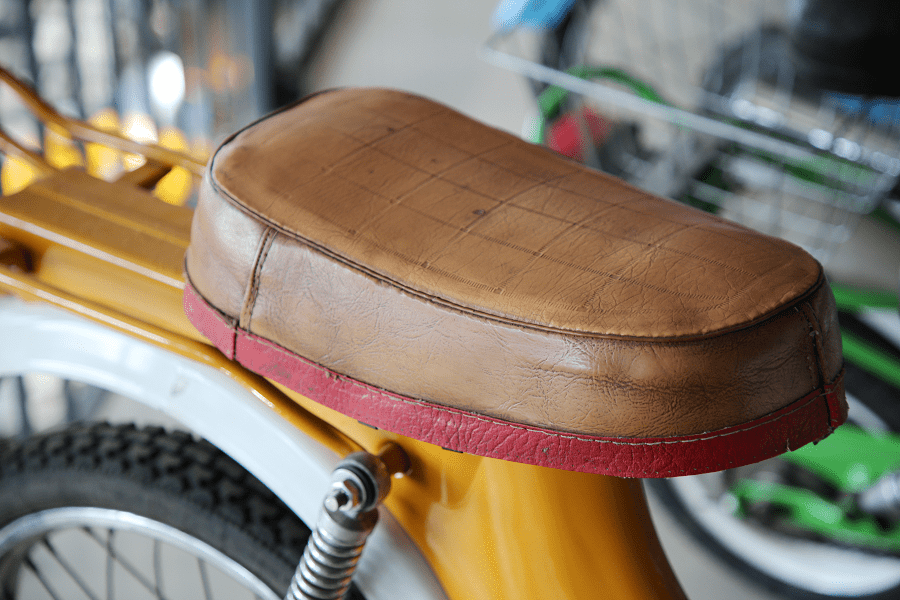
In 1965, the production of the “Riga-1” model ceased, and it was replaced by a new model of 1964 – “Riga-3”. It was equipped with a Š-51 engine made in Šiauliai. However, these engines turned out to be less reliable than the Czech ones, and the popularity of the moped decreased. Externally, the Riga-3 differed little from its predecessor. Only the shape of the brake drums and spokes, the shape of the tank, the seat became cushioned, and the frame had an elongated tail section.
Riga-4
The Riga-4 model was produced from 1968 to 1974. Externally, it resembled the Riga-3, but had a number of technical changes. In particular, the electrical circuit was modernized with the addition of a high-voltage transformer. The wheel guards and chain were also updated, the design of the gearbox gears was changed, and a luggage rack appeared.
Riga-5
The light moped Riga-5 was produced from 1966 to 1971. At first, the Riga-5 had a classic bicycle hub on the rear wheel. It braked the same way as on a bicycle. But in 1968, a modification with shoe brakes appeared. At first, both versions were produced in parallel, and then shoe brakes completely replaced the hub. The reinforced frame was made due to frequent breakdowns of its predecessors. Production of the Riga-5 ceased in 1971. It was replaced by the Riga-7 moped.
Riga-7
The Riga-7 moped was launched into production in 1969 as a replacement for the Riga-5. The main difference of the new version is the D-6 engine. It allowed for the connection of a headlight and a rear side light. The decorative protection of the drive chains was removed. To prevent frame breakage during emergency braking, a special rail was added to the design of the Riga-7.
Riga-11
The Riga-11 was a hybrid of the Riga-7 and the promising Riga-9. It was planned that the moped would be equipped with an engine with an automatic clutch. However, after testing, this idea was abandoned.

Riga-12
The two-speed moped was equipped with bicycle pedals. They helped the engine on difficult sections of the road, for example, when climbing a hill. The moped was produced in different mounting options and fuel tank shapes: with an ignition coil on top of the frame and with an ignition coil under the tank. Externally, it differed from the Riga-16 in its short saddle and smaller luggage rack.
Riga-13
The light moped “Riga-13” replaced the “Riga-11” model and was produced since 1983. The features of the “Riga-13” were good lighting and a high-voltage transformer, which eliminated problems with the ignition coil. The production of “Riga-13” continued until 1998, and this model became the most popular in the “Riga” line. However, it had a drawback – frequent clutch failure.
Riga-15S
A motorcycle for road-circuit racing in the 50 cm³ class first appeared in 1976. It was equipped with a Serpukhov SK-54 engine with a volume of 49.8 cm³ and a power of about 12 HP at 10,000 rpm. The engine was combined with a six-speed gearbox. The motorcycle weighed 62 kg, and its maximum speed reached 150 km/h.
Riga-16
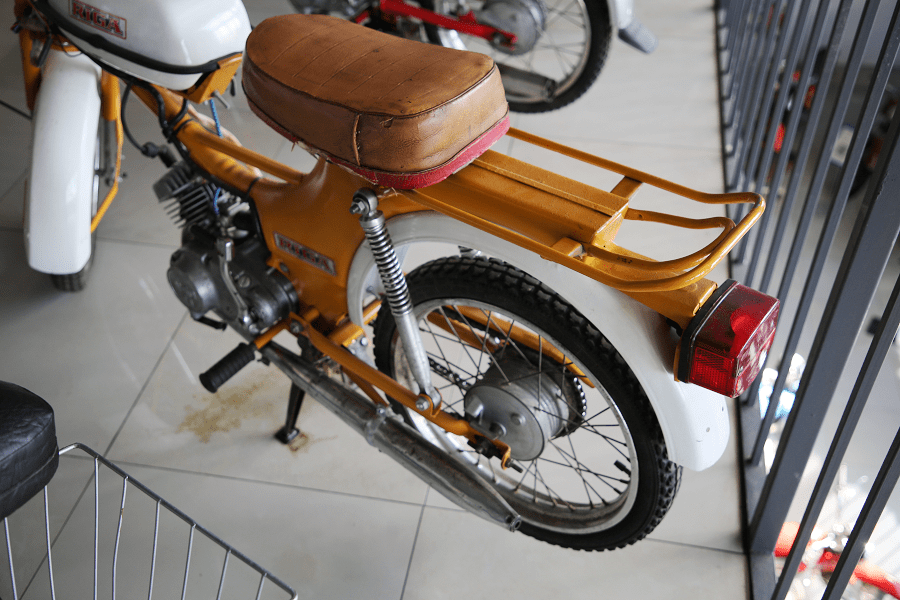
In 1977, the plant released a two-speed moped “Riga-16”. This was the first model of this type produced at the plant. The moped had a kickstarter, a motorcycle muffler, new steering wheel and a taillight. In the same year, LMZ presented its first moped model – “Verkhovyna-6“.
Riga-17S
In 1983, the Riga plant began producing the sports model “Riga-17S”. This was an improved version of the “Riga-15S”. The 49.8 cubic centimeter engine with 16.5 horsepower allowed the moped to accelerate to 153 km/h.
Riga-21S
The Riga-21S model was an improved version of the Riga-15S and Riga-17S. It featured cast wheel rims and a more powerful engine — 18 HP.
Riga-22
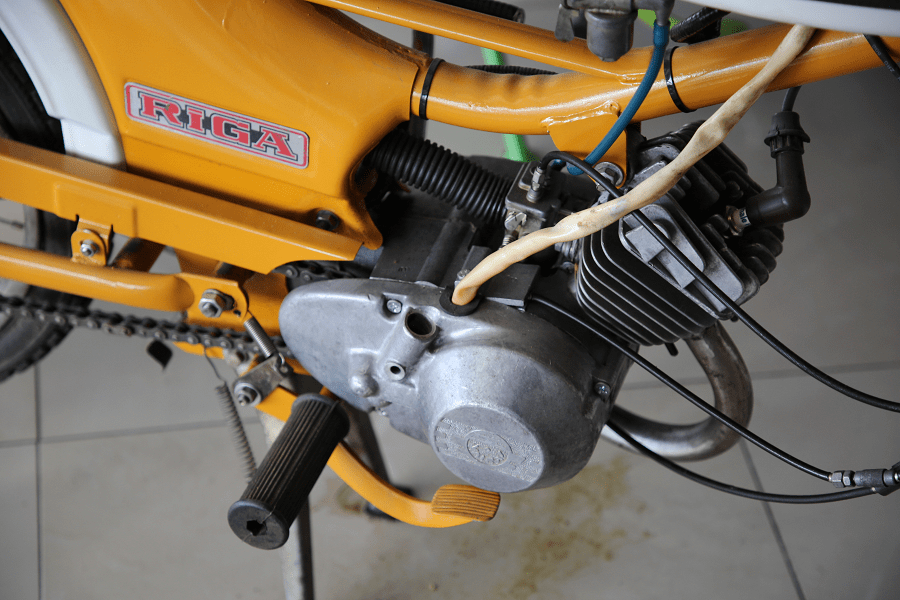
In 1981, the Riga-22 moped, an improved version of the Riga-16, appeared. The engines featured a powerful electronic ignition and gearbox, which required changing the direction of rotation of the crankshaft. Electronic ignition increased the reliability of starting and operating the system.
Riga-20U
The Riga-20U is a motocross version of the Riga-22 moped. It had a sports frame, a larger front wheel, and foot-operated gear shifting. The model was produced in small quantities and was intended for training and competitions of young athletes.
Riga-26
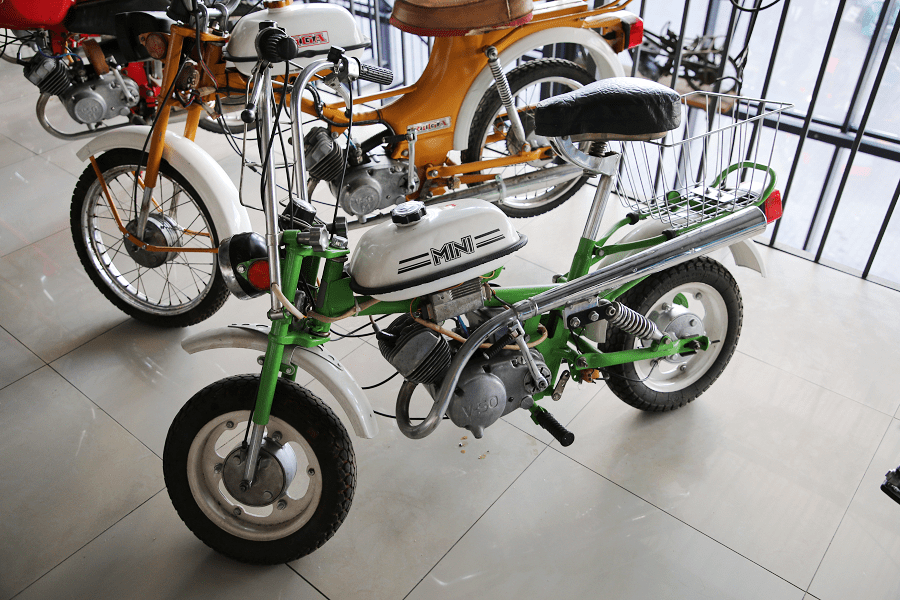
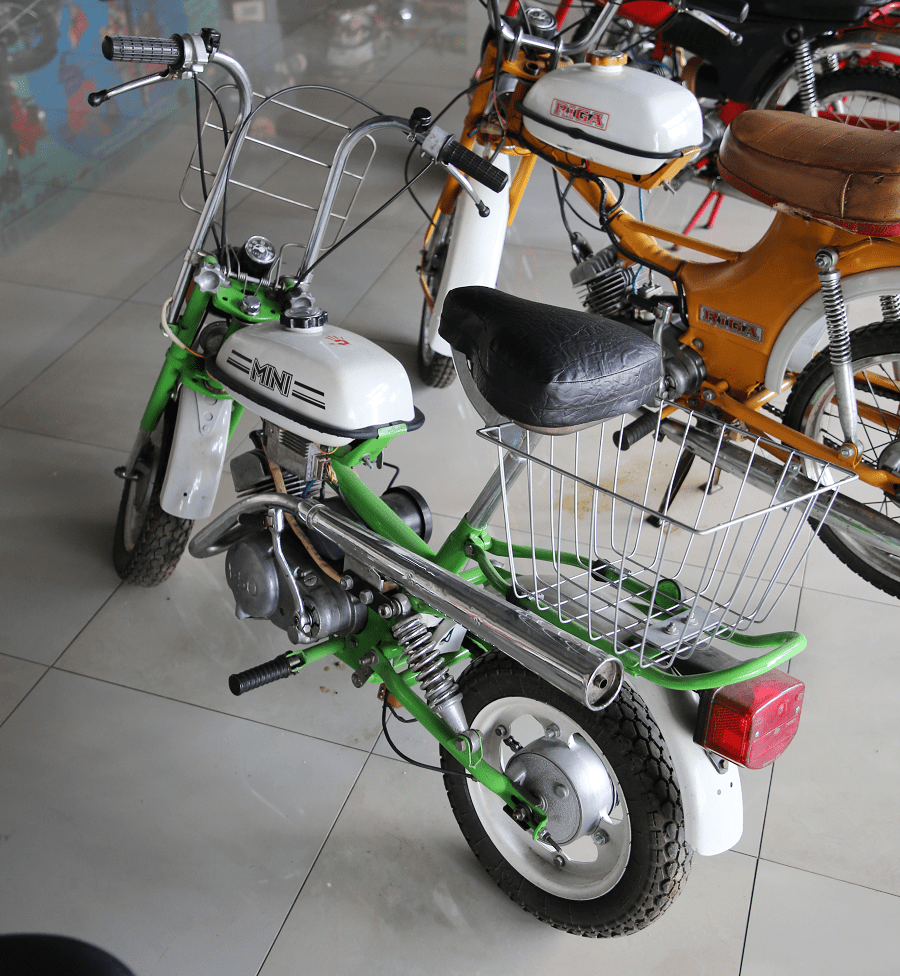
In 1982, the mini moped “Riga-Mini” appeared, also known as RMZ-2.126. This model combined the advantages of a moped and a scooter, while maintaining simplicity and ease of storage. “Riga-26” was compact: it could easily be placed on the roof of a car, in an elevator or on a balcony. The wheels were small in diameter, like “Vyatka“, “Tourist” and “Elektron“, but with smaller tires.
Riga-30
RMZ 2.130 differed from “Riga-26” by a softer spring suspension on the rear axle.
“Stella” RMZ-2.136
In July 1987, the Riga motorcycle plant “Sarkanā Zvaigzne” and the Czechoslovak company “ZVL-Kolarovo” signed an agreement on joint work. They produced mopeds “Stella” and “Babetta”. The result was a moped with an engine from Czechoslovakia and a chassis from the USSR. This moped was presented at the VDNKh (Moscow).
Production of “Stella” began in 1990 and continued until 1997. It was one of the most stylish and advanced mini-mopeds in the USSR. The model was distinguished by a new frame, a comfortable seat and a modern design.
“Delta”
In 1986, the moped “Delta” (RMZ 2.124) entered the market, which became a new stage in the development of mopeds “Riga”. It had a new frame and engines. The model was offered in several modifications: “Sport”, “Tourist”, “Lux” and “Cross”. The first batches of mokies had a weak frame, but this drawback was eliminated later. The trunk handle was chromed. The headlight was round black with a chrome rim. In addition, “Deltas” with cast wheels and a “Dezamet” engine with a three-speed gearbox of Polish manufacture were produced. These models were sold in Latvia in small batches.
Riga SZ-80
In 1983, the GDR acquired a license for the “Simson M531/541 KG-40” engine. In 1984, a prototype of the “SZ-80” (“Sarkanā Zvaigzne”) was created on its basis. This mini-motorcycle received improvements unique to the USSR: a full-size two-seater seat, cast collapsible wheels, disc brakes, hydraulic shock absorbers and a central monoshock absorber with a lever system. The SZ-80 was on par with the best world models and was considered the best in its class in the USSR. However, like most prototypes, it never went into production.
Characteristics (Riga-16)
Manufacturer: Sarkanā Zvaigzne
Assembly: Riga (Soviet Union / Latvia)
Years of production: 1958—1998
Length: 1850 mm
Width: 750 mm
Height: 1150 mm
Engine: 1 cylinder; 49.8 cc
Power: 2.2 HP
Max speed: 50 km/h
Fuel consumption: 2 l/100 km
Weight: 70 kg
Gonshchik Motorcycle Museum (Russia)
See also Transport blog
See also Cars blog
See also Motorcycles blog
See also Buses blog
See also Shipbuilding blog
See also Motors and Engines blog
See also Trains and railways blog
See also Trucks and Cargo Vehicles blog
See also Tractors and Special Equipment blog
See also Tanks and Armored Vehicles
See also Airplanes blog
See also Helicopters blog
See also Artillery, Missiles and Rockets blog
See also Bicycles blog