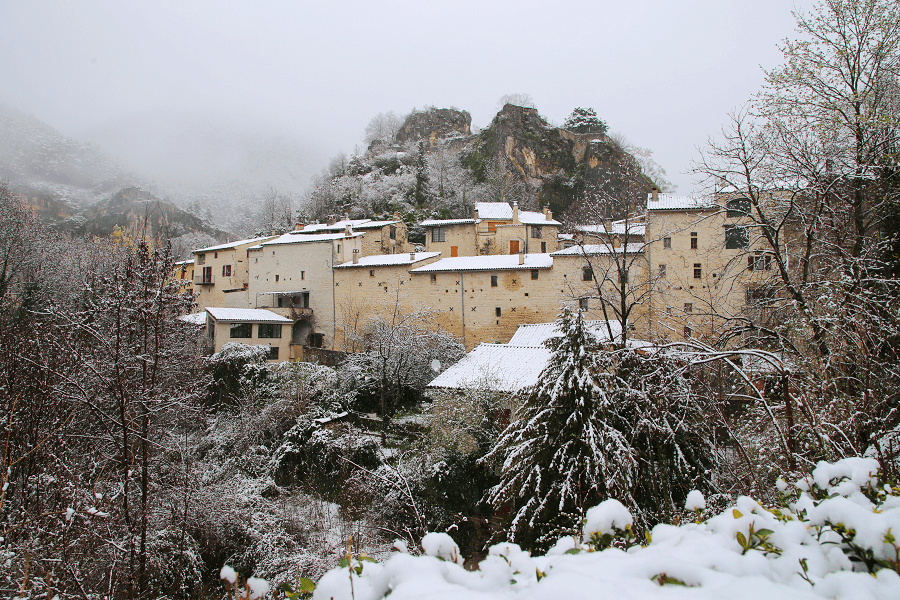
Forcalquier is the town and commune in the Alpes-de-Haute-Provence department, Provence-Alpes-Côte d’Azur region, southeastern France.
Founded in the 11th century, then capital of a flourishing county of Provence, nicknamed the “County City”, it is today the capital of the district. Its inhabitants are called Forcalquiérens.
Its motto is “Pus aut que les Aups” (“higher than the Alps”).

Forcalquier has the distinction of having “the purest sky and air in France, if not in Europe”.

Tourism amd main attractions
Military architecture
Porte des Cordeliers, from the 14th century, is the last vestige of the six gates that made up the city. The citadel gate, dating from the previous century, also remains. It is the only remains of the medieval fortress, known as the citadel, with a tower which still has two vaulted rooms.

There also remain some remains of the bishops’ castle, at the top of the town, integrated into more recent constructions: bases of towers, sections of walls, part of the main building.

Religious architecture
The Notre-Dame-du-Bourguet concathedral (13th and 17th centuries), also known as Notre-Dame du Marché, whose central nave, choir, transept and bell tower date from the early years of the 13th century and constitute the first attempt at adaptation of Gothic art in Pays d’Oc. The campanile is from the 16th century, the side naves and the second floor of the bell tower are from the 17th century. The bell is from 1609. The large organ is classified as a historic monument.

The Récollets convent was installed in 1627 in the Saint-Pierre church, one of the four parishes of the city.
The Cordeliers convent (13th century), probably founded around 1236, is one of the first Franciscan foundations in Provence.

The Visitandines convent and its cloister, which served as a college: the convent and the cloister date from 1634, the Saint-Ange chapel (or church) dates from 1687.

Civil architecture
The Hôtel d’Autane offers a beautiful facade (exceptional according to Raymond Collier), with two large broken arcades (14th century): it is listed in the supplementary inventory of historical monuments. The Dauphin’s house is from the same period: arcades and twin bays.

From the following century, at least three buildings remain, a house behind the Hôtel d’Autane, a Roubaud passage, and the Jean Rey house. Made of cut stone, with an interior courtyard and a spiral staircase, its facades are pierced with mullioned windows.
There remains a door with woodwork in the shape of a folded napkin. In the 16th century it belonged to Jean Rey, from the family of the Lords of Nails. Its roof is protected by registration in the supplementary inventory of historic monuments.

Monday morning is a market day in Forcalquier. The market fills the Place du Bourguet and the adjoining streets.
Noteworthy is the Musée Municipal with its prehistoric and Gallo-Roman artifacts, glass works, and faïence pottery from Apt and Moustiers-Sainte-Marie.

Shortest distances by car
From Paris: 7 hr 57 min (761 km) via A6
From Marseille: 1 hr 14 min (108 km) via A51
From Nice: 2 hr 40 min (216 km) via A8
From Toulouse: 4 hr 54 min (465 km) via A61 and A9
From Monaco: 2 hr 58 min (239 km) via A8
From Andorra: 6 hr 22 min (591 km) via A9
From Madrid: 11 hr 25 min (1,169 km) via A-2
From Moscow: 35 hr (3,197 km) via E30/M1
From Belgrade: 14 hr 59 min (1,436 km) via E70 and A4
From Istanbul: 26 hr (2,385 km) via A4
From Bern: 5 hr 38 min (490 km) via A1

Main information
Area: 42,76 km2
Population: 5 118
Coordinates: 43°57′36″N 5°46′50″E
Language: French
Currency: Euro
Visa: Schengen
Time: Central European UTC +1

See here France travel guide
See here Spain travel guide
See here Pyrenees travel guide
See here Andorra travel guide