Восход-175 ШК
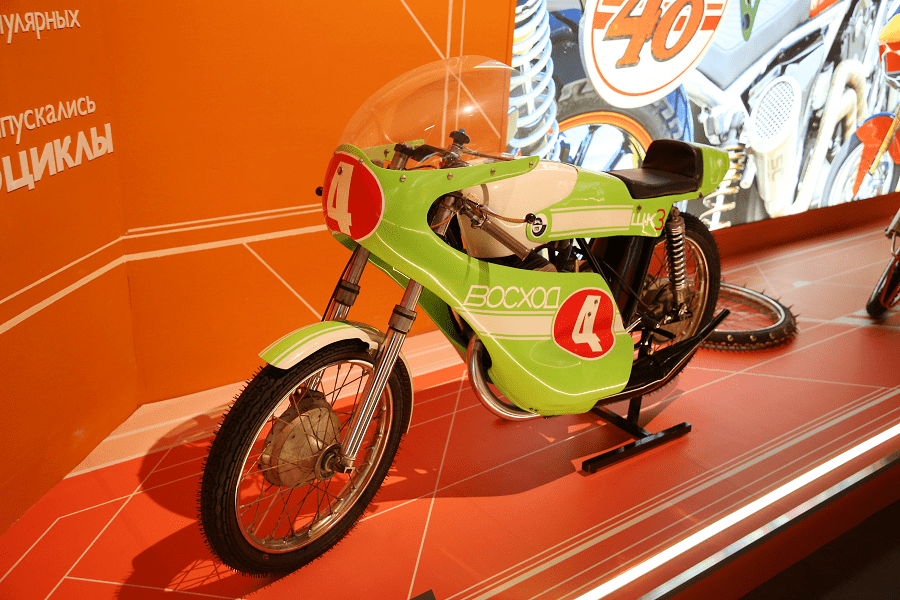
Voskhod-175 ShK 3
In the late 1960s, the Degtyaryov Plant (ZiD) began active work on racing motorcycles. Previously, developments were limited to creating prototypes that did not enter serial production.
This motorcycle implemented many new technical solutions. For the first time, a valve intake was used, and a crankshaft and a cylinder-piston group for the engine were created. With a compression ratio of 12 units, the power was 10 HP.
Also for the first time, a semi-fairing, a clip-on handlebar, a ventilated front brake, a jumper between the front fork cups, and rear shock absorber springs with progressive characteristics were used. The tires for the motorcycle were developed in Leningrad and had a size of 2.5 by 19.
The frame of this motorcycle is made of 30KhGSA steel pipes. The front fork resembles similar parts of road motorcycles with a limited stroke of 125 mm. The fork tubes are chrome-plated, the coating thickness is 9 microns. The rear wheel travel is 60 mm. The force required to operate the rear brake is 35 kg, and for the front brake – 15 kg. The motorcycle is equipped with Leningrad tires L-169 with dimensions 3.00X19 in the front and L-170 with dimensions 3.00X19 in the rear.
Voskhod-175 ShK
The Voskhod 175 SHK became the first mass-produced racing motorcycle produced by the Degtyarev Plant after the K-125S and K-55S2 models, which were produced in the fifties. These motorcycles were mainly intended for young men and women and became the basis of the 175 B class – sports motorcycles that were mass-produced.
Many famous Soviet racers competed on Voskhods. In the jargon of those years, they were affectionately called “rug”. By using parts from serial motorcycles, the plant was able to establish mass production and provide athletes with the necessary spare parts.
In 1977, the Voskhod-175SHK was discontinued and replaced by the Voskhod ShK3.
Voskhod-175 ShK3
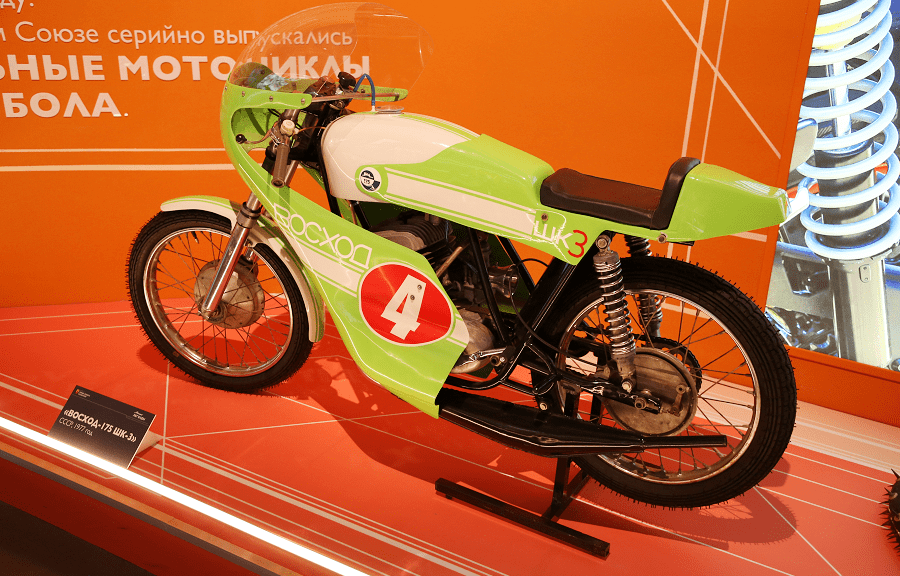
In 1977, the Voskhod 175 SHK model was replaced by a new model — Voskhod 175 SHK 3. This motorcycle, created for the 175B “Men” and 175 “Women” classes, became a continuation of the ideas implemented in the previous model.
The front fork of this motorcycle was similar to the one used on the road “Voskhods”, but it was made shorter. The rear shock absorbers were also taken from the regular “Voskhods”.
Some engine parts were also taken from standard motorcycles of this brand. The level of unification with road motorcycles reached 70%. However, all other parts were original and were created specifically for racing use.
The motorcycle frame was made of thin-walled pipes and was duplex. The wheels had a diameter of 18 inches, the brake drums were 160 mm. The brake mechanisms were original. Clip-ons were used instead of the steering wheel. The throttle handle was short-stroke. A friction brake damper and a plastic aerodynamic body kit were also installed.
The exhaust system included a resonator without a muffler.
The Voskhod-SHK 3 engine stands out from other racing modifications of Voskhods, such as SK and SMB, with its gear ratios in the gearbox. On each gear of the gearbox you can see the “SHK” stamp.
The ignition system of this motorcycle is typical for sports equipment produced by the Kovrov and Minsk plants. It includes a 38A.3437 switch and a 59.3701 generator.
Instead of an air filter, a bell is installed on the intake, which functions as an intake resonator. On the motorcycle, you can find both Soviet K-series carburetors and foreign Jikov models.
There is no kickstarter on this motorcycle. However, despite this, the 173.7 cc engine cm develops power from 17 to 20 hp, which allows accelerating the 80-kilogram motorcycle to a speed of 150 km / h.
The cylinder diameter is 61.75 mm, the piston stroke is 58 mm, and the compression ratio is 11 units.
Tests of this motorcycle were carried out as part of the road-ring races of the USSR Championship on the tracks in Kiev, Kaunas, Riga and Tallinn under the leadership of the master of sports V. Tyurin from CSKA.
In 1981, the motorcycle was modernized, which was associated with the launch of the new motorcycle “Voskhod-3”.
Among the famous racers who drove the “Voskhod-SHK 3”, it is worth highlighting the Estonian athlete Luule Tull. Between 1966 and 1991, she won 21 gold, 7 silver and 3 bronze medals in various circuit and hippodrome racing competitions. Her achievements earned her 42 Estonian Champion titles.
The estimated annual production volume was 80 units, but in reality the number of motorcycles produced did not exceed 30–40 per year. The price was about 480 rubles.
The next generation, Voskhod SHK 4, appeared in 1985, this motorcycle was the last in the racing program of the Kovrov ZiD Plant.
Voskhod-175 SHK4
The last motorcycle produced by the Kovrov Motorcycle Plant in the road-ring segment was the Voskhod-SHK 4. It was created on the basis of the Voskhod-SHK 3 model.
The plant team made changes to the frame, bodywork and fairing. The engine, brakes, wheels and suspension remained unchanged.
The production of Voskhod-SHK 4 motorcycles was discontinued in 1991. During this time, they underwent several upgrades. The latest models of this motorcycle are distinguished by a special shape of the cylinder head and the cylinder itself – they have a fan-shaped structure.
This model used a contactless ignition system consisting of a 59.3701 generator and a 38A.3734 switch. The motorcycle was equipped with a valve and a plastic adapter, which made it possible to install both Jikov and K-63 carburetors.
The design also included an aluminum straight-through muffler, and a pneumatic one was installed instead of a friction steering damper. The changes affected the frame: the footrests were redesigned, and a bracket for attaching the rear fairing was added.
The new fuel tank was made of sheet steel using argon welding and featured angular shapes, which corresponded to the fashion of the eighties. Externally, the motorcycle differed most from the previous model SHK-3 in the presence of new plastic and a front fender.
To achieve maximum speed on this motorcycle, it was decided to use gears from Voskhod road motorcycles. As a result, the gear ratio of the rear gear turned out to be quite “long”. Because of this, starting from a standstill in first gear becomes difficult, but when “starting from a walk” this does not matter much.
Nevertheless, this ratio allows you to develop high speed, using all four gears. On the move, the motorcycle feels light, rigid and precise in control. On turns, the rigidity of the frame provides good control, and the geometry and rigidity of the suspension allow you to confidently control the trajectory. The brakes with a diameter of 160 mm stop this lightweight motorcycle well.
The Voskhod-SHK-4 motorcycle was outdated even before its production began. In the early 90s, such racing motorcycles already seemed strange on the tracks.
The Voskhod-SHK-4 can be considered one of the examples of how a once great country is losing its positions over time.
However, now the Voskhod-SHK 4 attracts the interest of spectators at exhibitions and in museums, looks unusual and is a valuable exhibit.
Manufacturer: ОАО «Завод им. В. А. Дегтярёва» (ОАО «ЗиД») (Degtyaryov Plant)
Assembly: Kovrov (USSR/Russia)
Years of production: 1971—1992
Based on: Voskhod-175
Engine: 2 cylinders; 175 cc
Power: 20 HP
Max speed: 180 km/h
Weight: 80 kg
FSO Museum (VDNKh, Moscow, Russia)
See also Transport blog
See also Cars blog
See also Motorcycles blog
See also Buses blog
See also Shipbuilding blog
See also Motors and Engines blog
See also Trains and railways blog
See also Trucks and Cargo Vehicles blog
See also Tractors and Special Equipment blog
See also Tanks and Armored Vehicles
See also Airplanes blog
See also Helicopters blog
See also Artillery, Missiles and Rockets blog
See also Bicycles blog