Hudson Commodore (3rd generation)

The Hudson Commodore is an automobile that was produced by the Hudson Motor Car Company of Detroit, Michigan between 1941 and 1952. During its time in production, the Commodore was the largest and most luxurious Hudson model.
III Generation (1948-1952)
Hudson developed a new and radical car design. Production of the 1948 Hudsons began on 12 October 1947. Introduced on 7 December 1947, the Hudson Commodore was one of the first new-design postwar cars made. The 1948 model year inaugurated Hudson’s trademarked “Monobuilt” construction or “step-down” automobile. The new cars were designed by Frank Spring and in part by Betty Thatcher, the first female designer to be employed by a car manufacturer. The marketing tagline for the innovative Hudsons was “Now You’re Face to Face with Tomorrow.”
The cars had a light and strong semi-unit body with a perimeter frame. Because of the encircling frame, passengers stepped down into the vehicles. Hudson’s step-down design made the body lower than contemporary cars. It offered passengers the protection of being surrounded by the car’s chassis with a lower center of gravity. In addition to the safety of being surrounded by the car’s chassis, the step-down also allowed Hudson to achieve weight savings through the unibody construction, making for a well-performing automobile. The “monobuilt” or “step-down design also required less steel for its production.
The cars featured slab-sided bodies with fully integrated fenders. The Brougham and sedans were of a fastback design, while convertibles and coupes were notchbacks. A character line ran from the front to back further lowering the car even more visually, so “the new Hudson looked like a dream car straight from the auto show.”
In 1948, Commodores came in one series and were available in either I6 or optional I8 engines. Interiors were upholstered in broadcloth on sedans, and leather on convertibles. Again, Hudson continued to provide numerous standard features that other manufacturers classified as upcharge options. Not only were the 1948 models “truly significant new designs of the early postwar years. The “Step-Down” Hudson was low and sleek, which many consumers really enjoyed.” Total Commodore production was 62,474 of which 35,315 were I8 units.
For the 1949 model year, the Commodore line was enlarged to include more luxurious Custom models. As a marketing promotion, Hudson had plastic specialists use scaled-down blueprints to develop transparent models of the Commodore Eight sedan to demonstrate and promote the design and construction of the cars.
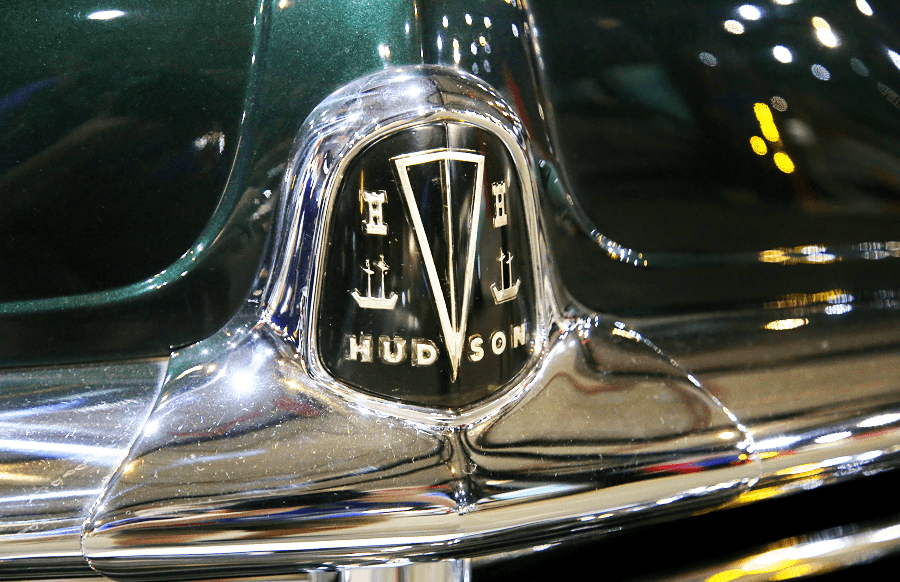
The most noticeable change to the 1950 model year was the restyled grille featuring a design that superimposed Hudson’s signature triangle logo on four horizontal bars. This would become the “Hudson look.” The 1950 models included a new split back window and redesigned interiors. A new Custom Commodore convertible model debuted in mid-April 1950.
In 1951, Hudson introduced a new I6 engine and offered General Motors’ Hydra-Matic as an optional transmission. The grille was redesigned from a rather rectangular shape to an oval shape, a design that would carry through to 1953. The grille would be redesigned again in 1954, the last year for the famous aerodynamic Hudson body style which was used from 1948 until 1954.
In its final year in 1952, the Commodore was split into the Six Series and Eight Series. The exterior received another trim change, but by the end of 1953, the Step-Down styling was beginning to look outdated. Hudson lacked the resources to keep adding new and exciting changes to keep up with the competition from the other automakers, whose annual redesigns added tailfins and more chrome trim that consumers wanted. Instead of redesigning the aging “set-down” models, company President A. E. Barit pushed ahead with the firm’s plan for the Jet compact.
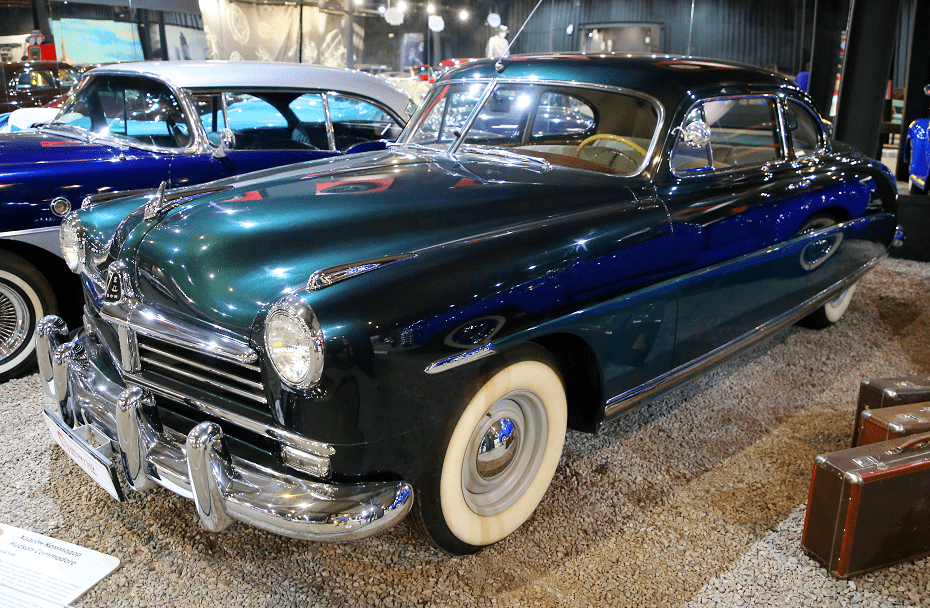
Assembly: Detroit (Michigan, USA)
Years of production: 1948—1952
Production: 143,794 units
Length: 5270 mm
Width: 1957 mm
Height: 1534 mm
Engine: 6 cylinders; 4170 cc
Power: 130 HP
Max speed: 150 km/h
Fuel consumption: 17 l/100 km
Weight: 1606 kg
World cars museum (Moscow, Russia)
See also Transport blog
See also Cars blog
See also Motorcycles blog
See also Buses blog
See also Shipbuilding blog
See also Motors and Engines blog
See also Trains and railways blog
See also Trucks and Cargo Vehicles blog
See also Tractors and Special Equipment blog
See also Tanks and Armored Vehicles
See also Airplanes blog
See also Helicopters blog
See also Artillery, Missiles and Rockets blog
See also Bicycles blog