SNCF X 2800
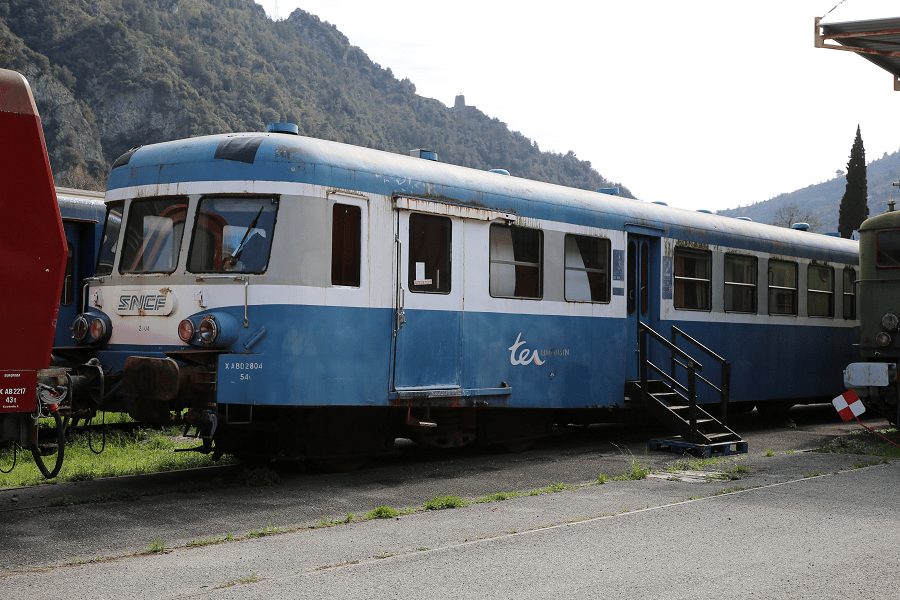
The X 2800 series is a French railcar. The first of 119 examples of this model was delivered to the Carmaux depot in Tarn (Occitania) on 28 May 1957.
It was the most powerful single-engine railcar in France at the time, with an 825 horsepower engine. It was designed specifically to haul multiple trailers on mountain roads and difficult sections of track. The railcar was highly reliable and durable, remaining in service from 1957 to 2009, serving the Massif Central railway lines.
Description
The X 2800, also called U-825 (Unified; 825 hp), is the culmination of Renault’s development of railcars, which began with the Renault VH and continued with the ABJ and ADP.
The car is equipped with a powerful diesel engine MGO (Marep, Grosshans, Ollier), which is located above the motor bogie. The engine block is made of steel and assembled using mechanical welding, which gives it a unique sound, unlike the noise of locomotives. The engine has 12 V-shaped cylinders (54 liters) and a Brown Boveri turbocharger. The power developed by the X 2800 allows it to tow up to five cars. They can be combined with cars of the X 2100, X 2200, X 2400 and X 4200 series. It can also work in tandem with the ZR 17000 and 27000, as well as the Z 7100. The design uses a four-speed Mekydro gearbox, which operates on the hydromechanical principle and has the ability to reverse. Gear shifting occurs automatically, but in the event of a malfunction, gears can be shifted manually. The engine and gearbox are connected via a torque converter.
Two manufacturers were involved in the construction of this series: the Decauville company (X 2801–2816) and the Régie Nationale des Usines Renault (RNUR) through its railway division (X 2817–2919).
Modernization
The development plan for the Auvergne region, presented in January 1976 during the government of Valéry Giscard d’Estaing, included the delivery of new XR 6000 trailer cars to the region. It was also planned to refurbish the regional X 2800, which at that time was officially called “Massif Central”.
During the modernization process, they lost their traditional red and cream color and acquired the same color as the new XR 6000 and X 4900 models, which entered production in 1975: “blue-gray-white”.
In addition to the new exterior paint, the refurbishment includes replacing the brown benches with individual orange seats. This reduces the number of seats in the second-class carriage to 50, including five folding seats. The interior is finished in warm tones with “Corail” curtains.
End of service
In 1995, the decision was made to stop major repairs. After this, the X 2800 could travel another 800,000 kilometers. However, due to the unreliability of the new X 72500 and X 73500 series, the end date of the series was postponed from 2003 to 2009.
Characteristics
Manufacturer: Decauville / Régie Renault
Assembly: France
Years of production: 1957—1962
Years in service: 1957—2009
Production: 119 units
Length: 26400 mm
Width: 2840 mm
Height: 3717 mm
Track gauge: 1435 mm
Passenger capacity: 62 seats
Formation: 1 railcar
Powerplant: MGO V12 ASH
Continuous power: 607 kW (825 HP)
Max speed: 140 km/h
Fuel consumption: 1.5 l/1 km
Weight: 57 t
Éco-Musée de Transport (Breil-sur-Roya, Provence)
See also Transport blog
See also Cars blog
See also Motorcycles blog
See also Buses blog
See also Shipbuilding blog
See also Motors and Engines blog
See also Trains and railways blog
See also Trucks and Cargo Vehicles blog
See also Tractors and Special Equipment blog
See also Tanks and Armored Vehicles
See also Airplanes blog
See also Helicopters blog
See also Artillery, Missiles and Rockets blog
See also Bicycles blog