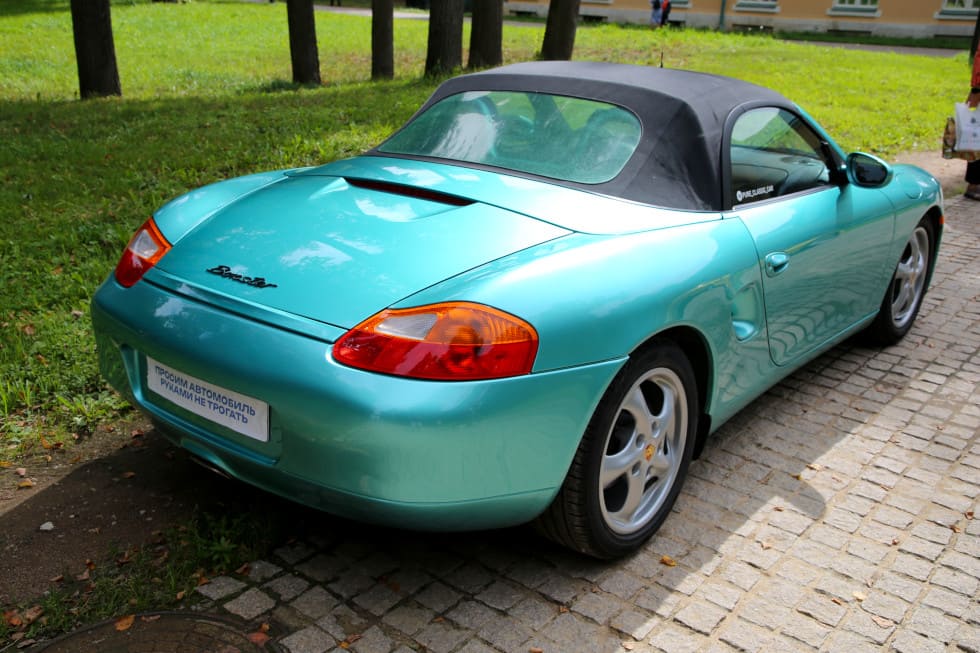
Porsche Boxster 986

Porsche Boxster 986 at Arkhangelskoye Estate (Moscow Region, Russia)
The Porsche 986 is the internal name of the first-generation Boxster, a two-seat roadster with a mid-engine layout. The German automaker unveiled it in late 1996. Based on a 1993 concept, the Boxster was the first Porsche road car designed from the ground up as a roadster since the 914 model.
The name Boxster derives from “boxer,” meaning boxer engine, and “speedster,” first used on the 356. The standard version was equipped with a 2.5-liter flat-six engine. In 2000, the engine was upgraded to 2.7 liters, and in 2003, the Boxster S with a 3.2-liter unit was introduced. The 986 was replaced by the 987, which retained the Boxster roadster and added a coupe with a hardtop borrowed from the Cayman.
Development
By the early 1990s, Porsche’s model lineup was significantly outdated. The last new design was the 1978 Porsche 928 and the 968, an evolution of the 944.
Collaboration with Toyota allowed Porsche to share parts between models, reducing costs. The Boxster borrowed elements from the 911 (996): the hood, front fenders, headlights, interior, and engine.
Production of the 986 began in 1996 at the former 928 plant in Stuttgart, Germany. Valmet Automotive also assembled the Boxster under contract for Porsche at its plant in Uusikaupunki, Finland.
Engine
The Porsche Boxster 986 is equipped with the M96 engine—a liquid-cooled flat-six. It is the first engine in Porsche history with this layout that is not located in the front. The Boxster features a mid-engine layout, unlike the traditional rear-engine layout of the 911.
The Boxster’s engines are compact versions of the 3.4-liter flat-six found in the 996 Carrera. This layout ensures a low center of gravity, ideal weight distribution, and excellent handling.
Facelift
In 2002, the model underwent a minor facelift. The plastic rear window was replaced with a smaller, heated glass window. The interior received a glovebox and a new electromechanical hood and trunk release mechanism with an emergency release via the fuse box. The steering wheel was also updated. Porsche also installed a redesigned exhaust pipe and air intake.
Furthermore, the amber-tinted headlights were replaced with clear ones. The bumpers were given a more prominent appearance, and new wheel options were added.

Manufacturer: Dr. Ing. h.c. F. Porsche AG
Assembly: Stuttgart (Germany)
Years of production: 1996—2004
Length: 4315 mm
Width: 1780 mm
Height: 1290 mm
Engine: 6 cylinders; 2480–3179 cc
Power: 204–260 HP
Max speed: 258 km/h
Fuel consumption: 11 l/100 km
Weight: 1435 kg
See also Transport blog
See also Cars blog
See also Motorcycles blog
See also Buses blog
See also Shipbuilding blog
See also Motors and Engines blog
See also Trains and railways blog
See also Trucks and Cargo Vehicles blog
See also Tractors and Special Equipment blog
See also Tanks and Armored Vehicles
See also Airplanes blog
See also Helicopters blog
See also Artillery, Missiles and Rockets blog
See also Bicycles blog