Chausson AP

Chausson AP, Chausson SAVIEM SC3 and SC4 are models of city and intercity buses and trolleybuses, which were manufactured by Société des usines Chausson, and then jointly with SAVIEM, from 1942 to 1964.
Models
AP1
This was the first model of bus produced by this manufacturer. It was presented on July 30, 1942 under the index KOM and the designation AP1. The bus was equipped with a Panhard petrol engine with 80 hp and a gas generator. Only 15 units of this model were produced.
It was only after the end of the war, in 1945, that its replacement appeared – the APE model, also equipped with a petrol engine, but still sold under the name AP1. In 1945 and 1946, 166 units of this model were produced.
AP2
The new version of the bus was equipped with two engines: a six-cylinder Hotchkiss petrol engine with 105 horsepower and a Panhard 4HL diesel engine with 85 horsepower.
The engine was positioned vertically at the front, creating a significant bulge inside the vehicle. This made it difficult to get on board and ensured high levels of noise and heat generation. One feature worth noting is that although the driver’s seat was on the left, the gearshift lever was also located to the left of him.
Because the Hotchkiss engine was longer than the Panhard, an unusual protrusion appeared at the front of the vehicle, which quickly received the nickname “pig’s nose”. A total of 63 units of all versions (APE, AH and APH) were produced in 1946 under the name AP2. The length of the version increased to 10.47 meters. The bus had 45 seats, plus 10 folding seats.
AP3
From March 1946, the AP2 model underwent significant changes due to the improvement of the engine. This new version featured two different engines: a 6-cylinder Buda engine (80 hp) and a Panhard 4HL (100 hp).
The AP3 model was produced until 1949, when it was replaced by the AP48 model. In March 1947, the commercial names were changed to AH47, APH and ABH47, still depending on the chosen engine. On 14 February 1947, Chausson celebrated the production of the 1000th car.
From an aesthetic point of view, the “pig’s nose” was standardized regardless of the engine type.
AP48
Depending on the engine type, the vehicle received different names: AH, APH and ASH.
The ABH version was excluded from the range, since the Buda engine was not in demand. On the other hand, the ASH version appeared, equipped with a new 6-cylinder Somua D615H engine (150 hp). This version of Chausson was distinguished by its luxurious design, which was made even more attractive by the Telma front fairing. The structure was reinforced at the base, and three rear windows became a standard option.
Starting with this version, Chausson began supplying motorized chassis to several specialized coachbuilders, which contributed to the development and expansion of the model range.
AP52
At the Paris Motor Show in October 1951, Chausson presented the AP52 model with a new front end design. The company abandoned the “pig nose”.
At the official presentation, the model was a great success. Production began only in March 1952. In addition to a modern appearance, the car received a new engine:
- AH (Hotchkiss engine);
- APH (Panhard 4HL engine);
- ASH (Somua D615H engine);
- AHH (Hispano-Suiza DWXLD engine).
The windscreen was taller and wider, but still in two parts. The pillars were considerably thinner, and the grille, with a modern design, was flat and integrated the headlights.
AP521
At the end of 1953, Chausson changed the name of the AP52 to AP521, still producing AH, APH, ASH and AHH versions depending on the engine chosen.
APU
In 1953, Chausson received its first major order for 240 urban buses for the RATP. After building the first prototype based on the AP52 in 1952 and the second in 1953 based on the AP521, the company began delivering buses during 1954 and 1955. The new buses featured a modified rear section, which was designed specifically for urban use. Production totaled 350 units (with various AP521 engines).
AP522
At the beginning of February 1956, Chausson presented a new bus model, the AP522. This bus featured a number of technical improvements and an improved interior. It was 18 centimeters higher.
APV
In addition to the AP522, Chausson improved the urban version of the APU. The main change concerns the height of the body, which was raised to increase the glass area and, above all, to increase the height of the ceiling. This change was particularly relevant given the frequent complaints of customers. As a result, Chausson raised the ceiling of the urban version of the APV to 2.17 m.
SC3 and SC4
Following the merger of Chausson and Saviem in 1959, the vehicles were renamed SC3 for the AP522 interurban bus and SC4 for the APV urban bus. These buses were restyled, receiving the dual Chausson-Saviem badge, and underwent various modifications until the end of 1964, when AP production ended.
Assembly will continue to take place at the Chausson plant in Gennevilliers (5 km from Paris), but the pre-painted bodies will be finished in Annonay (70 km from Lyon).
The Saviem-Chausson SC3 was replaced by the SC10.
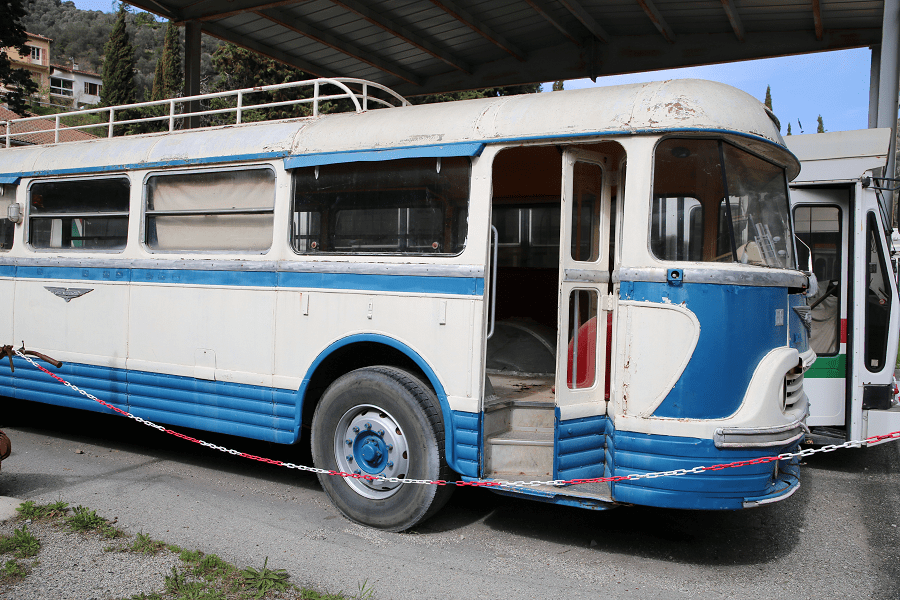
Manufacturer: Société des usines Chausson
Assembly: Annonay (Auvergne-Rhône-Alpes, France)
Years of production: 1942—1964
Production: ≈10,000 units
Length: 10470 mm
Width: 2500 mm
Passenger capacity: 55 (32 seats)
Powerplant: Hispano Hercules
Power: 125 HP
Max speed: 55 km/h
Weight: 12250 kg
Éco-Musée de Transport (Breil-sur-Roya, Provence)
See also Transport blog
See also Cars blog
See also Motorcycles blog
See also Buses blog
See also Shipbuilding blog
See also Motors and Engines blog
See also Trains and railways blog
See also Trucks and Cargo Vehicles blog
See also Tractors and Special Equipment blog
See also Tanks and Armored Vehicles
See also Airplanes blog
See also Helicopters blog
See also Artillery, Missiles and Rockets blog
See also Bicycles blog