SAVIEM SC10
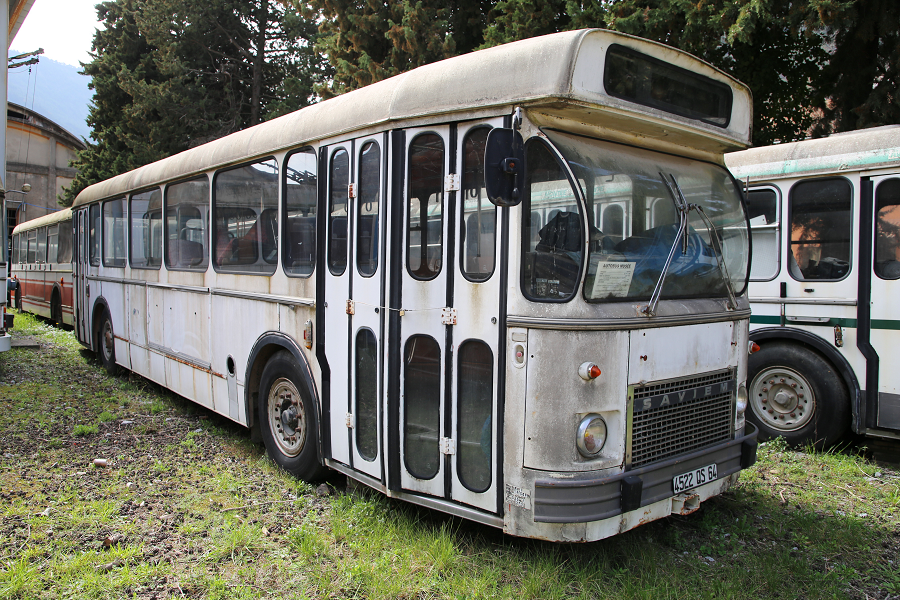
The Saviem SC10 is a French city bus designed and manufactured by Saviem and later Renault Véhicules Industriels (RVI) between 1965 and 1989. The name “SC” stands for SAVIEM-Chausson.
Developed through a joint study by the RATP and the Union des Transports Publics Urbains et Régionaux (UPTUR), the first commercial version of the SC10 was unveiled in September 1965. Over the years, the model underwent several modifications, with its final version, the SC10 R, released between 1982 and 1989. A total of 11,004 units were produced, but only fifteen were exported, all to Brescia, Italy.
History
In the late 1950s, public transport in French cities was dominated by buses, with few exceptions such as the Paris metro, some trolleybuses, and occasional tram lines. These buses were expensive to purchase and maintain, and their high floors, low ceilings, and limited accessibility made them inefficient for modern urban transport.
In 1958, the RATP and UPTUR collaborated to design a standardized city bus, referred to as the “standard bus”. The main requirements for this new model included a length of 11 meters, a floor no higher than 63.5 centimeters, an interior height of at least 2.20 meters with large windows, an anti-glare front windshield, and a 150-horsepower engine.
The companies SAVIEM, Berliet, and Verney expressed interest in producing this bus, but Verney withdrew due to a lack of production capacity. Berliet won the initial tender with its Berliet PCM model. However, Saviem continued its own development, leading to the introduction of the SC10.
On May 19, 1965, the first SC10 was produced at the Annonay plant (Auvergne-Rhône-Alpes). The city of Nancy became the first provincial network to acquire the SC10 later that year. The prototype was initially fitted with a French Fulgur engine, but it proved underpowered and was replaced in production models with a German MAN engine.
Production
The SC10 quickly became a commercial success in France. By November 1969, there were already 1,440 units in service across various transport networks.
In 1970, the front direction indicators were moved above the headlights to improve visibility. In October 1974, SAVIEM introduced a modernized model, the SC10 UM, which featured improved sound insulation and braking systems that met new EEC standards.
In 1977, SAVIEM and Berliet merged to form Renault Véhicules Industriels (RVI), leading to the phase-out of the SAVIEM brand in 1980. The SC10 was then renamed the Renault SC10 and underwent improvements, later becoming the SC10 UO.
In the autumn of 1981, Renault introduced the SC10 R, a restyled version. The windshield design was modified, retaining a curved shape only at the top instead of its previous cylindrical-cyclic form. The side doors were now fully glazed, improving thermal comfort through better ventilation, heating, and defrosting. At the rear, only the lights were redesigned. Despite these updates, the engine remained unchanged.
The SC10 R remained in production for seven and a half years, with 1,630 units manufactured. By 1987, this model accounted for 91% of the RATP fleet.
End of service
In the early 2000s, stricter environmental regulations across Europe led to the retirement of SC10 buses. They were replaced by newer, more fuel-efficient, and environmentally friendly models such as the Renault R312 and Renault Agora. These new buses featured lower floors, making them significantly more accessible and comfortable for passengers.
Despite being withdrawn from regular public transport services, many SC10s found a second life. Some were refurbished and repurposed for school transport by municipalities or private owners. Thanks to the used vehicle market, these buses continued operating in several countries, including Cambodia, Albania, Armenia, Romania, Russia, and multiple African countries.
Characteristics
Manufacturer: Société anonyme de véhicules industriels et d’équipements mécaniques (SAVIEM) / RVI (Renault)
Assembly: Annonay (Auvergne-Rhône-Alpes, France)
Years of production: 1965—1989
Production: 11,004 units
Length: 11000 mm
Width: 2500 mm
Height: 2940 mm
Passenger capacity: 93 (31 seats)
Powerplant: MAN DO636HM8U
Engine (specs): 6 cylinders; 7034 cc
Power: 150 HP
Max speed: 80 km/h
Weight: 8150 kg
Éco-Musée de Transport (Breil-sur-Roya, Provence)
See also Transport blog
See also Cars blog
See also Motorcycles blog
See also Buses blog
See also Shipbuilding blog
See also Motors and Engines blog
See also Trains and railways blog
See also Trucks and Cargo Vehicles blog
See also Tractors and Special Equipment blog
See also Tanks and Armored Vehicles
See also Airplanes blog
See also Helicopters blog
See also Artillery, Missiles and Rockets blog
See also Bicycles blog