2TE116
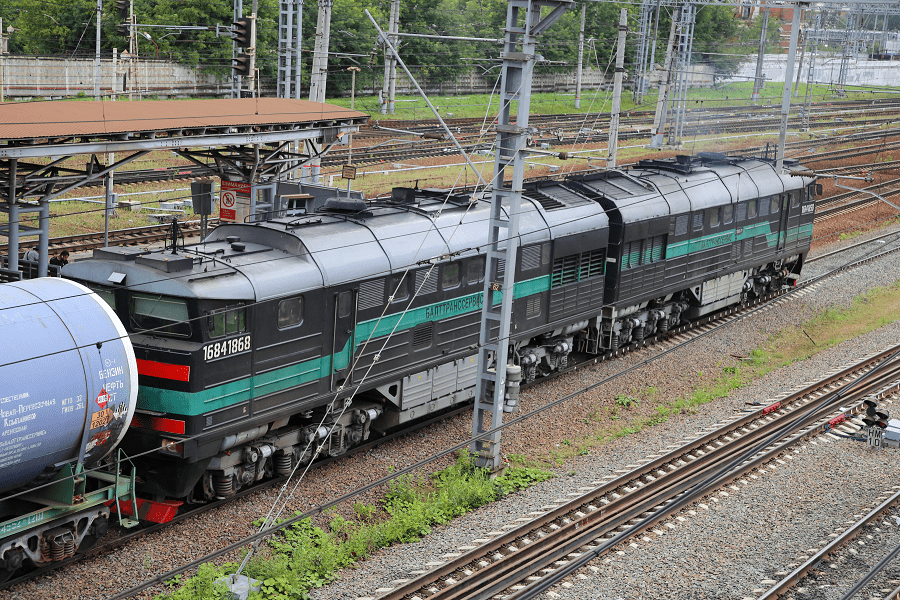
2TE116 in Mytishchi (Moscow region)
2ТЭ116 (2-секционный тепловоз с электропередачей, тип 116) (2-section diesel locomotive with electric transmission, type 116) is a series of mainline two-section freight diesel locomotives with electric transmission, produced in the USSR and (after the collapse of the USSR) in Ukraine by the Luhansk Diesel Locomotive Plant (Luhanskteplovoz, formerly VZOR – Voroshilovgrad Plant named after the October Revolution).
One of the most popular freight diesel locomotives in Russia and other countries of the former USSR. Railway workers nicknamed it “Hunchback” (due to the characteristic shape of the roof), “Fantomas” and “Boeing”.
History
The main directions of development of the national economy of the USSR in 1976-1980 included the development and production of two-section freight mainline diesel locomotives.
The mainline two-section diesel locomotive of the 2TE116 series, with a capacity of 2×3060 horsepower, was created for freight transportation on the railways of the USSR. It was developed by specialists from the October Revolution Diesel Locomotive Plant, located in the city of Voroshilovgrad (now Luhansk/Lugansk), as well as other enterprises and industry institutes.
The Kuibyshev Diesel Locomotive Plant, located in the city of Kolomna, the Malyshev Transport Engineering Plant, Elektrotyazhmash named after Lenin and Elektromashina in Kharkov participated in the creation of this locomotive. Industry institutes of diesel locomotive construction and the Ministry of Railways also took part in the development.
Production
From 1971 to 2016, 2176 units of all versions of the 2TE116 diesel locomotive were produced.
The largest number of diesel locomotives of this series were produced in the 1980s and in 2012 and 2013.
Since the early 1990s, after the collapse of the USSR, the volume of diesel locomotive production has decreased significantly: from several dozen per year to several units per year. In some years, diesel locomotives were not produced at all.
However, since 2004, production has increased significantly and continued until 2007. Then the plant switched to the production of an improved modification 2TE116U.
At the moment, the production of diesel locomotives of the 2TE116U series has been discontinued due to the military conflict in Donbas.
It is also worth noting that some diesel locomotives purchased by private carriers such as BTS and Transoil were built in the second half of the 1990s and early 2000s. These locomotives were manufactured in the bodies of previously produced units, but in fact they received new numbers. That is, in essence, they underwent major repairs at the manufacturer’s plant.
Construction
The 2TE116 diesel locomotive is a train consisting of two identical single-cabin sections. The locomotive is controlled from any position in the cab. The sections are connected by an SA-3 automatic coupling. If necessary, each section can operate as an independent locomotive.
For the transition from one section to another, the rear wall of the sections has doors and a transition platform covered with a rubber coating. All the necessary power and auxiliary equipment is located in the body with a supporting main frame.
The locomotive is equipped with a body with a supporting main frame. For ease of installation and dismantling of equipment, the roof of the body consists of five removable sections. On earlier models, three sections were equipped with built-in air intake boxes. These boxes serve to clean the air necessary for cooling the traction generator, rectifier unit and traction electric motors.
The diesel air is cleaned using rotating screens, the lower part of which is in an oil bath, and the upper part is responsible for filtering the passing air. The screens rotate automatically when the motor-compressor is turned on. An electropneumatic drive rotates the screens by 45 degrees.
The use of connectors in the electrical wiring along the body and sealing belts on the roof allows you to quickly remove the necessary roof section for dismantling the equipment. The diesel exhaust noise muffler is also attached to the removable roof section.
The main source of energy on the locomotive is a diesel generator set model 1A-9DG, which is located in the middle part of the main frame. This unit consists of a 16-cylinder four-stroke V-shaped diesel engine 1A-5D49 and a synchronous alternating current generator GS-501A.
The diesel engine and traction generator are fixed on one welded frame and connected to each other by a semi-rigid plate coupling. The 5D49 engine belongs to the unified series CHN26/26, which means: four-stroke with gas turbine supercharging, cylinder diameter and piston stroke of 26 centimeters.
The diesel engine is controlled remotely, using electrical signals coming from the driver’s controller through four electromagnets, which are located in the diesel regulator. These electromagnets are switched on in various combinations, which allows you to control the engine.
The electric transmission of the locomotive is made according to the standard Soviet alternating-direct current scheme. The same scheme is used on the TE109, TEP70, 2TE121 and TEM7 diesel locomotives.
The synchronous traction generator powers the asynchronous motors with a squirrel-cage rotor (AD KZ), which drive the motor-fans for cooling the equipment.
A single-phase synchronous exciter VS-650 and a collector starter-generator PSG are installed above the GS-501A generator. When the locomotive starts, the PSG receives power from the battery and cranks the diesel. After starting, the PSG operates as a generator, producing a constant voltage of 110 V to charge the battery, power the control and lighting circuits, and to operate the DC collector motors (DCM), which drive some units.
Modifications
2TE116G — gas-fueled diesel locomotive. Consists of three sections — two diesel (with cabins, as on a regular 2TE116 diesel locomotive) and one cryogenic — with a gasifier (without control cabins). The locomotive uses a 1GDG gas-diesel generator with an electronic diesel control, regulation and protection system (SKRZD-3), additional systems for water and gas supply, gas equipment control, control and protection, signaling, gas switching (“shield-2-1”), ventilation of electrical compartments and gas equipment compartment, remote uncoupling of diesel sections from the cryogenic one. Built in 1988.
2TE116M — modification of the 2TE116 diesel locomotive, during which a rheostatic brake was installed, which was subsequently installed on serial modifications of 2TE116 and 2TE116U. The peculiarity of the electrical circuit of this locomotive is the preservation of the power supply of the asynchronous three-phase electric motors of the auxiliary machines from the traction generator during electric braking, as well as the control of the electric braking mode using the automatic braking control system (ABCS). The system allows, in particular, to automatically maintain a set speed on descents.
2TE116K is a locomotive that has undergone major repairs with the replacement of the diesel engine.
2TE116UP is a freight and passenger modification, a single copy was built in 1996. The diesel engine power has been increased to 3600 hp, the locomotive is equipped with a rheostatic brake and an electric heating system for the train. The traction unit consists of a traction and auxiliary synchronous generators mounted in a single housing. The auxiliary generator, via a rectifier, provides power supply to the passenger train with a voltage of 3000 V DC with a capacity of 575 kW from each section in nominal mode. Continuous traction force 2*323 kN (2*33 tf), design speed 120 km/h.
2TE116A is a diesel locomotive that was designed for maximum unification with the new 2TE121 diesel locomotive built in the 80s and was also a prototype of the 4TE130 diesel locomotive.
2TE116U — “improved”. Modification of the 2TE116 locomotive for Russian Railways, equipped with a new cabin (like 2TE126/136) with air conditioning, with rheostatic braking, with increased diesel power of 3600 hp and a microprocessor control and diagnostics system (MSU-TP).
3TE116U — three-section version of 2TE116U. The train includes an intermediate section with a simplified control cabin with an inter-section transition at the head.
2TE116UM — a modification for Mongolia with an improved charge air cleaning system and increased diesel power. 31 units were built. It is worth noting the 2TE116U-0062 diesel locomotive with increased diesel power to 4100 hp, produced for Mongolian Railways. Due to this change, the rear part of the section roof was slightly changed; the locomotive received an additional nickname “two-humped”.
2TE116UK — for PromTransManagement LLC, without a microprocessor control system, power 3060 hp, without air conditioners.
2TE116UD — modification with a diesel engine from General Electric (GEVO12 from GE Transportation with a capacity of 3100 kW (4216 hp) and a traction unit A723M U2 from the State Enterprise “Plant “Electrotyazhmash”).
2TE116UR — modification with a diesel engine 20V4000R63R from MTU and a traction unit A728 U2 from the State Enterprise “Plant “Electrotyazhmash”).
Characteristics
Manufacturer: Luhanskteplovoz
Assembly: Luhansk (USSR/Ukraine)
Years of production: 1971—2016
Production: 2176 units
Length: 2×18150 mm
Width: 3080 mm
Height: 5104 mm
Track gauge: 1520 mm
Powerplant: 18-9ДГ
Power: 3604 HP
Traction force: 323 kN
Max speed: 105 km/h
Weight: 2×138 t
Operation:
→ USSR (out of use)
→ Russia
→ Ukraine
→ Estonia
→ Latvia
→ Uzbekistan
→ Kazakhstan
→ Mongolia
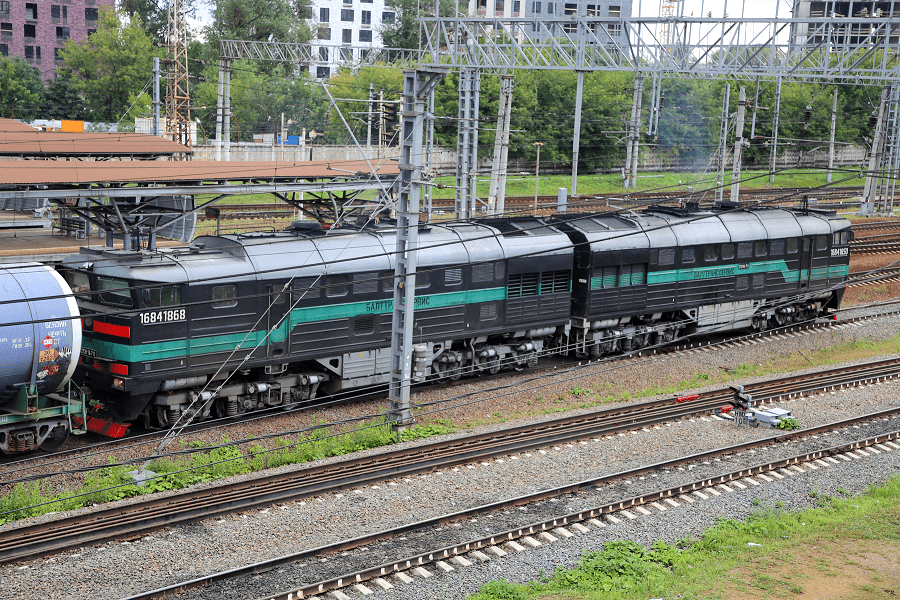
See also Transport blog
See also Cars blog
See also Motorcycles blog
See also Buses blog
See also Shipbuilding blog
See also Motors and Engines blog
See also Trains and railways blog
See also Trucks and Cargo Vehicles blog
See also Tractors and Special Equipment blog
See also Tanks and Armored Vehicles
See also Airplanes blog
See also Helicopters blog
See also Artillery, Missiles and Rockets blog
See also Bicycles blog