Volvo 9700

Volvo 9700 in Digne-les-Bains (Provence-Alpes-Côte d’Azur)
The Volvo 9700 is a family of buses developed by the Swedish manufacturer Volvo. It was introduced in 2001, replacing the Carrus Star and Vector/Regal models.
The family includes three main models, differing in height: 9700S (3.42 m), 9700H (3.61 m) and 9700HD (3.73 m). The 9700S is only available in the Nordic countries. In addition, the lineup includes the more compact 9500 and 9900 models. The length of the buses varies from 9 to 15 meters. Currently, the Volvo 9700 can be found on sale in most countries in Europe and North America.
In 2015, a new model was launched on the Mexican market – the Volvo 9800, which replaced the 9700. In March 2018, a double-decker version – the 9800DD – followed.
I generation (2001–2007)
In the summer of 2001, serial production of the 9700H and 9700HD models based on the Volvo TX platform began, with the 9700S entering production in the autumn. All three models were built at the Carrus Oy Delta plant in Lieto, while the 9700H and 9700S were also built at the Carrus Oy Ajokki plant in Tampere.
In 2003, production also began at the Volvo Polska Sp. z o.o. plant in Wrocław, Poland, where only the 9700H and 9700HD models were built.
For the Nordic markets, the body was mounted on the B12B (rear-engine layout) or B12M (mid-engine layout) chassis. Also, a very small number of the first generation 9700 were built on the B9R chassis.
In 2004, the model underwent minor changes in appearance. In the same year, the Finnish factories were renamed: the Tampere factory became Volvo Bus Finland Oy Tampere Factory, and the Lieto factory was named Volvo Bus Finland Oy Turku Factory.
II generation (2006–2013)
In the autumn of 2006, the Volvo 9700 NG (New/Next Generation) was introduced – a new bus that became the successor to the previous 9700 models. It had a completely updated body, but retained the main features of its predecessors. In 2007, the 9700 NG was awarded the title “Coach of the Year 2008” by European bus journalists.
The popular B12M was no longer available. The B13R could have been a replacement for the 9700H and 9700HD models, but the high B13R did not fit the 9700S model. Until the introduction of the B11R in 2011, the 9700S was only available with 340 HP (B12B) or 380 HP (B9R) engines. Until 2009, 420 HP engines were quite common for both the B12B and B12M.
III generation (2012–2018)
The Volvo 9700 UG (Upgrade) was first introduced in November 2012 in the Nordic markets. By early 2013, production at the Finnish plant had been fully converted to the UG model. For other European markets, the launch of the new generation was postponed until the Euro VI chassis models were available in the autumn.
The new generation received a refreshed body design. Inside the bus, Volvo installed new seats, which were thinner, allowing for a little more legroom.
While the Nordic markets received these seats when they were still Euro V/EEV compliant, they were also available on the B9R and B13R chassis. While the rest of Europe only received them on the B8R and B11R chassis.
IV Generation (2018–)
The fourth generation 9700 was introduced in May 2018. It resembles the Mexican 9800 and is built in the same European factories as its more modern counterpart, the new 9900.
In February 2020, a double-decker version of the fourth generation 9700, the 9700DD, was launched. It is based on the Volvo B11RLE chassis, developed from the B11R. The model was initially offered with a height of 4.25 m, with a lower 4 m version appearing a year later.
Since mid-2022, all versions of the 9700 are built on the upgraded B13R chassis with the D13K engine.
Production of the 9700 single-deck body, previously carried out at Volvo’s now-closed plant in Wrocław, Poland, will be transferred to the Sunsundegui bodyworks facility (Pamplona, Spain) by the end of 2024.
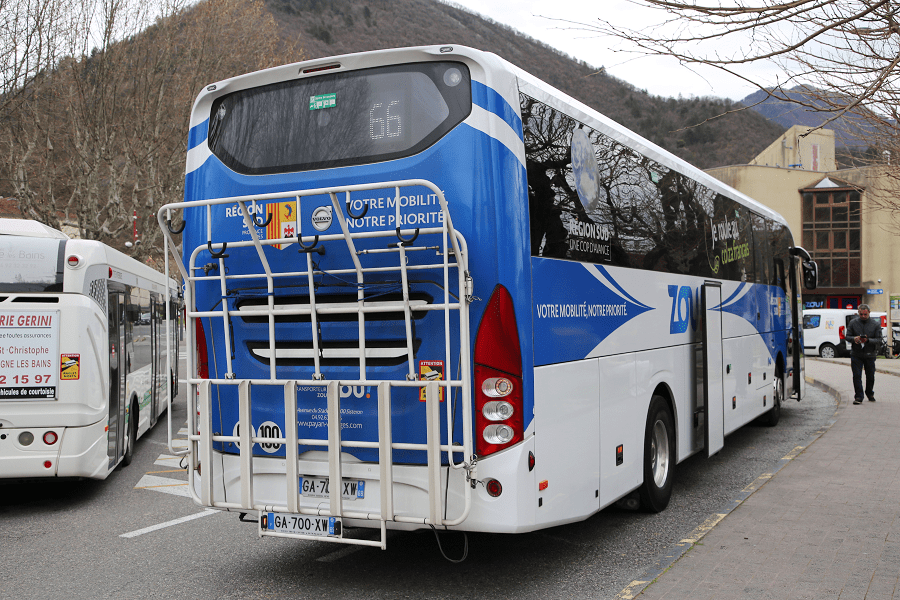
Manufacturer: Volvo Bussar AB (later Volvo Buses)
Assembly: Lieto (Finland) / Tampere (Finland) / Wrocław (Poland) / Tultitlan (Mexico) / Alsasua (Navarre)
Years of production: 2001—
Length: 10300—14955 mm
Width: 2550 mm
Height: 3420—3730 mm
Passenger capacity: 46—65 seats
Engine: 6 cylinders; 12800 cc
Power: 340—500 HP
Max speed: 120 km/h
Fuel consumption: 33 l/100 km
Weight: 8198 kg
See also Transport blog
See also Cars blog
See also Motorcycles blog
See also Buses blog
See also Shipbuilding blog
See also Motors and Engines blog
See also Trains and railways blog
See also Trucks and Cargo Vehicles blog
See also Tractors and Special Equipment blog
See also Tanks and Armored Vehicles
See also Airplanes blog
See also Helicopters blog
See also Artillery, Missiles and Rockets blog
See also Bicycles blog