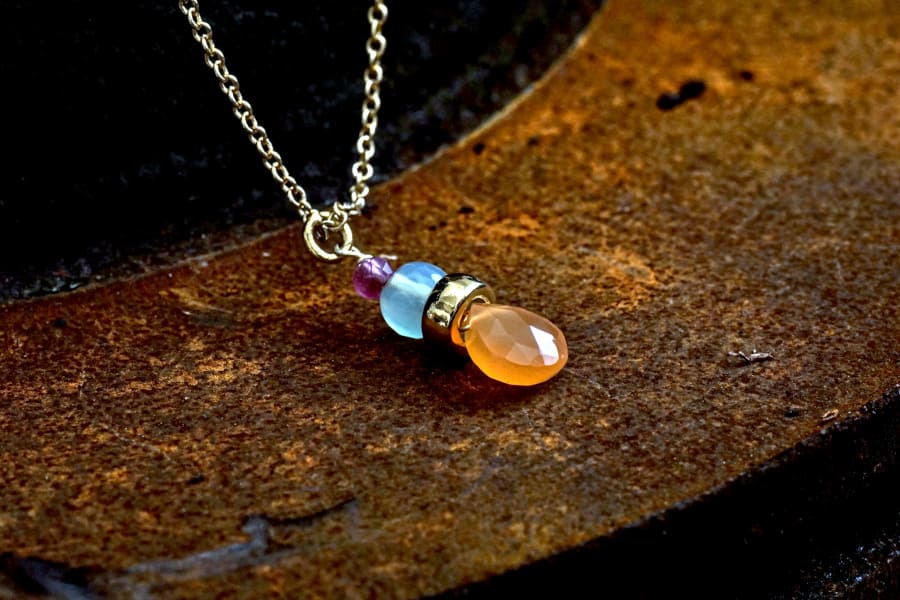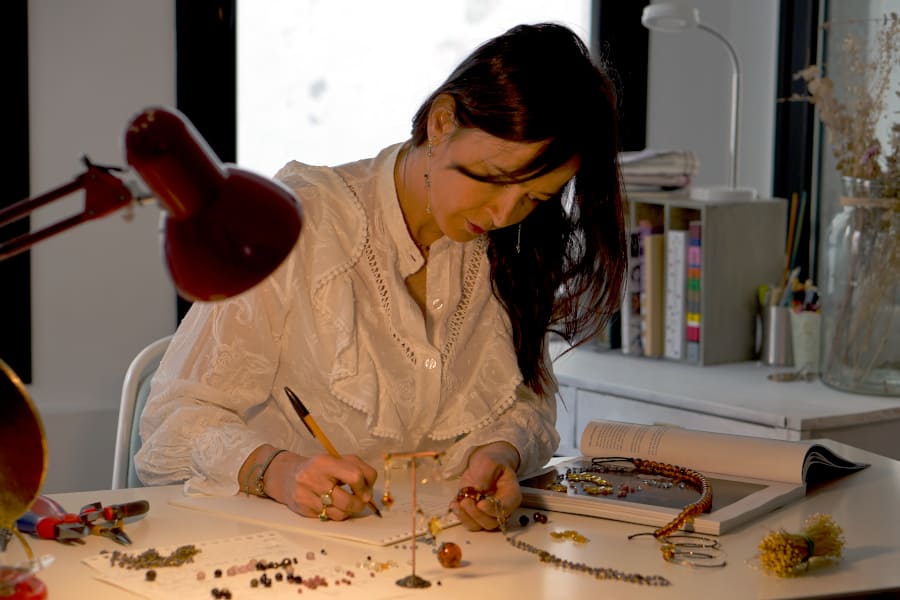
The Carmen Thyssen Andorra Museum and Shiori are presenting a special edition of “L’Art fet Joia,” dedicated to the muses of the Carmen Thyssen-Bornemisza Collection, on the occasion of International Women’s Day.
Jewelry designer Silvia Hernández turns emotions and ways of seeing into pieces that balance strength and sensitivity. The female figures in the artworks became the starting point for her creative process set in dialogue with flamenco artists, painters’ muses, and other characters who have inspired the six editions of “L’Art fet Joia” since this collaboration between the Carmen Thyssen Andorra Museum and Shiori began in 2019. The initiative also pairs these creations with the work of other women artists from Andorra, invited to participate in the presentations, spotlighting women’s talent in the process.
We met with Silvia to talk about this project at the crossroads of painting and jewelry design, as well as the magic and symbolism of stones – and the way jewelry can express, and preserve, each woman’s individuality.
Interview: Irina Rybalchenko
Photo: Sonia Mandicó, IXI Studio

Please tell us your story. How did you end up here?
My story with Andorra begins thanks to my sister. She married an Andorran who had studied in San Sebastián, in the Basque Country, Spain, where we’re from. I came without any plan to settle here, but things changed: I stayed in Andorra… and I’m still here. To tell the truth, I really enjoy living here.
How do you combine your artistic sensibility and your business training in your creative process?
I earned a degree in business administration and management from the University of Deusto, but my family environment has always been closely tied to fashion. My mother was, in her time, an entrepreneur who ran two very well-known companies, both connected to the fashion world. I grew up surrounded by sewing, creativity, and artistic sensitivity. Art has always been part of my world. I started painting as a teenager and took painting classes for many years in a studio in Vitoria.
So my path is a natural fusion of two dimensions: on the one hand, creativity and an entrepreneurial drive; on the other, management education that gave me the tools to run my own project.
How long have you been running your business?
In reality, I had been making jewelry for many years already: for myself, for friends, and for a few jewelry stores… but it wasn’t structured as a business. The turning point came in 2014. That year, I began taking part in international trade shows, especially in Milan and Madrid where I presented my creations. I also launched the online shop and registered the brand name. In other words, 2014 is when the project became more official and gained a clear direction.
What does your brand name mean?
Shiori is a Japanese female given name. It has several meanings, one of them being “life guide.” It’s a very common name in Japan, much like “Carme” in Spain. I loved the sound of it, and SH also matches my initials.
Many pieces of jewelry are passed down from one generation to the next. Unlike painting, jewelry seems to accumulate emotions. Why, in your view, does a piece absorb so much emotional energy?
I’d nuance that slightly, because I think painting is also deeply charged with emotion. Take, for example, Pablo Picasso’s Blue Period: it’s steeped in sadness, melancholy, and a very particular sensitivity. When a painter stands before the canvas, their inner world is reflected, somehow, in the work; and that’s likely why, when we visit a museum, we connect and feel different emotions.
With jewelry, something similar happens: on one side, there’s the feeling of the artist who creates it and the energy of the stones, which, after all, are atoms of one or more chemical elements, concentrated energy. On the other side, there’s the person who wears the piece. Jewelry isn’t only contemplated: you wear it, it accompanies you in everyday life, and it’s in contact with your skin.
In fact, that’s the very essence of “L’Art fet Joia”: creating an emotional and creative coherence between the museum’s artworks and the jewelry. I achieve that through the stones and the designs I create, to reflect – and let us carry with us, the essence of works of art in daily life.
A piece of jewelry is both inheritance and presence. If it’s a family piece, sometimes without much economic value, but with immense sentimental value, something that belonged to a grandmother or a mother, it becomes continuity, a link.
Which stones do you most enjoy working with?
It depends a lot on the season. I like to connect stones to the natural rhythm of the year, as if each period had its own energetic palette.
For me, fall and winter call for deeper, more intense stones: tourmaline, garnet, obsidian… Darker, warmer tones, often associated with the element of fire. In winter we need that energy: a strength that warms, supports, and accompanies a more introspective time.
By contrast, in spring and summer I’m drawn to lighter, more luminous colors: greens, blues, and oranges that I find in aquamarine, amazonite, carnelian, quartz, and moonstone. These are stones that evoke water, vitality, and lightness.
My process is entirely intuitive and, in a way, very close to what we were saying about painting. At the workbench, I feel like I’m painting: I combine colors and forms to create visual and emotional harmony.
Is there a trend in jewelry or in the world of stones that you’d like to highlight?
In jewelry, there’s a huge variety of styles, and I’d say they all have a place. There’s maximalism, minimalism, and often the two blend together. I think that, more than a question of fashion, it’s about identifying with your own style and reflecting your personality.
But, for instance, what will we be wearing this summer?
I think brands are offering a wide range. This summer, based on what we’re seeing in the press and on runways, bold statement pieces and heavily worked metal jewelry are taking up more space. That said, very different styles coexist: spectacular pieces alongside more discreet ones, and everyone chooses according to their own sensibility.
At Shiori, I believe our clients choose the pieces they recognize themselves in, beyond trends. They choose Shiori because they find themselves in it, in the brand’s values as well as in the style and design of each creation.
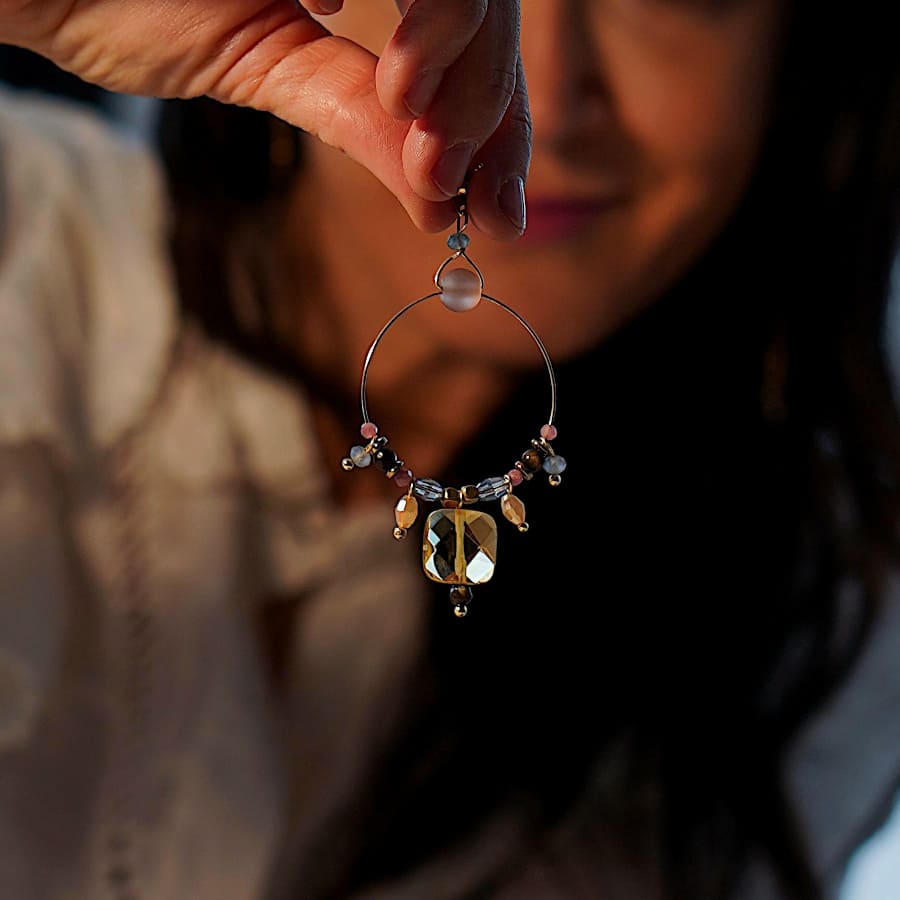
How can a piece of jewelry reflect our personality? Could we say, “Tell me what jewelry you wear and I’ll tell you who you are”?
Yes, in a way. It’s like any accessory: each detail is a brushstroke in your personal style. In jewelry, for example, pearls evoke classicism and elegance. It’s a bit like perfume: depending on the scent, intense or subtle, you reveal a lot about your personality. And it also depends on the occasion. In everyday life, you might wear a discreet, elegant necklace; and for an event, you may want something bolder, more striking, that reveals another side of you.
How has customer behavior changed? Could we say that people buy less often but spend more, or the opposite, buy more frequently but spend less?
I can’t speak for the entire market, but at Shiori we see a bit of both. Some clients make larger purchases once a season or when they have a special occasion. Others prefer to buy smaller pieces, but more frequently.
Has the symbolic or emotional value of stones changed? In the past, for example, ruby was associated with passion, does that still hold, or has it evolved?
I think it remains fairly stable: the origins often lie in myths and traditions that have crossed eras and cultures and endured through history. For example, in ancient Rome, garnet was associated with strength and protection; similarly, centuries later, knights in medieval Europe wore garnets on their sword hilts as a talisman.
In ancient Greece, aquamarines were considered protective stones for sailors and were associated with adventure and new beginnings. During the Renaissance, they often appeared in engagement rings as a symbol of fresh starts.
These beliefs still carry a very present symbolic force today.
And you, do you believe in that?
I mainly rely on historical literature, documented sources, and classical mythology to establish associations between different stones and the concept, or inspiration, I want to express through them.
Can artificial intelligence help you create jewelry, or do you prefer the process to remain 100% human?
I use AI in other areas of my life, but when it comes to creating jewelry, I don’t use it. Behind every Shiori collection there is a very specific inspiration: a character, a film, a place, an era, or a culture.
We’ll soon be launching the “Venice” collection, which I’ve been developing for about two years. It reflects the city’s essence: water, light, the patina of buildings, the legacy of majestic eras, among many other details.
I recently returned to Venice and felt the same emotion as the first time; and in fact it also brought me back to painting: Venice was the main entry port for lapis lazuli into Europe in the Middle Ages and the Renaissance. As the gateway for this stone from Afghanistan, the city saw the birth of the first ultramarine blue pigment, which became one of the signatures of Venetian painting.
Every trip, every experience brings a new detail that defines a collection, and a machine can’t do that, because there’s no feeling, no soul.
Where do you source the stones? Do you buy them first and then create your designs?
Yes, that’s the most common approach. It usually begins with an inspiration or an idea, and with the color palette I want to use. From there, I choose the stones, contact my suppliers, and prepare everything I need.
Sometimes I also come across stones I’m drawn to for one reason or another, and I buy them even if I won’t use them until years later. And then, suddenly, after some time, I feel they’ve finally found their place.