Renault PR 100 / Berliet PR 100
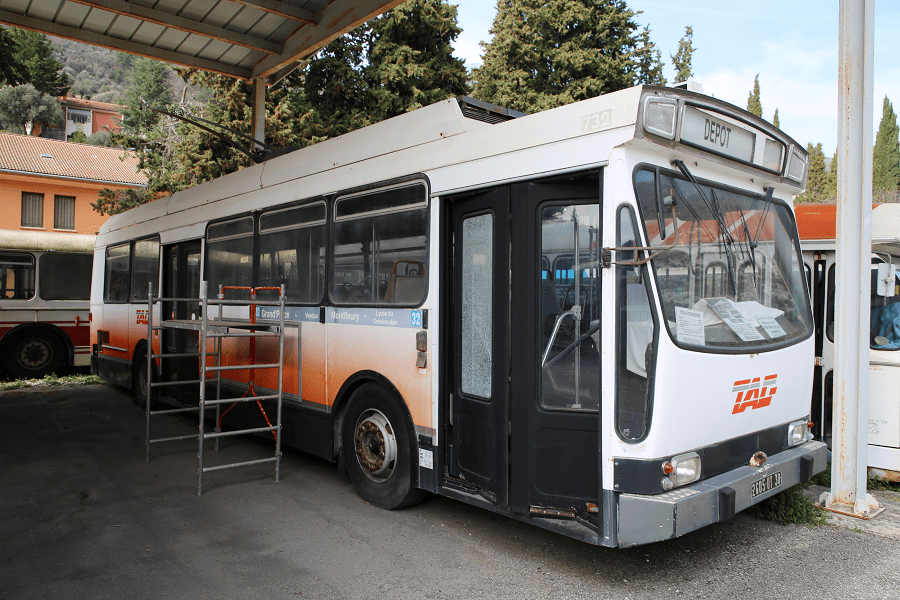
Berliet ER 100 in Éco-Musée de Transport (Breil-sur-Roya, Provence)
The PR 100 is the generic name for a family of buses produced in France by Berliet and later by Renault from 1970 to 1999. Over the years, these buses underwent numerous modifications and improvements.
The PR 100 was the first mass-produced French bus with a rear engine. The naming convention of its models reflected their seating capacity: 100 seats for the standard versions (11 m).
Other manufacturers and coachbuilders, such as Heuliez in France and various international companies, used the PR 100 chassis as a base for developing their own vehicles. In total, 20,600 units were produced.
History
In the late 1960s, front-engined city buses were still dominant on French roads, while buses with mid-mounted engines were less common. During this period, Berliet developed a model for the RATP, known as the Berliet PCM, which complied with the latest specifications. However, despite Berliet’s efforts, the PCM failed to surpass its main competitor, the Saviem SC 10, which was designed according to the same standards.
To compete more effectively, Berliet embarked on the development of a radically new model featuring a rear engine, diverging from the traditional French and German bus designs of the time. The result was the PR 100, with two prototypes completed in 1970.
In 1971, four demonstration vehicles (designated PR 100.P) were built. That May, Berliet officially unveiled the bus at the 20th International Bus Week in Monaco, presenting it under the name PR 100.PA. This model featured a longitudinally mounted rear engine, optimizing balance and interior space.
While Berliet claimed the PR 100 to be France’s first mass-produced rear-engined bus, similar designs had already appeared in the 1950s, such as the Million-Guiet-Tubauto B 9 and the Isobloc 655 DHU. However, these earlier models were only produced in limited numbers.
Description
The PR 100 featured a self-supporting body, constructed entirely from welded tubular frames, a departure from the traditional method of bolting a body onto a chassis, as seen in the PCM. This construction provided greater rigidity and durability.
The bus had a distinctive angular design, setting it apart from other models of the era. The front windshield, with an anti-glare coating, was inclined at an 11-degree angle, improving visibility in low-light conditions. Positioned just 90 centimeters above the ground, the windshield offered the driver an excellent field of view, further enhanced by two side windows, which facilitated parking maneuvers.
Mechanically, the PR 100 was equipped with a Perkins V8.510 engine, an 8-cylinder V-shaped diesel unit developed in England. This engine produced 138 kW (187 hp), but its output was limited to 131 kW (178 hp) to reduce fuel and oil consumption, as well as to minimize noise levels.
The engine was mounted longitudinally in the rear overhang, under the floor, and paired with a Wilson Pont-à-Mousson HVD semi-automatic gearbox, controlled electromechanically. For operators seeking greater driving convenience, a fully automatic transmission was available as an option, featuring either a Voith Diwa or a Pont-à-Mousson 412 C 70 torque converter.
Model range
Diesel
- PR 100 (prototype of standard bus, two units produced in 1970)
- PR 100.P (pre-series demonstration standard bus, four units produced in 1971)
- PR 100.PA (series standard bus, 1173 units produced since 1972)
- PR 100.B (standard PR 100 PA with new Berliet engine, 296 units produced since 1973)
- PR 100.R (standard bus for RATP with a cylindro-cyclic windshield, 10 units produced in 1974)
- PR 100.PRS (standard suburban coach with 45 seats, 17 units produced since 1976)
- PR 100.MI (standard bus with new engines replacing Perkins and Berliet, 2308 units produced since 1977)
- PR 100.2 (standard bus)
- PR 112 (standard bus)
- PR 180 (articulated bus)
- PR 180.R (articulated bus)
- PR 180.2 (articulated bus)
- PR 118 (articulated bus)
Trolleybus
- ER 100.R (standard trolleybus, 299 units produced)
- ER 100.H (standard trolleybus)
- ER 100.2H (standard trolleybus)
- PER 180.H (articulated trolleybus)
- PER 180.2H (articulated trolleybus)

Manufacturer: Automobiles Marius Berliet / Renault Véhicules Industriels
Assembly: Vénissieux (Lyon, France)
Years of production: 1970—1999
Production: 20,600 units
Length: 11230—17625 mm
Width: 2500 mm
Height: 2845 mm
Passenger capacity: 99-153 (29-47 seats)
Powerplant: Perkins V8.510 / Berliet V800 (V8) / Berliet MIP (L6)
Engine (specs): 6-8 cylinders; 6920-9834 cc
Power: 170-256 HP
Max speed: 90 km/h
Fuel consumption: 30 l/100 km
Weight: 9460-14880 kg
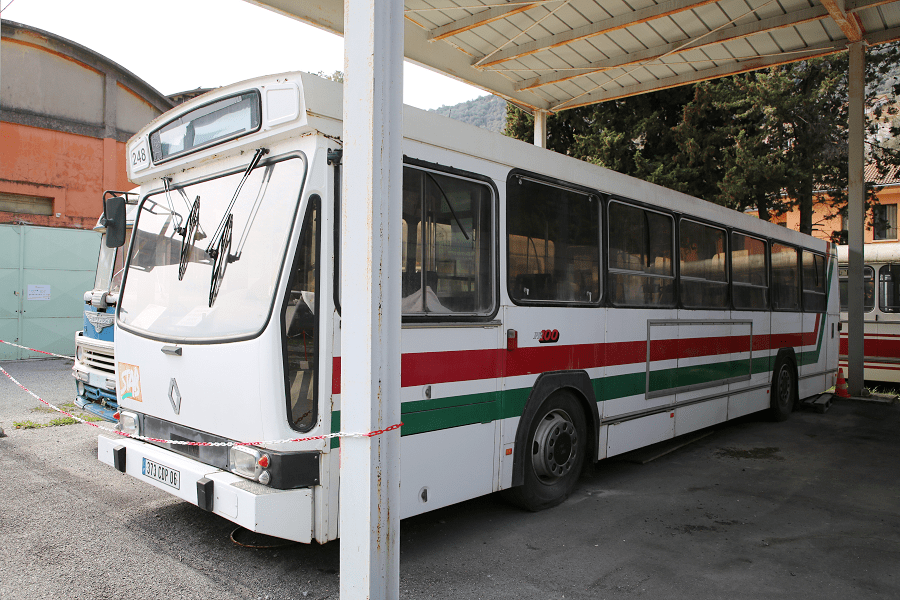
Renault PR 100PA in Éco-Musée de Transport (Breil-sur-Roya, Provence)
See also Transport blog
See also Cars blog
See also Motorcycles blog
See also Buses blog
See also Shipbuilding blog
See also Motors and Engines blog
See also Trains and railways blog
See also Trucks and Cargo Vehicles blog
See also Tractors and Special Equipment blog
See also Tanks and Armored Vehicles
See also Airplanes blog
See also Helicopters blog
See also Artillery, Missiles and Rockets blog
See also Bicycles blog