Р-27
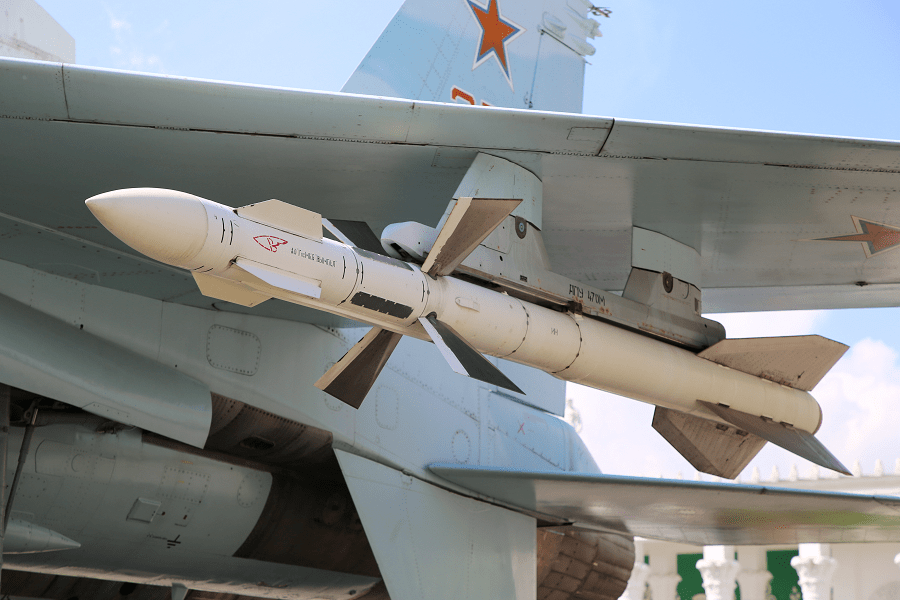
The R-27 (NATO reporting name: AA-10 Alamo) is a Soviet medium-range air-to-air missile. It was developed by the I. I. Toropov Vympel Design Bureau. It is manufactured by the Artem company in Kiev and the Vympel company in Moscow.
The R-27 is designed to intercept aircraft and drones in long-range and short-range air combat, as well as cruise missiles.
History of creation
In accordance with the resolution of the Central Committee of the Communist Party of the Soviet Union and the Council of Ministers of the USSR dated June 26, 1974, experimental design work was started on the creation of fourth-generation fighters, which later became known as the MiG-29 and Su-27.
In the same year, the Vympel design bureau presented technical proposals for the creation of a new K-27 missile (product 470). This missile was intended to arm advanced aircraft.
The development of the K-27 was entrusted to a team led by A. L. Lyapin. The design was carried out under the leadership of P. P. Dementyev and V. T. Korsakov.
Already in 1974, at the stage of the technical proposal, a fundamental decision was made to create a system of unified missiles. The K-27A missile was intended for the light MiG-29 fighter, and the K-27B for the heavy Su-27. It was assumed that the missile variants would differ in propulsion systems and, accordingly, launch range.
Based on established practice, it was decided to create two versions with different propulsion systems for each missile variant: with “radio” and “thermal” homing heads. This is how the concept of a “modular” missile emerged, which could be used with different homing heads and propulsion systems.
The first tests of the K-27, which were conducted in 1979, were carried out using a modified MiG-23ML aircraft. Serial production of the R-27, also known as “product 470”, began in 1984. And in 1987, the missile was accepted into service in the R-27ER and R-27ET versions.
Description
The R-27T, R-27R and R-27P missiles are designed to engage air targets, such as highly maneuverable aircraft and helicopters, at any time of day and in any weather conditions. They can be used against the background of the earth or water surface, as well as in the presence of natural or organized interference.
The R-27 is capable of hitting targets at an altitude of 20 meters to 25 kilometers with a maximum excess (lowering) of 10 kilometers. The target speed can reach 3,500 kilometers per hour, and the overload is 8g. If necessary, two missiles can be launched at two targets simultaneously.
The homing head is ready for use in 1 second after receiving target designation from the weapons control system of the carrier aircraft, for example, the MiG-29. The missile fuses are equipped with radar non-contact and contact target sensors.
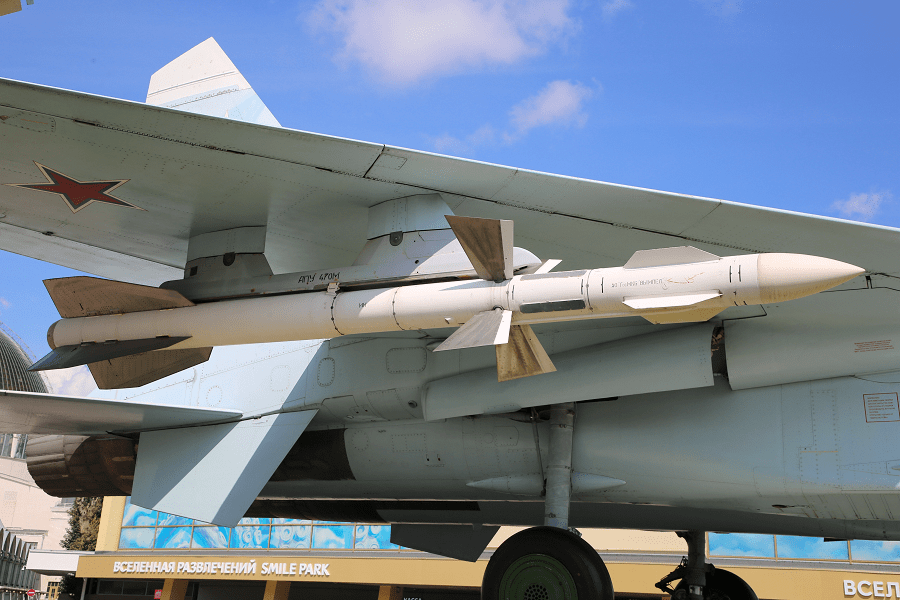
The R-27 missiles are part of the armament of various types of aircraft, including the MiG and Su. To suspend them on the carrier aircraft and provide the necessary power supply, an APU-470 aircraft launcher or an AKU-470 aircraft ejection device is used. These devices also allow for the combat launch and emergency release of missiles.
Modifications
- R-27R is a version with a semi-active 9B1101K radar seeker (target acquisition range with an EPR of 3 m² is 25 km) for engaging air targets, including with enemy jamming. Launch range is 0.5-60 km.
- R-27ER is a version with a semi-active radar seeker of increased range. It is 0.7 m longer and slightly wider. Launch range is 0.5-95 km. In service in the USSR since 1990.
- R-27T is a version with a passive IR seeker. Launch range is 50 km.
- R-27ET — a variant with an IR seeker and an increased launch range. Weight — 343 kg. Launch range 90 km. In service in the USSR since 1990.
- R-27P — a missile with a 9B1032 passive radar homing head, for engaging radio-emitting air targets, ensuring the destruction of aircraft that are actively jamming. Launch range is 72 km.
- R-27EP — a missile with a 9B1032 passive radar homing head and an increased launch range, for engaging radio-emitting air targets, ensuring the destruction of aircraft that are actively jamming. Launch range is 110 km.
Manufacturer: Vympel NPO (USSR)
Assembly: Artem holding company (USSR/Ukraine) / Vympel NPO (USSR/Russia)
Years of production: 1984—
Length: 4080 mm
Diameter: 230 mm
Carrier: MiG-29, Su-27, Su-33, Su-34, Su-35, Yak-141
Max speed: 3500 km/h
Flight range: 110 km
Weight: 253 kg
See also Transport blog
See also Cars blog
See also Motorcycles blog
See also Buses blog
See also Shipbuilding blog
See also Motors and Engines blog
See also Trains and railways blog
See also Trucks and Cargo Vehicles blog
See also Tractors and Special Equipment blog
See also Tanks and Armored Vehicles
See also Airplanes blog
See also Helicopters blog
See also Artillery, Missiles and Rockets blog
See also Bicycles blog