ЭП20 «Олимп»
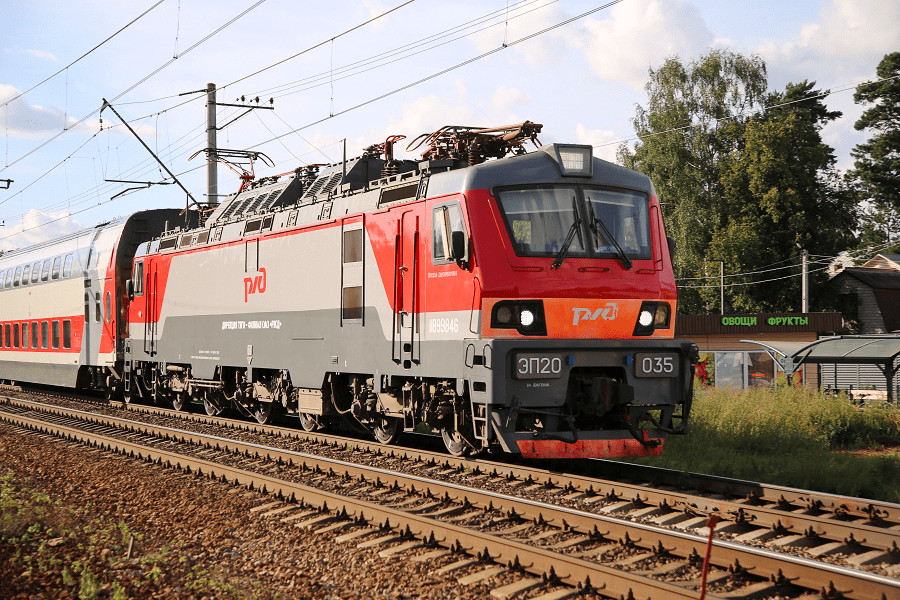
EP20 “Olymp” is a Russian high-speed six-axle electric locomotive that operates on both direct and alternating current. It was developed by Transmashholding using technical solutions from the French company Alstom.
The electric locomotive was created as part of the joint venture “Rail Transport Technologies”. It is conceived as the main project of a large-scale program for the development of new Russian electric locomotives with an asynchronous traction drive.
EP20 is mass-produced at the Novocherkassk Electric Locomotive Plant. By December 2021, 80 electric locomotives had been produced. All of them belong to Russian Railways and are used for passenger trains.
Design
In the 2000s, Russian railways needed electric locomotives that could operate on different current systems. This was necessary in order to increase the speed of passenger trains and reduce their downtime at stations where the current system is changed.
The use of such electric locomotives not only saved time, but also reduced operating costs, since there was no need to change locomotives.
In the late 1990s, the Novocherkassk Electric Locomotive Plant (NEVZ), together with Adtranz, created a six-axle passenger electric locomotive of the EP10 series with an asynchronous drive. This electric locomotive was supposed to meet the needs of Russian Railways for dual-system locomotives and replace the two-section eight-axle ChS7 and ChS8 electric locomotives on routes, as well as the six-axle ChS4T with lower-power commutator motors.
It was planned to establish mass production of these electric locomotives, but due to the low reliability of some components and the obsolescence of technologies, Russian Railways refused to purchase further. As a result, only a limited batch of 12 electric locomotives was produced between 2005 and 2006. For some of them, components had already been manufactured, and refusing to purchase them threatened the manufacturer with a penalty.
Due to the low reliability of the EP10 series electric locomotives, the management of the Russian Railways company decided to create a new dual-system electric locomotive. It received the designation of the EP20 series.
After conducting pre-project studies, the technical design for the EP20 was approved. Like the EP10, the new electric locomotive was to have an asynchronous traction drive and a regenerative braking system to save resources. The technical characteristics were also supposed to be similar, but at the same time, the electric locomotive had to meet higher safety and reliability requirements, as is customary for electric locomotives in Europe. In addition, comfortable conditions for the locomotive crew were to be created in the electric locomotive.
It was planned that the electric locomotive would haul trains traveling in transit during the daytime on the Moscow—St. Petersburg route. Therefore, the requirements for the future electric locomotive included the ability to create its variants for operation at speeds of up to 200 km/h.
Russian Railways commissioned the Russian Transmashholding to develop and create a new electric locomotive by 2008. To do this, Transmashholding entered into a partnership agreement with the French company Alstom Transport, which specializes in the production of high-speed electric locomotives and electric trains.
Alstom Transport was to develop and supply the most complex components of the electric locomotive, taking into account the specific features of the Russian climate. This was necessary because Russian enterprises did not have the necessary equipment and experience for the production of individual parts and complex electrical equipment. In particular, this concerned traction inverters and a control system. The creation of these components required a lot of time, and the purchase of foreign electric locomotives was too expensive.
The project was implemented jointly with the participation of the VElNII. For this purpose, Transmashholding and Alstom created a joint company, Rail Transport Technologies (TRTrans). Its task was to develop a rolling stock that was fundamentally new for Russia.
Fundamentally new parts were developed and manufactured for the new electric locomotive: body, driver’s cab with a safety system, bogies, traction electric motors, control and monitoring system, braking and mechanical equipment.
Alstom modified the traction converter in accordance with the requirements of Russian standards and operating conditions.
The final design of the electric locomotive was completed in 2010. In May of the same year, Russian Railways signed a contract for the supply of 200 electric locomotives of the series for about 1 billion euros.
The production of electric locomotives was established at the main enterprise for the production of electric locomotives in Russia – the Novocherkassk plant.
The electric locomotive can be operated at ambient temperatures from -50 °C to +40 °C.
Production
The assembly of the first EP20-001 series electric locomotive began in the second half of 2010 and was completed in April 2011. These electric locomotives were designed to operate on the Moscow-Adler route without changing the locomotive along the entire route. They were supposed to transport passengers during the 2014 Winter Olympics in Sochi. In honor of the upcoming Olympics, the series was named “Olympus”.
The first electric locomotive was painted in an original orange-blue-light blue color scheme with images of mountains and flames. It had standard gearboxes for driving trains at a maximum speed of 160 km/h. After adjustments at the plant, the locomotive was sent for testing.
At the beginning of 2012, the second electric locomotive was released, designed to travel at a speed of 200 km/h. This allowed parallel testing at different speeds. In September of the same year, certification was completed, and their serial production began.
At the end of the year, a pilot batch of six high-speed electric locomotives was released. Since 2013, production has become more widespread, but in 2014, the volume of production dropped sharply due to the currency crisis in Russia. This led to an increase in the cost of imported components and made electric locomotives too expensive.
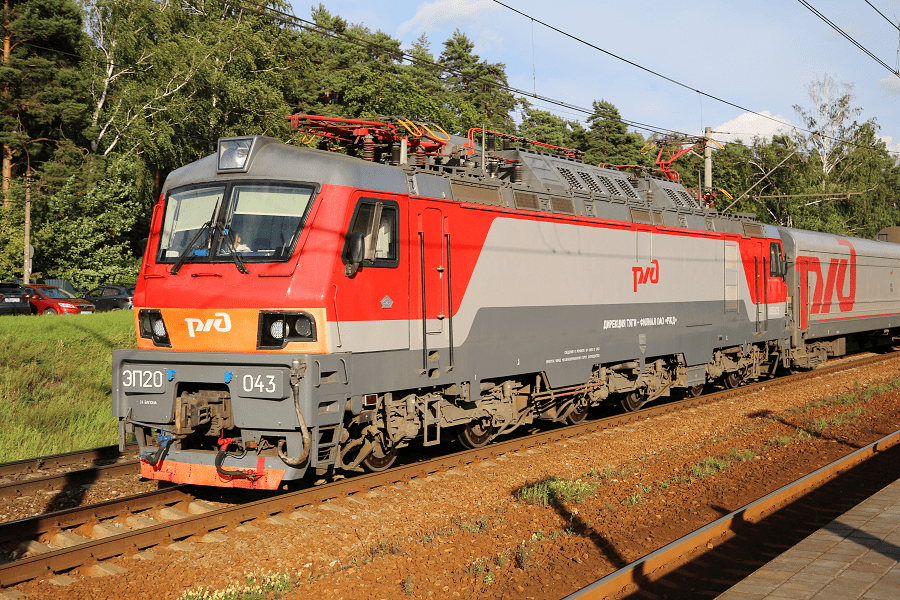
Starting with number 002, all electric locomotives received a three-color corporate paint job of Russian Railways: red, light gray and dark gray. Red was predominant in the cabin area, light gray on the sides, and dark gray at the bottom. At the same time, the front of the electric locomotive was painted orange on top. In 2018, the first electric locomotive was repainted in the same color scheme.
Electric locomotives of the EP20 series were produced in two modifications: regular, with a design speed of 160 km/h, and high-speed, with a design speed of 200 km/h.
Starting with number 053 (electric locomotive built in 2016), all vehicles were equipped with Russian-made cabins. The cabins featured a modified design of buffer lights and windows.
Starting with number 067 (electric locomotive built in 2019), some side panels of the electric locomotives began to have horizontal corrugations.
By the end of 2021, 80 electric locomotives were built. However, after a special military operation in Ukraine in 2022, Alstom and other foreign manufacturers left the Russian market and stopped supplying components for EP20 electric locomotives. As a result, the production of these locomotives was completely stopped.
In the future, Transmashholding plans to develop and begin production of a new EP40 electric locomotive, which will have completely Russian electrical equipment. The EP20 design will be taken as a basis.
Manufacturer: Novocherkassk Electric Locomotive Plant / Transmashholding
Assembly: Novocherkassk (Russia)
Years of production: 2011—2021
Production: 80 units
Length: 22,550 mm
Width: 3100 mm
Height: 5100 mm
Track gauge: 1520 mm
Powerplant: ДТА-1200А
Continuous power: 6000 kW
Traction force: 450 kN
Max speed: 200 km/h
Weight: 80 t
See also Transport blog
See also Cars blog
See also Motorcycles blog
See also Buses blog
See also Shipbuilding blog
See also Motors and Engines blog
See also Trains and railways blog
See also Trucks and Cargo Vehicles blog
See also Tractors and Special Equipment blog
See also Tanks and Armored Vehicles
See also Airplanes blog
See also Helicopters blog
See also Artillery, Missiles and Rockets blog
See also Bicycles blog