
Stadler AM1-AM5
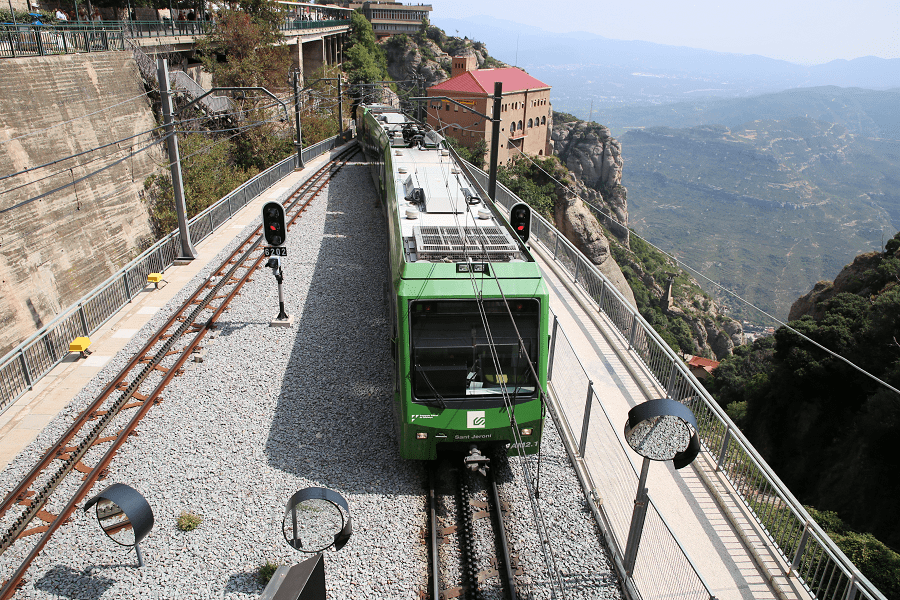
The A GTW articulated rack and pinion series consists of seven units that entered service in 2003. They were originally intended to operate on the Cremallera Montserrat (numbered AM1-AM5) and Núria (numbered A10-A11) lines of Ferrocarrils del Generalitat de Catalunya.
History
Forty-two years after the closure of the first railway line to Montserrat, in 1999 the Generalitat of Catalonia (Spain) decided to rebuild the old Cremallera de Montserrat line, extending it to connect with the Llobregat-Anoia line at Monistrol de Montserrat station. The work was completed in 2001 and the line was inaugurated on 11 June 2003. Ownership and operation of the line was transferred to Ferrocarrils de la Generalitat de Catalunya (FGC).
The new Cremallera de Montserrat line will be fully electrified and will operate independently of the rest of the FGC network. It was estimated that five new articulated trains would need to be purchased to operate it.
Cremallera de Núria also took advantage of this purchase to purchase two identical trains to improve service and replace the aging carriages that had been in use since the line opened. The Catalan government approved the purchase in May 2001.
On 12 September 2000, FGC and Stadler Rail AG signed a contract for the production of seven articulated trains. The total purchase price was 4,300,000,000 pesetas (€25,840,000). The price of each three-car train was 550,000,000 pesetas (€3,310,000), with the rest being reserved for spare parts.
Production was split between two Stadler plants: Bussnang produced the central modules, bogies and trailer boxes, while final assembly took place in Altenrhein. The electrical equipment was supplied by Bombardier.
The first train, which arrived at Martorell station, was officially unveiled on 7 October 2002. On the 22nd of the same month, it made its first test runs.
They began running on 12 June 2003, the day after the official opening of the line.
After the arrival of the two new locomotives on the Nuria line in the summer of 2003, testing and training began. The first trains ran on the route later that year.
A new timetable was introduced on the line on 14 July. This meant that from now on the line would no longer use trains of the 1-51 series.
Thanks to this decision, it was possible to increase the speed of trains (from 13 to 25 km/h on descents).
Operation
The Cremallera de Montserrat carriages have always performed the same functions, running between Monistrol Vila and Montserrat stations every 20 to 30 minutes, depending on the season.
Since the start of operations, the Cremallera de Nuria line has operated with two trains.
The trains are serviced in a workshop at Ribes Vila station.
Technical description
This train differs from the usual trains, which are made up of several motor cars and trailers, each supported by two bogies. Instead, it is an articulated, self-propelled structure.
The idea arose in the 1990s, when European rail companies developed several models of light passenger vehicles for lightly loaded lines to prevent their closure.
Stadler Rail was actively involved in the development of articulated self-propelled trains, introducing the GTW (Gelenktriebwagen) model. This unique train consists of a central motor car with a two-axle bogie, which is short and heavy. All the traction equipment is mounted on this bogie.
These seven trains, operated by Ferrocarrils de la Generalitat de Catalunya, are the first Stadler Rail GTW trains to be equipped with a rack and pinion system. According to the Swiss classification, they belong to the GTW 2/6 type.
The train moves on an Abt rack and pinion system.
The maximum traction power of the engine is 800 kW, and the maximum tractive effort is 110 kN.
Manufacturer: Stadler Rail / Bombardier
Assembly: Bussnang / Altenrhein (Switzerland)
Years of production: 2002—2003
Production: 7 units
Length: 34,452 mm
Width: 2600 mm
Height: 3600 mm
Passenger capacity: 168 (114 seats)
Track gauge: 1000 mm
Chassis: GTW 2/6
Traction: 110 kN
Continuous power: 800 kW
Electrification: 1500 V (DC)
Max speed: 45 km/h
Weight: 45 t
See also Transport blog
See also Cars blog
See also Motorcycles blog
See also Buses blog
See also Shipbuilding blog
See also Motors and Engines blog
See also Trains and railways blog
See also Trucks and Cargo Vehicles blog
See also Tractors and Special Equipment blog
See also Tanks and Armored Vehicles
See also Airplanes blog
See also Helicopters blog
See also Artillery, Missiles and Rockets blog
See also Bicycles blog