Airbus Helicopters H135 / Eurocopter EC135
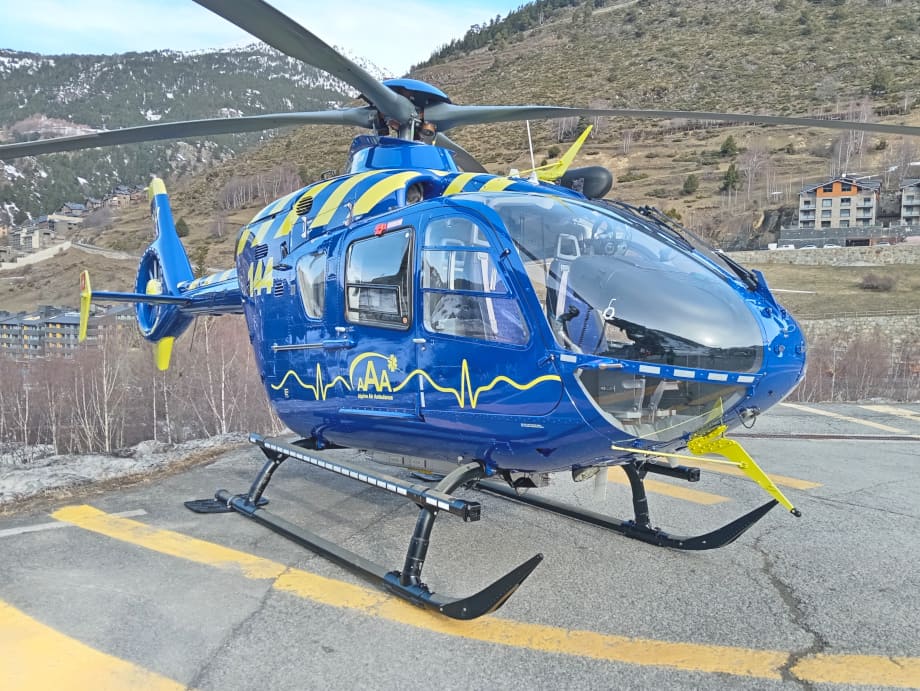
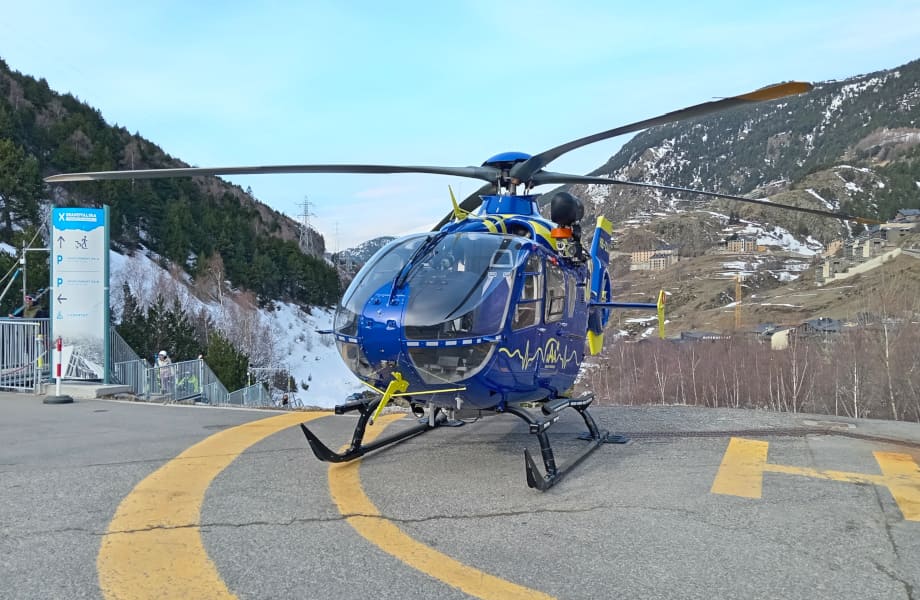
Eurocopter EC135P2+ (HB-ZJJ) in Andorra
The Airbus Helicopters H135 (originally Eurocopter EC135) is a twin-engine light helicopter designed for civil use. It is a development of the earlier MBB Bo 105 and is manufactured by Airbus Helicopters. The helicopter is equipped with a digital flight control system and can fly under IFR. Its maiden flight took place in 1994.
Based on the Messerschmitt-Bölkow-Blohm Bo 108 prototype, the H135 entered service in 1996. By September 2020, more than 1,400 helicopters had been delivered to 300 operators in 60 countries. The total flight time exceeded 5 million hours.
The H135 is actively used in air ambulance services, corporate transport, law enforcement, offshore wind energy support and military pilot training. Half of the helicopters are operated in Europe and a quarter in North America.
The military version of the H135 is the Eurocopter EC635.
Development
Development of the H135 began in the 1970s under the management of MBB as the Bo 108 in partnership with Aérospatiale. The first prototype took to the air in 1988 with Allison engines, the second in 1991 with Turbomeca engines. In the late 1990s, the design was revised, incorporating a Fenestron tail rotor system and composite materials, giving the helicopter a new designation, EC135. In 1994, two pre-production prototypes were built with Turbomeca Arrius and Pratt & Whitney PW206B engines, which proved successful.
The EC135 was first presented in 1995 at the Heli-Expo exhibition. It was distinguished by its low noise level and popularity among a wide range of operators. In 1996, the EC135 received JAA certification, and in 1997, FAA certification.
In 2000, Eurocopter began certification of the EC135P2 with a PW206B2 engine. In September 2002, the EC135T2 with a Turbomeca Arrius 2B2 engine was released.
In 2002, Eurocopter introduced ACT/FHS for testing fibre optic-based control systems. In 2014, testing began on the Bluecopter with improved fuel efficiency, noise reduction and design optimisation.
In March 2007, Eurocopter unveiled the EC135 VIP model from Hermès with a four-seat cabin and luggage compartment. Falcon Aviation Services was the first customer.
In 2011, Eurocopter signed an agreement with Zhong’ou International to manufacture the EC135 in China. In 2015, Airbus and Ecopark signed an agreement to establish an assembly line in Qingdao.
In January 2016, the Ural Works of Civil Aviation signed an agreement to manufacture the H135 in Russia. In 2014, the EC135 T3 was adopted for service with improved characteristics for flying at high altitudes.
In December 2020, EASA certified the H135 with an increased take-off weight of up to 120 kg, which allows for increased range and flight duration.
Design
The H135 is a twin-engine helicopter that can be equipped with Turbomeca Arrius 2B or Pratt & Whitney Canada PW206B engines. Depending on the engine selection, the model name includes the letter T or P. The helicopter’s main rotor is made of composite fibre and has a four-bladed, hingeless design. Since the model’s introduction, its performance has been improved and maintenance costs have been reduced.
The EC135 is the quietest helicopter in its class thanks to an anti-resonance isolation system that dampens vibrations from the main rotor. The Fenestron torque suppression device can be adjusted in HI NR mode, which improves controllability during take-off and landing with heavy loads. The helicopter is capable of performing Category A operations in any flight performance range.
The EC135 cockpit can be standard or Avionique Novelle glass, which allows the helicopter to be flown without a co-pilot. The glass cockpit has several liquid crystal displays, including two Sextant SMD45s and a central display.
The newer H135 model is equipped with a four-axis Helionix autopilot, which unifies it with other Airbus Helicopters such as the H145, H160 and H175.
The cabin can be equipped with medical devices, including intensive care stations with resuscitation functions. The floor is covered with hygienic materials. In the configuration for mountain rescue operations, the cabin can accommodate two stretchers, a pilot, an anaesthetist, a winch operator, a mechanic and an additional specialist.
Variants
- EC135 P1 (powered by 2× Pratt & Whitney Canada PW206B)
- EC135 T1 (powered by 2× Turbomeca Arrius 2B1/2B1A/2B1A1)
- EC135 P2 (powered by 2× Pratt & Whitney Canada PW206B2)
- EC135 T2 (powered by 2× Turbomeca Arrius 2B2)
- EC135 P2+ / EC135 P2i (latest current production version with 2× PW206B2)
- EC135 T2+ / EC135 T2i (latest current production version with 2× Arrius 2B2)
- EC135 P2+ / EC135 P2e (increased maximum take-off weight)
- EC135 T2+ / EC135 T2e (increased maximum take-off weight)
- EC135 P3 (powered by 2× PW206B3)
- H135 / EC135 T3 (powered by 2× Arrius 2B2Plus)
- EC635 / H135M (military variant to Portuguese, Jordan, Swiss and Iraqi armed forces)
- TH-135 (military training variant)
- ACH135 (corporate variant)
- VH-35 (Brazilian Air Force designation for a VIP transport variant)
- H.13 (Royal Thai Armed Forces designation)

Manufacturer: Airbus Helicopters SAS (formerly Eurocopter S.A.)
Country of origin: multinational
First flight: 15 February 1994
Years of production: 1995—
Production: +1,400 units
Length: 10.2 m (33 ft 6 in)
Height: 3.51 m (11 ft 6 in)
Crew: 1 pilot + 6 passengers / 2 pilots + 2 patients (ambulance version)
Powerplant: 2× Turbomeca Arrius 2B2 (2× 633 HP)
Never exceed speed: 287 km/h (178 mph, 155 kn)
Range: 635 km (395 mi, 343 nmi)
Ceiling: 6,096 m (20,000 ft)
Weight: 3,208 lb (1,455 kg)
See also Transport blog
See also Cars blog
See also Motorcycles blog
See also Buses blog
See also Shipbuilding blog
See also Motors and Engines blog
See also Trains and railways blog
See also Trucks and Cargo Vehicles blog
See also Tractors and Special Equipment blog
See also Tanks and Armored Vehicles
See also Airplanes blog
See also Helicopters blog
See also Artillery, Missiles and Rockets blog
See also Bicycles blog