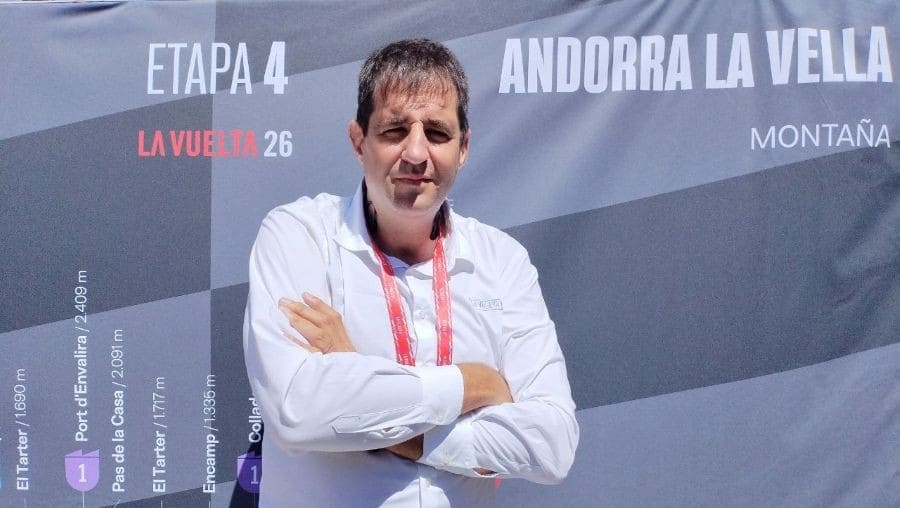


Bernat Vilanova Caminal is a helicopter mechanic at the Andorra–La Seu d’Urgell Airport and a long-time amateur cyclist. He’s been practicing the sport for many years purely for the joy of it. In this article, Bernat shares his views on the benefits of cycling, the importance of safety, and the need for mutual respect between cyclists and drivers.
I love cycling because it lets me enjoy the natural surroundings while staying in shape. It helps me break out of my daily routine, spend time with friends, and talk about everything – from personal issues to work, politics, or global events. For me, cycling is both physical and mental wellbeing, as well as a sense of social connection – all against the backdrop of beautiful landscapes.
Cycling has introduced me to incredible people and unforgettable experiences. I particularly enjoy routes that take me far from big cities. In the summer, for instance, I ride through ski resorts, where the fresh mountain air, waterfalls, and roaming wildlife create a deep sense of harmony with nature.
If you asked me where I’d love to go exclusively by bike, I’d say: someday I’d like to cross the Pyrenees or explore one of the scenic routes in the Alps.
I believe cycling infrastructure in Spain, France, and Andorra is generally excellent. Nowadays, there are barely any places left that a road doesn’t reach. Andorra, in particular, has made great progress. The road surfaces are often in top condition, and many routes feature kilometer markers that include gradient, altitude, and elevation data – a detail that attracts international tourists.
In neighboring countries, like France and certain parts of Alt Urgell, there are long stretches of road where you might not see a single person for hours – unlike Andorra, where you often pass through villages.
On the topic of road respect, Andorra stands out positively. Drivers here are generally very aware and respectful. Unfortunately, the same can’t always be said for Catalonia, especially on roads popular with French tourists. It’s not uncommon for a motorhome to speed past you, missing your handlebars by just a few centimeters.
It’s important to note key differences in traffic laws. In France, cyclists are not allowed to ride side-by-side — in single line. In Spain and Andorra, however, riding two abreast is permitted. This legal nuance often leads to misunderstandings and, at times, a lack of respect on the roads.
To make cycling safer and more appealing, we need more bike routes fully separated from motor traffic. Wide, rideable shoulders are crucial. I’d also love to see short sections of secondary roads closed to car traffic on weekend mornings, for example. It would allow children to ride safely or give people who are anxious about traffic a chance to cycle with confidence
If I could speak to every driver, my message would be simple: “Be empathetic – there’s enough space for everyone on the road”. Drivers often feel stressed when they see a cyclist, but the cyclist isn’t trying to get in the way.
I see cycling as a real solution for regional mobility. We’ve become used to doing everything by car or motorbike. Yes, the Pyrenean climate and elevation changes aren’t always ideal for year-round cycling commutes, but that’s not an excuse. With better culture and infrastructure, things can change. In Switzerland, for instance, most locals and tourists cycle to the train station – where they find large, secure bike parking.
Unfortunately, safety is still an issue. Bike theft is common in Spain – even in La Seu d’Urgell and the surrounding areas. My hometown could be ideal for daily cycling, but sadly, you can’t just leave your bike outside while you quickly run into a shop.
So, even small changes can inspire millions to switch to more sustainable ways of getting around.