At the beginning of October, Galerie Untitled (Andorra) inaugurated a new exhibition featuring Spanish artist Paula Valdeón Lemus. We spoke with Paula about the challenges young artists face in establishing themselves in the contemporary art world, the state of art education in Spain, and the creative universe and vision that shape her work.
Interview : Irina Rybalchenko
Where did you study, and how would you assess contemporary art education in Spain? Does it offer young artists the freedom to express themselves, or does it impose limitations on them?
I studied Fine Arts at the University of Salamanca, and later completed a research master’s degree at the Complutense University of Madrid — one of Spain’s oldest and largest universities. Officially called the Universidad Complutense de Madrid, it has a long history dating back to the 13th century, although it was established in Madrid in the 19th century.
I can only speak from my own personal experience, which dates back about fourteen years. To be honest, at that time there were many limitations — strong divisions between disciplines, to the point that they almost seemed to compete with one another. I hope, and I believe, that things have changed since then, although much depends on each faculty.
When it comes to master’s programmes, professors often try to draw you into their own area of interest, and I don’t think that’s necessarily a good thing. In my view, it’s essential for teachers to have a real understanding of the contemporary art world and to expose students to its realities. Otherwise, unless you have a strong personal drive, you might finish your studies without really knowing how the environment you want to enter actually works. But again, I’m speaking purely from my own experience.
Is it easy for young artists today to make a name for themselves in Spain? What challenges have you faced along the way?
The truth is, it all depends on where you come from. If you’re from a small village, from a modest family, and don’t have many resources, things are much more complicated than if you have support. You have to work twice as hard — that’s crystal clear. It can be a very class-conscious environment at times. But if you’re truly sincere in your work and genuinely want to give shape to your ideas, you can find your way.
I’ve had to work in a thousand different jobs, and it wasn’t easy — I didn’t have much time to read or to produce what I really wanted, since I started working at sixteen. That makes the path much harder.
Despite everything, I’m not sure where this ambition I’ve always had comes from, but I’ve faced both economic and personal difficulties without ever letting the world around me bring me down.
These challenges, even if they are less present today, will always exist. It’s a profession where, when you start from the bottom, you have to step into the arena. The ups and downs, the uncertainty, and the instability are all part of the journey. Yet for me, it’s deeply rewarding — when I work, I’m happy. And when you achieve something, you feel such an intense rush of adrenaline; nothing else has ever given me that feeling.
Have you ever had a solo exhibition?
Yes, my first solo show was in Madrid in 2021, with the Rio & Meñana gallery (formerly WeCollect), which really helped me make a name for myself. Since then, I’ve presented solo exhibitions at the galleries that currently represent me — Artizar in Tenerife and Tönnheim Gallery in Madrid.
Tell us about your exhibition in Andorra: how did the idea come about and what did you want to convey to the public?
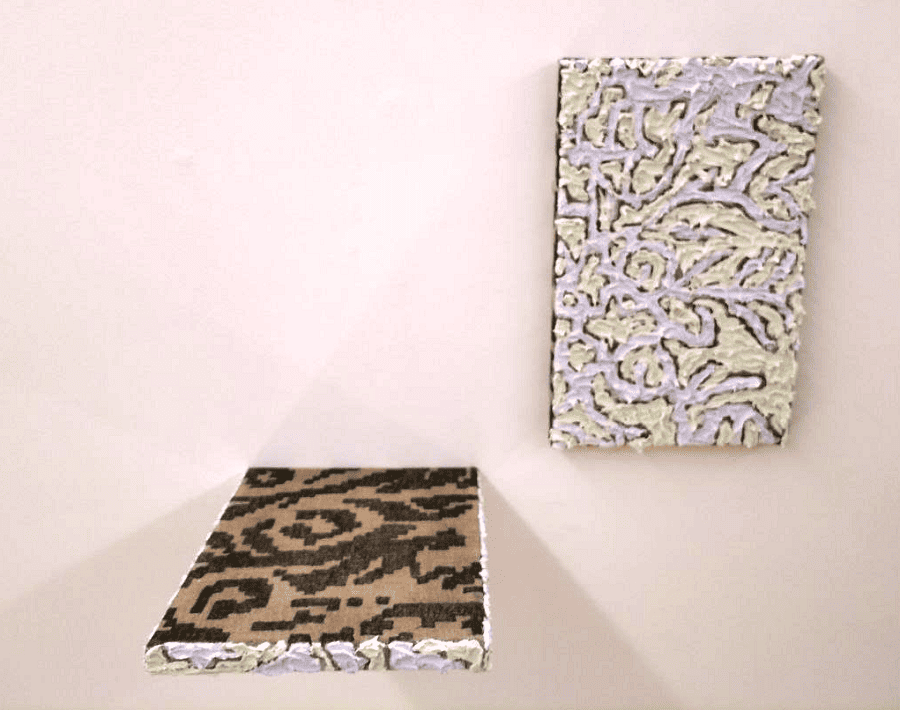
It all began when I met Marta Llompart, the gallery owner at Untitled Contemporani. She discovered my work and invited me to create something specifically for her gallery. The exhibition I developed for this space, Detrás de / unas flores (Behind / some flowers), serves as a bridge between two solo shows I had previously presented.
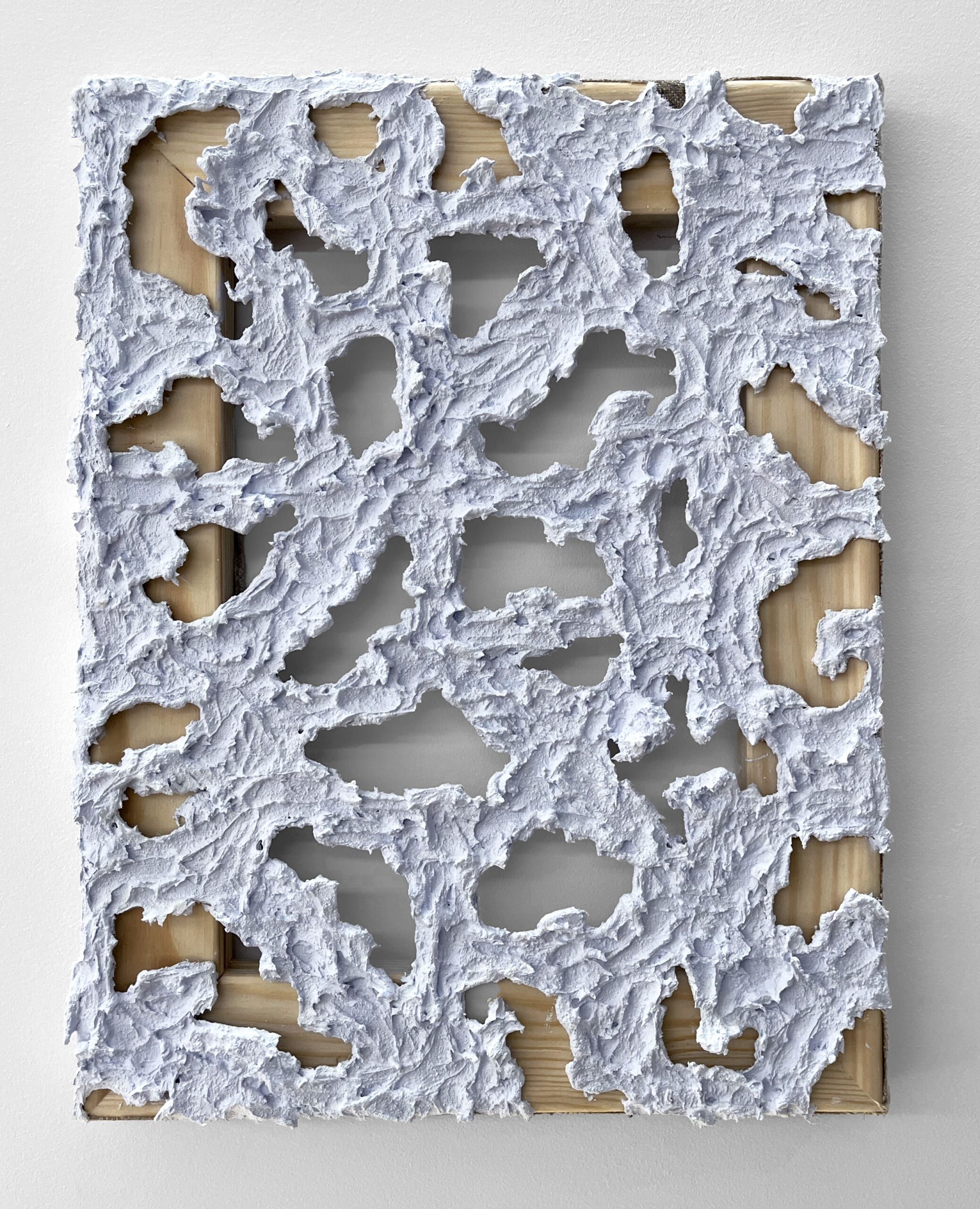
In this exhibition, I explore the fiction of nature within an ornamental and decorative world that envelops architectural structures. As I worked on the pieces, the process gradually became a formal exercise — one that sought to transform ornamentation into the organic element from which it originally emerges, and to conceive of the works as bark or shells that cover architectural bodies.
I want the public to perceive decoration as something far more complex than a simple surface — as an element shaped and used by humans to make spaces more habitable. Behind it lies a structure, sometimes uncomfortable, yet essential for what exists on the outside to take form.
You combine traditional and digital techniques. Could you explain how that works?
I specialised in painting and worked as a restorer, which gave me a real passion for canvas, linen, oil, and traditional techniques — things I cannot, and do not want to, do without. In fact, I consider them essential.
When I come across patterns that inspire me during my urban walks, I like to transpose them into digital software such as Photoshop, translating them through a grid so that the design becomes synthesised and can be reproduced by repeating the pattern. In this process, pixels and grids become the building blocks of all constructions — whether in iron mesh, tiles, or the images we exchange every day.
I see all this material as a repetition of forms and motifs, which I then use to create new ones.
Flowers often appear in your work. What do they symbolise for you?
In this case, after collecting various decorative elements, most of them evoke plant motifs. The works are based on one or two tile designs that represent a flower — a heart and an outline — which can be endlessly repeated to create a continuous pattern.
For me, the flower functions as a module that generates images — images we bring into our homes or place on building façades to make our living spaces or passageways more pleasant. It’s a paradox, because we destroy real nature around us in order to reintroduce it artificially. In my work, the flower thus becomes a paradoxical symbol.
Can your art be seen as an invitation to observe urban spaces and everyday details that are often overlooked, with a fresh perspective?
I would like to think so. I’d like us to look at the city and its architecture — both inside and out — with greater attention, to understand their forms, to turn a simple walk into an aesthetic experience, and to become aware of what they silently hold within.
How do you see your artistic practice evolving in the coming years? Are there any new materials or themes you would like to explore?
I work very intuitively, and change tends to emerge naturally through the process itself. That said, I have many ideas and projects I’d like to realise — if time and resources allow. Sometimes I feel overwhelmed, because I have so many ideas that I fear I won’t be able to bring them all to life.
More specifically, I’ve started to explore the idea of decorative “bark” applied to the human body — the way we cover our own bodies, objects, and surfaces in our daily lives for the sake of appearance.
Alongside this, I’m delving into new materials such as metal and textiles, as well as large-scale works intended for institutional projects and public spaces.
If you had to explain the central meaning of your work to someone who had never seen it, what would you say?
That’s a very difficult question — sometimes even I don’t fully understand it myself. But at this moment, I would say that my pieces speak about the tension between surface and interior, between fragility and resistance — that which endures. And about how the memory of the material that connects them is continually transformed.