Bell 429 GlobalRanger

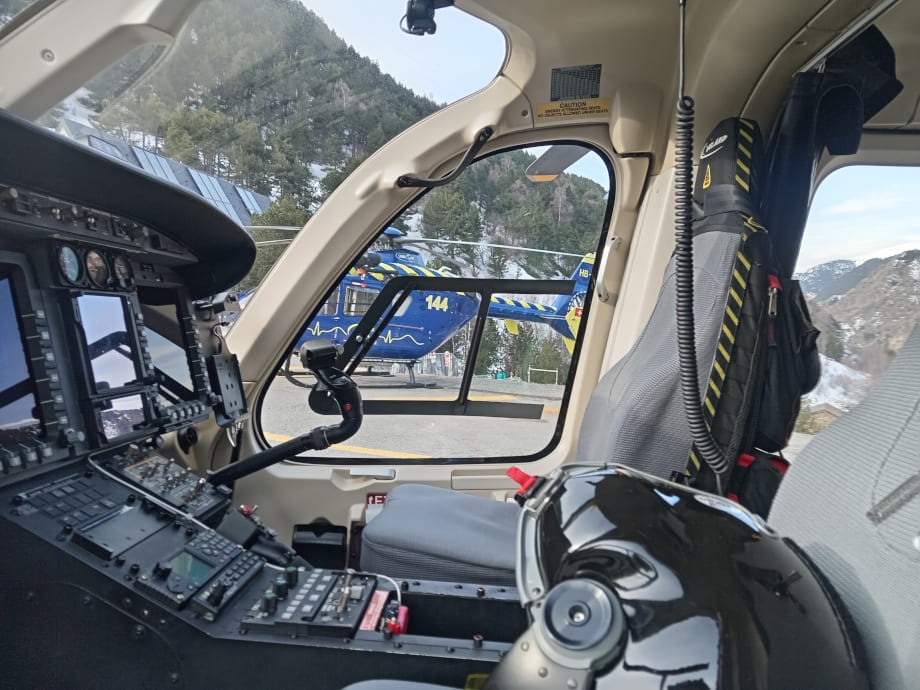
Bell 429 GlobalRanger HB-ZOP operated by Heliand (Andorra)
The Bell 429 GlobalRanger is a light twin-engine helicopter developed by Bell Helicopter and Korea Aerospace Industries. The first prototype flew on February 27, 2007, and the authorities certified it on July 1, 2009. This helicopter can perform instrument flight rules (IFR) and operate from Category A runways.
The helicopter is also used for military purposes by countries like Argentina, Australia, Canada, United States, etc.

Development
The company initiated development of the Bell 429 to meet the demand for a new medical helicopter for emergency services. Initially, engineers planned to use the Bell 427 for this purpose, but its cabin proved too small to accommodate a stretcher with a patient, and its equipment failed to meet instrument flight requirements. At first, the team considered the Bell 429 as a stretched version of the Bell 427 (designated the Bell 427s3i), but even this variant failed to satisfy all customer requirements.
Asian companies Korea Aerospace Industries and Mitsui Bussan Aerospace also participated in the helicopter’s development.
By February 2006, Bell had tested all key components of the new MAPL system on a Bell 427 helicopter. The Bell 429 made its maiden flight on February 27, 2007. The company initially planned to complete certification by the end of 2007. However, parts and material shortages — a common challenge for aircraft manufacturers at the time — forced Bell to reschedule the deadline. By October 2007, engineers had finalized the helicopter’s external configuration. In February 2008, three Bell 429 helicopters completed flight testing and accumulated a total of 600 flight hours.
Transport Canada granted the Type Certificate (TCCA) on July 1, 2009, and the Federal Aviation Administration (FAA) granted its Type Certificate on July 7, 2009. The European Aviation Safety Agency (EASA) issued its certificate on September 24, 2009.
The Bell 429’s first customer was Air Methods Corporation, one of the largest air medical operators in the United States.
Design
The Bell 429 features a four-bladed main rotor with flexible hubs. The blades use composite materials and incorporate swept tips, which reduce noise. The tail rotor uses two two-bladed rotors arranged at irregular intervals in an X pattern, which further reduces noise.
The helicopter’s cabin offers a volume of 204 cubic feet (≈5.8 cubic meters), including 130 cubic feet for passengers and 74 cubic feet for baggage. The flat cabin floor simplifies patient loading. Operators can install rear hinged doors under the tail boom as an option to facilitate access during emergency medical operations.
The helicopter features a glass cockpit with a three-axis autopilot and flight director as standard equipment. It uses skid landing gear as standard, while retractable landing gear remains optional and increases cruising speed by five knots.
The helicopter holds Category A certification for IFR and can operate with one engine inoperative. The transmission has a 5,000-hour time between overhauls, and the tail rotor gearbox has a 3,200-hour time between overhauls.

Manufacturer: Bell Helicopter / Korea Aerospace Industries, Ltd.
Country of origin: United States / Canada / South Korea
First flight: February 27, 2007
Years of production: 2007—
Production: 500 units
Length: 41 ft 8 in (12.70 m)
Height: 13 ft 3 in (4.04 m)
Crew: 1 pilot + 6 passengers
Powerplant: 2× Pratt & Whitney Canada PW207D1
Maximum speed: 155 kn (178 mph, 287 km/h)
Range: 390 nmi (450 mi, 720 km)
Ceiling: 20,000 ft (6,100 m)
Weight: 4,245 lb (1,925 kg)

See also Transport blog
See also Cars blog
See also Motorcycles blog
See also Buses blog
See also Shipbuilding blog
See also Motors and Engines blog
See also Trains and railways blog
See also Trucks and Cargo Vehicles blog
See also Tractors and Special Equipment blog
See also Tanks and Armored Vehicles
See also Airplanes blog
See also Helicopters blog
See also Artillery, Missiles and Rockets blog
See also Bicycles blog