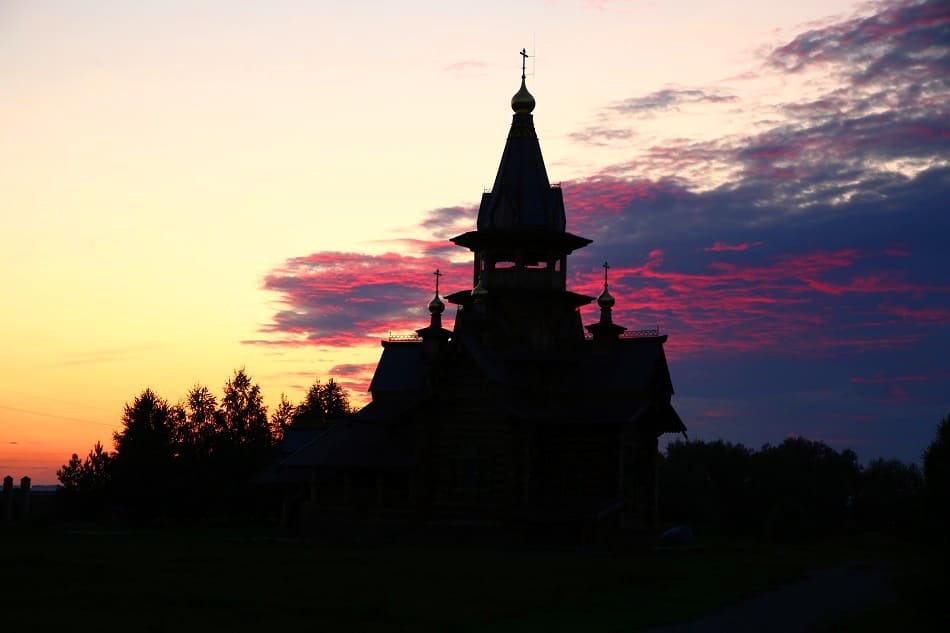
Novgorod (en russe : Новгород, « ville neuve »), officiellement Veliki Novgorod (en russe : Великий Новгород), est une ville russe du district fédéral du Nord-Ouest. Centre administratif de l’oblast de Novgorod, et du raïon de Novgorod, dont elle ne fait cependant pas partie, elle a le statut de ville d’importance régionale de l’oblast et forme un okroug urbain. Sa population s’élevait en 2023 à 223 191 personnes, et ses habitants sont appelés les Novgorodiens.

Histoire
Veliki Novgorod est l’une des plus anciennes villes de Russie selon l’une des versions de la Première chronique de Novgorod, où se serait passé l’appel des Varègues, évènement traditionnellement associé à la naissance de l’État russe, et la première capitale d’un État russe. Au Moyen Âge, elle est le deuxième centre le plus important de la Rus’ de Kiev après Kiev. Entre le XIIème et le XVème siècle, c’était la capitale de la république de Novgorod, et ce jusqu’à son annexion à la grande-principauté de Moscou en 1478. Elle est ensuite le centre du pays de Novgorod au sein du tsarat de Russie.

La date officielle de la fondation de Novgorod est considérée 859, selon la première mention de la ville dans la fin de la Chronique de Nikon du XVème siècle. Dans la Chronique des temps passés, écrite au XIIème siècle, la ville est mentionnée pour la première fois sous l’an 862. Néanmoins, les premières couches archéologiques datées de manière fiable de Novgorod ne remontent pas au-delà des années 930. Dans le deuxième quart du Xème siècle, le premier pont sur le fleuve Volkhov y fut construit.

En 1136, Novgorod devient la première république libre sur le territoire de la Rus’ de Kiev. Dès lors, les pouvoirs du prince de Novgorod sont fortement limités par les boyards et l’assemblée populaire de la vétché. La ville conquiert alors de grandes terres dans le Nord russe. Entre les XIIème et XVème siècles, Novgorod fait partie de la ligue hanséatique, et s’enrichit fortement du commerce. Novgorod n’a pas été soumise à l’invasion mongole, bien qu’elle ait rendu hommage à la Horde. Elle a ainsi conservé des monuments uniques de l’architecture russe ancienne de la période pré-mongole, le plus célèbre étant la cathédrale Sainte-Sophie. Elle fut la seule ville de la Rus’ à avoir échappé au déclin et à la fragmentation au XIème et XIIème siècles.

En 1478, elle est annexée par Ivan III, et en 1569 et 1570, elle subit le massacre par les opritchnisk du tsar Ivan IV, perdant alors son statut d’une des principales villes de Russie. Entre 1611 et 1617, la ville est sous domination suédoise. Avec la fondation de Saint-Pétersbourg en 1703, la ville perd de son importante économique, et reste à l’écart des principales routes commerciales. À partir de 1727, elle devient le centre du gouvernement de Novgorod, et est intégrée en 1927 à l’oblast de Léningrad. Pendant la Seconde Guerre mondiale, elle est occupée par les Allemands et est presque entièrement détruite. Après la libération, elle redevient un centre régional avec la formation de l’oblast de Novgorod, tandis qu’elle est reconstruite et restaurée par le pays. En 1992, l’UNESCO a classé le site au rang de patrimoine mondial.

Géographie
Novgorod est située dans l’oblast de Novgorod, un sujet du nord-ouest de la partie européenne de la Russie. La ville fait partie du district fédéral du Nord-Ouest, se situant à 180 km au sud-est de Saint-Pétersbourg, la capitale du district. La capitale Moscou est à 552 km au sud-est. Le fuseau horaire est l’heure de Moscou (MSK, UTC+03:00).
La ville proprement dite, forme une subdivision de l’oblast sous le nom d’okroug urbain de Veliki Novgorod (un okroug urbain). Dans ses limites actuelles, la ville couvre une superficie de 93,7 km².

Hydrographie
Veliki Novgorod est traversée par la rivière Volkhov et est bordée par le lac Ilmen. Alors que la rive droite est plate et surtout très marécageuse, sa rive gauche est surélevée, où se trouve la majeure partie de la ville. La rive gauche s’appelle la rive de Sainte-Sophie tandis que la rive droite est la rive du Commerce.
La situation géographique est favorable au transport, car les rivières et ruisseaux Lovat, Chelon, Msta, qui se jettent dans le lac, ainsi que la Volkhov, ouvrent des voies de transport idéales. Le fleuve Volkhov se jette dans le lac Ladoga, d’où l’on peut rejoindre la mer Baltique en passant par Saint-Pétersbourg. Il existe une connexion avec le bassin de la Volga et la mer Noire via les rivières du sud de l’oblast Novgorod.

Géologie
La ville se situe dans la plaine d’Europe orientale (dite « plaine russe ») et dans la partie la plus orientale des croupes lacustres de la Baltique. Géologiquement, la ville se trouve sur la plate-forme russe, qui se compose principalement de sédiments datant du Protérozoïque inférieur au Cénozoïque, qui couvraient de vastes zones du proto-continent Fenno-sarmatia. Contrairement aux montagnes environnantes, la plate-forme russe est pauvre en ressources minérales malgré sa taille.


Architecture and main attractions
The architecture of Veliky Novgorod can be divided into several periods of development:
• The architecture of ancient Novgorod (this includes the period from the emergence of the city in the 9th century to the annexation of the Novgorod Republic to the Russian state).
• The architecture of Novgorod is part of the Russian state and the Russian Empire (the period from the middle of the 15th century to 1917).

The most important building of ancient Novgorod before the emergence of the veche republic was the St. Sophia Cathedral, built in 1045-1050. Together with the citadel, it formed the monumental center of the city, uniting separate settlements (ends) around itself. Opposite the citadel, on the Yaroslav’s Court, in 1113, the Nikolo-Dvorishchensky Cathedral was founded – the compositional center of the Trade Side, which after 1136 became the main veche temple of Novgorod. In addition, in 1119, the Cathedral of St. George was built, and in 1117-1119 – the Cathedral of the Nativity of the Virgin was in the St. Anthony Monastery.

The Novgorod Detinets, also known as the Novgorod Kremlin, is a fortified complex. It stands on the left bank of the Volkhov River about two miles north of where it empties of Lake Ilmen. Novgorod Detinets, as part of the historical center of Veliky Novgorod, is included in the UNESCO World Heritage List.

The compound was originally the site of a pagan burial ground upon which the first bishop of Novgorod, Ioakim Korsunianin, built the Cathedral of Holy Wisdom upon his arrival in the area around 989. Thus, the compound was and remained largely an ecclesiastical site. However, many Novgorodian boyars built their houses in the southern part of the Detinets.

The first reference of the fortification on the site dates to 1044, with additional construction in 1116. These were probably earthen embankments topped by a wooden palisade, although stone towers and walls were built in 1302.
Archbishop Vasily Kalika (1330–1352) rebuilt the stone wall along the eastern side of the Detinets in 1331–1335. The rest was completed in stone only in 1400. Under the rule of Archbishop Evfimy II (1429–1458), a council hall for the nobility council and a clock tower were built in the Episcopal compound in 1433 and 1436, respectively. Due to its elaborate Gothic vaults, the council hall, now called the Episcopal Chamber or the Chamber of Facets, is one of the easternmost examples of Brick Gothic. In 1437, part of Vasily’s walls collapsed into the Volkhov River and were rebuilt by Evfimy II.

The fortress was rebuilt between 1484 and 1490 by Muscovite builders in the wake of Grand Prince Ivan III’s conquest of the city in 1478; a third of it was paid for by the Novgorodian archbishop Gennady, a Muscovite appointee (1484–1504).

It is a large oval 545 meters long and 240 meters wide with nine surviving towers (three additional towers have not survived). The tallest tower, the Kokui Tower, is capped by a silver dome. It was built in the 18th century, and its name is of Swedish origin. Today it is possible to enter this tower and climb to the top. The walls are 1,487 meters in circumference.

During this period, the Grand Dukes, and later the tsars, built many churches in Novgorod and its environs. So, in 1557, the Church of Nikita the Martyr was built in the 1560s Trinity Cathedral of the Klopsky Monastery by decree of Ivan the Terrible. The construction of street churches also continued – for example, in 1536, residents of Zapolskaya and Konyukhova streets erected the Church of Boris and Gleb in Plotniki.

After the events of the beginning of the XVII century and until the construction of the new capital – St. Petersburg, Novgorod continued to be one of the most important cities of the Russian state. The Novgorod voivode had his own money yard, and active trade was conducted. In the 1690s, Gostiny Dvor was built on the Torgovaya side (now only the Gate Tower and the arcade from the side of the Volkhov River embankment remain from this large complex). In 1682-1688 the grandiose Znamensky Cathedral was built – a temple that appeared typical of Moscow churches of that time.

At the beginning of the XVIII century, in the development of Novgorod, urban planning principles introduced by Peter I in St. Petersburg began to be applied. The Sofia side was given a radial-semicircular layout, and the Trade side received a grid of streets consisting of rectangular quarters. In 1771, the Travel Palace was built at the end of the 18th century – Metropolitan’s chambers in the Kremlin. In 1783-1786 on the site of the Order Chamber of the 17th century, the building of the Public Places was under construction (now it is the main building of the Novgorod State United Museum-Reserve).

In the 1820s, on the site of the Small Earthen City (a complex of defensive structures built during the time of Ivan IV), a garden of about 22 hectares (now the Kremlin Park) was arranged around the Kremlin wall. In 1828, the project of Sophia Square was approved – the main square of the city, intended for reviews and parades of troops. In 1851, according to the project of A. I. Stackenschneider, the building of the Nobility Assembly was erected on it (after the war, the building was heavily rebuilt. Currently, it houses the Museum of Fine Arts). One of the most famous sights of Novgorod was the Millennium of Russia monument erected in 1862.

Museums
Novgorod Museum-Reserve:
- Expositions and exhibitions on the territory of citadel
- The main building of the museum (formerly the building of the Presences)
- History of the Novgorod land
- Old Russian icon painting of the XI-XVII centuries
- Carved wood XIV-XVII centuries
- Russian fine art of the 18th-20th centuries
- Saint Sophia Cathedral
- “Ancient bells of Veliky Novgorod” in the Belfry of St. Sophia Cathedral
- Vladychnaya (Faceted) Chamber
- Decorative, applied and jewelry art of the XI-XX centuries.

Stand-alone monuments of the Sofia and Trade sides:
- Church of Simeon the God-Receiver
- Exhibition halls of Yaroslav’s Court
- Gate tower (“Gridnitsa”)
- Exhibition “Saved frescoes” (frescoes from the Church of the Transfiguration of the Savior on Kovalev, XIV century)
- Cathedral of the Sign
- Church of the Transfiguration on Ilyina street
- Cathedral of the Nativity of the Virgin in Antonov
- Church of the Nativity on the Red Field

- Georgievsky Cathedral of St. George’s Monastery
- Museum of Wooden Folk Architecture “Vitoslavlitsy“
- “The State Museum of Artistic Culture of the Novgorod Land” in the Desyatinny Monastery
- Museum Workshop of Porcelain
- The Museum of Written Culture and Books in the sub-church of the Church of the Presentation of the Lord of the 16th century on the territory of the Anthony Monastery
- Film museum in a historical building of the XIX century on Rogatica street, 16/21
- Museum of Archeology named after Sergei Orlov at the Humanitarian Institute of Novgorod State University named after Yaroslav the Wise
- Novgorod Center for Contemporary Arts
- Yuryev Monastery

Main information
Area: 90 sq. km
Coordinates: 58°33′N 31°16′E
Population: 224 286

Languages: Russian
Currency: roubles
Visa: Russian
Time: UTC+3:00
Telephone code: +7 8162