Babetta
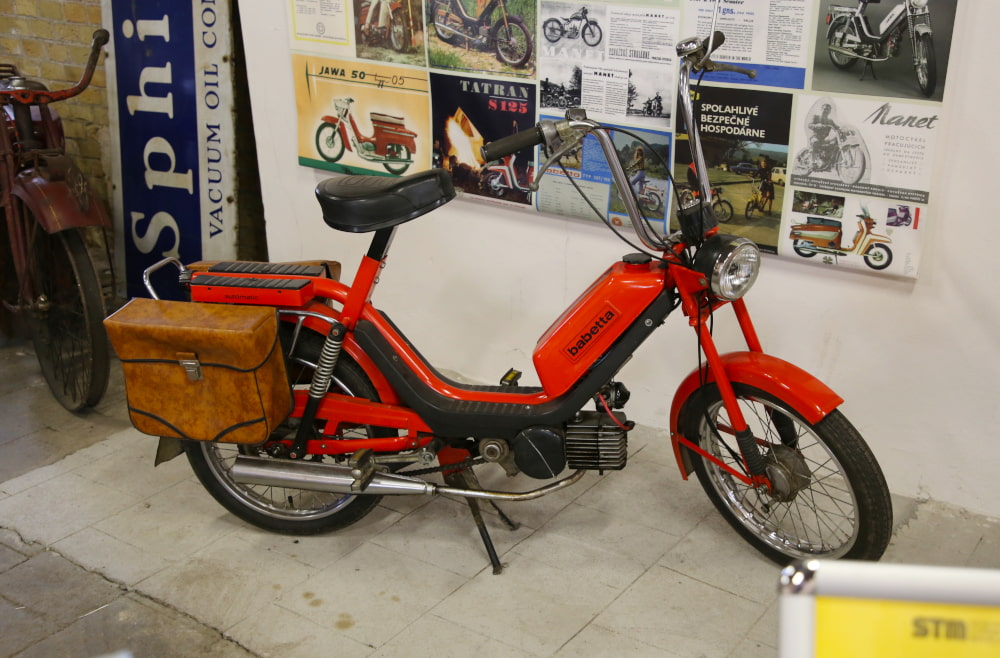
Babetta 210 at the Bratislava Transport Museum (Bratislava, Slovakia)
The JAWA Babetta was a series of mopeds built in Czechoslovakia and commonly marketed under the JAWA name in other countries. It had a 50cc two-stroke engine, a 1-speed or a 2-speed automatic transmission and reached 25–50 km/h depending on the model and year. They were produced in Považská Bystrica and later in Kolárovo.
Originally the Babetta was conceived as a lightweight moped to compete with the VéloSoleX moped which was popular during the 1960s. The first Babetta mopeds type 28 (type 228) was mass-produced from 1971 until 1973. The Babetta was notable for its electronic ignition – the first time a transistorized contactless ignition had been used in a moped.
Evolution
The type 206 was a modified type 28 with smaller 16 inch wheels produced in the years 1971–1972, mainly for Germany. Engine power was reduced to 1 kW and top speed was limited to 25 km/h and at the time no driver’s license was required for this Babetta.
The new Babetta 207 was presented in 1972. It had a more powerful engine on some models, but it otherwise it had the same general design as the type 206.
In 1983 the original models were replaced by the new 210. It featured a new engine and a 2-speed transmission, which was later swapped in favour of a 1-speed because of its unreliability.
In the first half of the 1990s, sales and exports gradually began to decline. By cooperation with a moped production plant in Latvia, originated Babetta 134 Stella (1989–1997). The last sold model was the Babetta 193 Sting, which was produced in 1999.
Characteristics
Manufacturer: Považské strojárne
Assembly: Považská Bystrica (Czechoslovakia) / Kolárovo (Slovakia)
Years of production: 1970—1999
Length: 1740 mm
Width: 625 mm
Height: 880 mm
Engine: 1 cylinder; 49 cc
Power: 2 HP
Max speed: 40 km/h
Fuel consumption: 2 l/100 km
Weight: 42 kg
See also: