TGM23

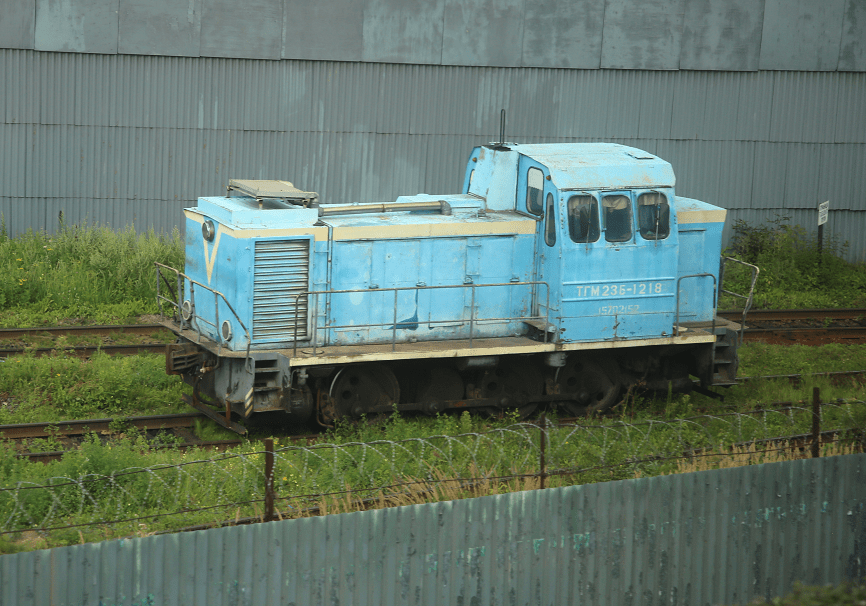
ТГМ23 (Тепловоз с Гидравлической передачей, Маневровый, 23-й тип) (Hydraulic Transmission Diesel Locomotive, Shunting, Type 23) is a serial Soviet three-axle shunting locomotive.
History
In 1962, the first experimental three-axle diesel locomotive TGM23-001 was created at the Murom Diesel Locomotive Plant named after F.E. Dzerzhinsky. A year later, the plant produced three more experimental locomotives of the same type.
The new locomotives differed from their predecessors, the TGM1 series diesel locomotives, which had the same axle arrangement 0-3-0. However, they retained a significant amount of equipment that was previously used in the TGM1 and TGM21 series diesel locomotives.
Design
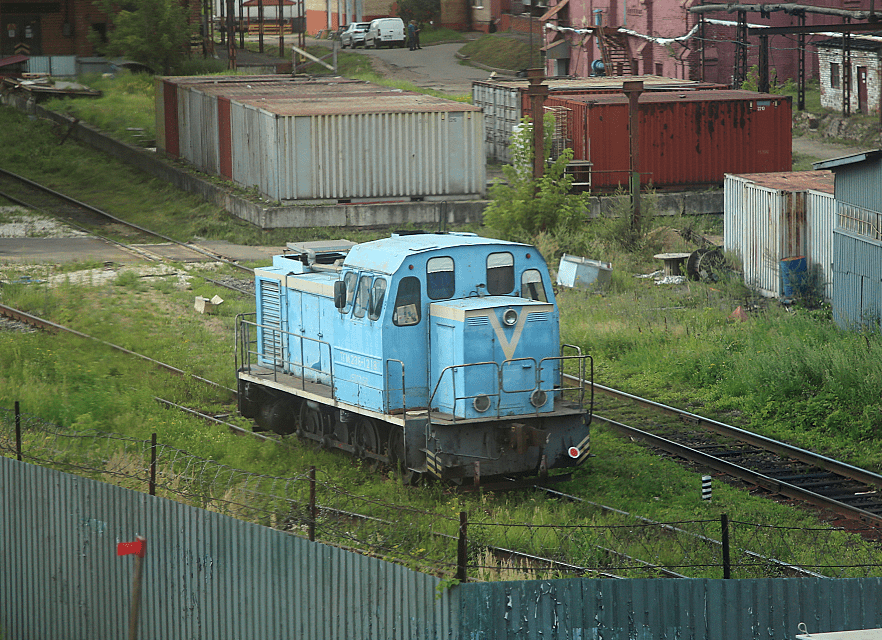
All TGM23 series locomotives have two hoods, inside which the equipment is located. Between them is the driver’s cabin, offset from the center.
The control cabin occupies the entire width of the frame, while the hoods are narrowed and form external side passages. These passages are fenced on the sides with safety fences. However, the first locomotives of this series did not have fences.
The frame of the locomotive is made of steel sheets 25 millimeters thick. The sheets are fastened with end coupling boxes and transverse fasteners. Automatic couplings of the SA-3 type are fixed at the ends of the frame.
In the last years of production of the TGM23 locomotive, the design of the upper part of the frame was significantly changed.
Chassis
The frame rests on the axle boxes with the help of individual spring suspension, without the use of balancers, which were previously used on the TGM1. In the case of the TGM23V and TGM23D locomotives, the spring suspension has again become balanced.
The softness of the suspension depends on the number of spring leaves, which may vary depending on the locomotive modification. For some time, nine-leaf springs were used on the locomotives, but then, in 1970, they switched back to ten-leaf ones. The axle boxes, in turn, are equipped with two tapered roller bearings.
The locomotive has three wheel pairs of a bandage type with counterweights and pins for the paired wheels. The diameter of the new wheels is 1,050 mm. The knockout shaft, unlike the TGM1 series locomotives, is located between the first and second wheel pairs. The pressure of the brake shoes on the wheels is one-sided, there is only one brake cylinder.
Power unit
The TGM23 diesel locomotives were equipped with a four-stroke V-shaped twelve-cylinder diesel engine 1D12N-500 with gas turbine supercharging. The cylinder diameter was 150 mm. The piston stroke with the main connecting rod was 180 mm, and with the connecting rod — 186.7 mm. At a shaft speed of 1,500 rpm, the rated power of this diesel engine reached 500 horsepower.
Depending on the design version, the following diesel engines were also used on the locomotive:
- 1D12N-500 with gas turbine supercharging (TGM23). Power: 500 HP;
- 1D12N-500M with higher boost pressure;
- 1D12-400 (TGM23B). Power: 400 HP;
- 1D12-400B (TGM23V and TGM23D).
Hydraulic transmission
The torque from the diesel engine is transmitted to the breaker shaft via the unified hydraulic transmission UGP 350-500 and the reverse-mode gearbox. The diesel shaft is connected to the main shaft of the hydraulic transmission via a step-up gearbox with a gear ratio of 0.676. The gear ratio of the gear wheels between the main and driven shafts when operating on the 1st hydraulic coupling is 2.43, on the 2nd – 1.49.
The driven shaft of the hydraulic transmission is connected to the reverse-mode gearbox, which consists of a mode box and an axial gearbox with bevel and cylindrical gears. In the shunting mode of operation, four gear wheels of the mode box participate in the mode, in the train mode, the gear wheels do not participate.
Two large bevel gears and a small bevel gear allow not only to reduce the rotation speed, but also to change the direction of movement.
During the production of TGM23 series diesel locomotives, changes were made to the design of the hydraulic transmission. Thus, already in the first years, a pair of gears of the 50:74 step-up gearbox was replaced by a pair of 52:72, which increased the gear ratio.
Electrical equipment
The diesel locomotive is equipped with a G-732 DC generator (1.2 kW, 28.5 V), a ST-722 starter and four 6ST-128 acid batteries (connected in series by two) with a capacity of 256 A⋅h.
Compressed air on early diesel locomotives is generated by a VV-1.5/9 compressor, driven by V-belts through an adjustable hydraulic clutch from the hydraulic transmission shaft. The compressor is single-cylinder, the cylinder is made stepwise to obtain two stages of compression. At a shaft speed of 1000 rpm, the compressor capacity is 1.6 m3/min.
Since 1972, diesel locomotives have been equipped with two-cylinder compressors PK-17M. At a shaft speed of 1450 rpm, their capacity was 1.75 cubic meters per minute.
However, in early 1973, on some models of diesel locomotives, for example, with TGM23-115, they began to use PK-35M compressors instead of PK-17M.
Driver’s cab
The diesel engine is controlled from the driver’s cab using a pneumatic drive, similar to how it is done on TGM1 series diesel locomotives. Torque from the diesel is transmitted through a UGP 350-500 hydraulic transmission manufactured by the Murom plant.
Modifications
TGM23A
In 1969, the Murom plant produced two experimental locomotives of the TGM23A series, numbers 001 and 002. These locomotives had significant differences from the production models.
The experimental locomotives were equipped with upgraded diesel engines of the 1D12N-500M model. Compared to the previous model 1D12N-500, they had a higher boost pressure and a number of design changes.
Two hydraulic units were used in the hydraulic transmission instead of three. Reverse-mode mechanisms of a new design were also used.
The changes also affected the exhaust gas tract. In connection with this, the muffler casing was removed from the upper part of the front hood. This change was also made to the design of the production locomotives of the TGM23 series.
In 1972 and 1973, the Murom plant manufactured one more TGM23A series locomotive under the same numbers 001 and 002. However, they had fundamental differences from the previous models: a 1D12-400N diesel engine with a capacity of 400 HP, a different hydraulic transmission, a modified body design with buffer lights built into the end parts of the hoods, and a completely redesigned refrigerator with side-mounted cooling radiators and blinds.
TGM23B
This locomotive was distinguished by a less powerful naturally aspirated diesel engine, which was installed on TGM1 locomotives. In addition, it had a softer spring suspension and some changes in the cooling system.
The hydraulic transmission remained the same as in the TGM23. However, already during the production of the TGM23B, the frame design was changed.
The TGM23B series diesel locomotives were produced from 1973 to 1985. During this time, about 3,400 units were produced.
TGM23BE
The export version of the locomotive was used in Germany. Two such locomotives (numbers 009 and 010) are known to have been delivered to Wustermark. There they were designated TGM23B.
TGM23V48
These locomotives differed from the original series in their diesel engine, generator, and battery.
The TGM23V series diesel locomotives were produced from 1982 to 1991. In 1985, a prototype TGM23V locomotive with two torque converters and a common turbine shaft was created. This type of hydraulic transmission is called a “hydraulic transmission with two torque converters.” A total of 2,667 of these locomotives were produced.
TGM23 d44⁄d48
A further development of the TGM23V locomotive, production of which ended in June 1991.
This locomotive uses a hydrodynamic transmission with an automatic gear shift function. This allows for greater traction when starting off and provides the ability to operate for longer periods at low speeds, which is especially important for shunting and industrial locomotives.
The driver’s cab is equipped with two control panels and has good sound insulation. Since the start of production, the service weight of the locomotive has been the same as that of its predecessor, the TGM23V – 48 tons. However, starting with No. 212, some models began to use the service weight of the TGM23B – 44 tons. This was reflected in the designation of the locomotive series, and now instead of TGM23D48 they began to write TGM23D44.
It is with this weight that the locomotive is produced in small batches to this day. In February 2014, diesel locomotive No. 0523 was sent to Kazakhstan.
TGM23Dg
The TGM23D diesel locomotive is equipped with a KamAZ-820.63-320 engine that runs on gas fuel (Euro-4). The gas is stored in special gas cylinder equipment.
According to expert estimates, the use of gas fuel allows reducing fuel costs by 30% compared to diesel. In addition, emissions of harmful substances into the atmosphere are reduced by 2-2.5 times.
3TGM23D
The three-section TGM23D diesel locomotive, which is designated as a monoblock in the factory documentation, consists of three TGM23D44 diesel locomotives connected using a multiple unit system. This allows it to be used as a three-section, two-section or single-section version.
Manufacturer: Муромский тепловозостроительный завод (Muromteplovoz)
Assembly: Murom (USSR/Russia)
Years of production: 1962—1985
Production: ≤9400 units
Length: 8920 mm
Width: 4070 mm
Height: 3150 mm
Track gauge: 1520/1435 mm
Powerplant: 1Д12
Power: 400 HP
Traction force: 100 kN
Max speed: 60 km/h
Weight: 44 t
See also Transport blog
See also Cars blog
See also Motorcycles blog
See also Buses blog
See also Shipbuilding blog
See also Motors and Engines blog
See also Trains and railways blog
See also Trucks and Cargo Vehicles blog
See also Tractors and Special Equipment blog
See also Tanks and Armored Vehicles
See also Airplanes blog
See also Helicopters blog
See also Artillery, Missiles and Rockets blog
See also Bicycles blog