Renault Express I

The Renault Express I is a light commercial vehicle marketed by the French car manufacturer Renault, from November 1985 to July 2000. On export markets, it is called Renault Rapid in Germany, and Renault Extra in the United Kingdom.
The Renault Express makes extensive use of the Renault parts bank that are contemporary with it. It is thus closely derived from the Renault Supercinq with which it partially shares the underbody. However, for some models, it is equipped with a four-bar rear axle, found on the sports versions Supercinq GT Turbo or 9 and 11 Turbo (then on the 9 and 11 equipped with the 1,721 cm³), the wheelbase, overhangs and front end (front mask, wings and hood) are specific.
History
In March 1984, the manufacturer Citroën unveiled a new model, the C15, intended to replace the Acadiane. While its marketing began in October of the same year, the arrival of the C15 had a significant impact on the light commercial vehicle market, mainly on the Renault 4 Van, which became obsolete in the face of this new product. In addition, the availability of the C15 in a diesel version marked a first in this segment. Renault, aware of the need to remain competitive in this segment, had to react by re-examining a previous project of the brand: a utility version of its new city car, the Supercinq.
At the launch in 1985, the Express was offered with three engines, including a diesel. The two petrol engines were Cléon-Fonte, with the 956 cc “C1C” and the 1,108 cc “C1E”. The diesel version was powered by the 1,595 cc Renault F “F8M-736” engine. Three body types were also available: the panel version (2 seats), the glass version (2 seats) and the estate version (5 seats). In 1986, a new version of the 1,397 cc Cléon-Fonte developing 60 hp was introduced, available in both estate and panel versions. In 1987, the estate was upgraded with additional equipment, such as wheel trims, side protection strips, two-tone upholstery, a trimmed trunk and the “equipment pack”, and it was available in three trim levels (GTC, GTL and GTD). The GTC trim level could be equipped with an optional 5-speed gearbox.
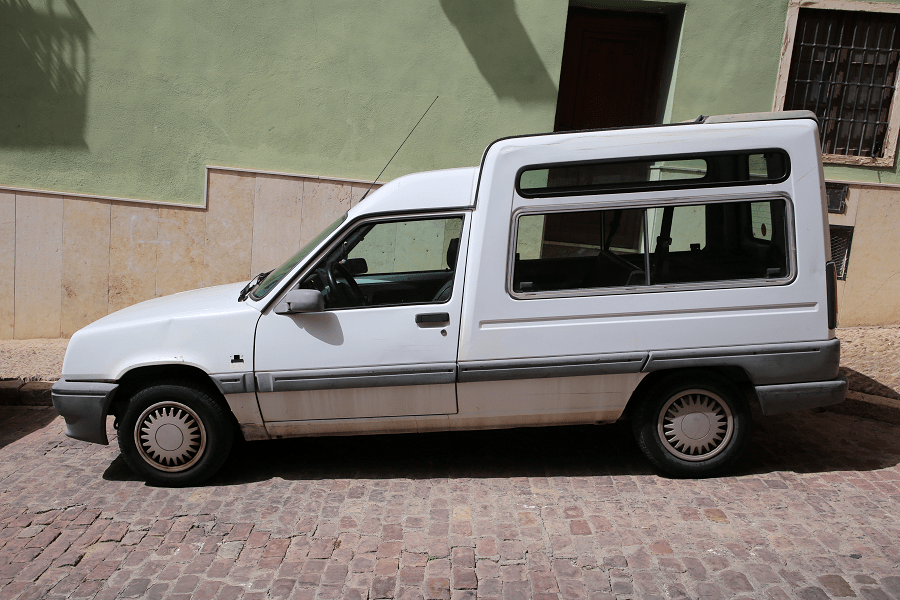
In September 1991, Renault presented phase 2 of the Express at the Frankfurt Motor Show. At the front, the grille was simplified with two openings instead of five on phase 1, featuring slightly rounded headlight optics. Normally black, the grille could be matched to the body color on high-end trim levels. The indicators were moved to the bumper, which also benefited from a new design. The side guards were repositioned higher, while the redesigned mirrors were now fixed to the windows. For the estate version, the tailgate is now installed as standard, while it remains optional for the five-seater Combi version. In an effort to improve the finish, all versions of the Express benefit from better sound insulation, while new options appear such as air conditioning, central door locking and power steering.
In September 1994, phase 3 of the Renault Express I is born. The main exterior change is the new grille with its two air intakes separated by the Renault logo. The front headlights are rounded, and the exterior mirrors enlarged. Inside, the dashboard is remodeled, and the steering wheel changes shape. In addition to these interior and exterior aesthetic changes, the Renault Express I abandons the engines of the Supercinq and is equipped with those of the Clio I.
End and succession
It is from the presentation of the Renault Kangoo I that the Express van begins its end of career. In 1997, only four versions of the Express remained: Base and Europa (replacing RL, RN and Extra) for the utility versions, Europa and Symphonie (replacing RN and RT) for the 5-seater version. In 1998, these family versions disappeared, only the 2-seater versions remained in the catalog. The Express disappeared in July 2000.
For the South American markets, production of the Expres continued until April 2001 in CKD kits in the plant of the Uruguayan assembler Nordex S.A.
In November 2020, Renault announced the marketing of a new Express from spring 2021, a simple utility vehicle, based on the chassis of the Dacia Dokker. On Thursday, February 11, the manufacturer confirmed the commercial launch of the Renault Express II.
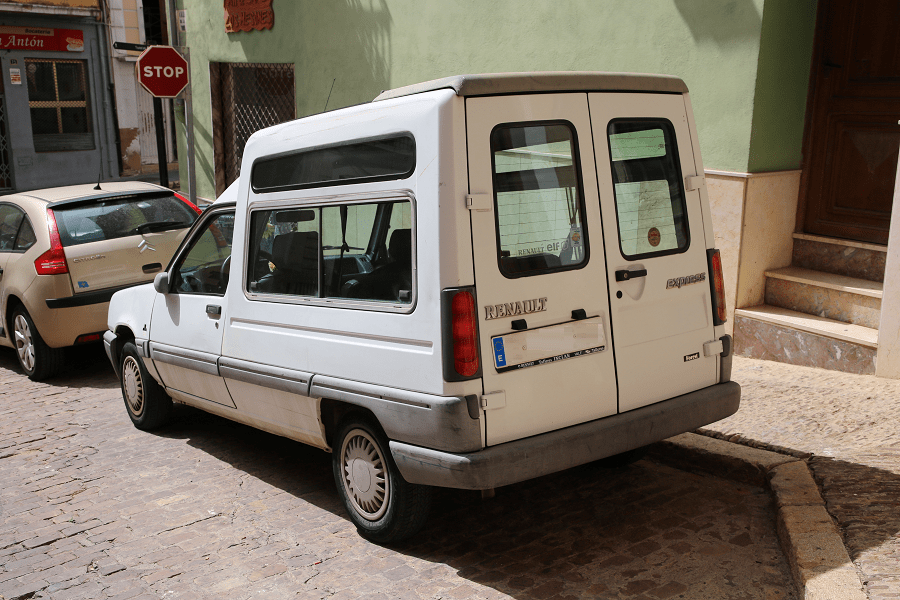
Assembly: Maubeuge (France) / Valladolid / Palencia (Spain) / Taichung (Taiwan) / Montevideo (Uruguay)
Years of production: 1985—2001
Production: 1 730 000 units
Length: 3982 mm
Width: 1588 mm
Height: 1790 mm
Engine: 4 cylinders; 1237 cc
Power: 48 HP
Max speed: 155 km/h
Fuel consumption: 8 l/100 km
Weight: 950 kg
See also Transport blog
See also Cars blog
See also Motorcycles blog
See also Buses blog
See also Shipbuilding blog
See also Motors and Engines blog
See also Trains and railways blog
See also Trucks and Cargo Vehicles blog
See also Tractors and Special Equipment blog
See also Tanks and Armored Vehicles
See also Airplanes blog
See also Helicopters blog
See also Artillery, Missiles and Rockets blog
See also Bicycles blog