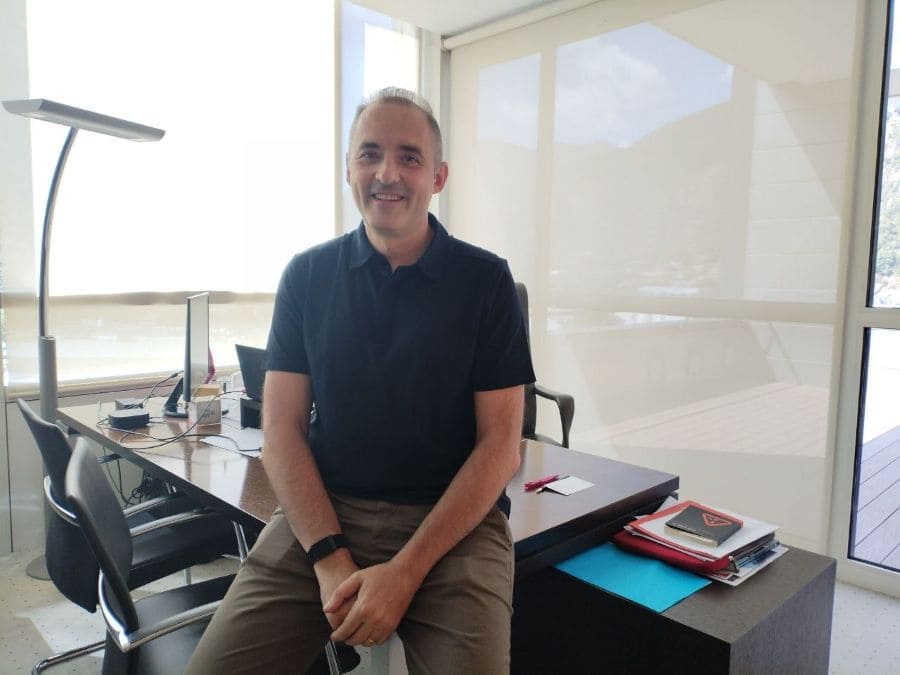
Alexander Beening was born in the Netherlands, in Breda (the birthplace of Pieter Bruegel, one of the most prominent painters of the Northern Renaissance). Since he was a child, Alexander has been interested in the sky and the objects visible to the naked eye. His mother told him that when he was a toddler, he was excited to see the Moon from the buggy he was transported in. In the following years, his curiosity expanded to include the Sun, the planets, and more distant stars.
He built his first telescope when he was 16 years old. At that time, telescopes were very expensive, so he tried to grind and polish his own mirror using two round pieces of glass, creating a mirror for a Newtonian telescope. With his knowledge of chemistry, he was even able to give the mirror a silver coating to make it reflective. His first large telescope – with a hand-made parabolic mirror, an 8-inch Newtonian – allowed him to see the rings of Saturn and other planets.
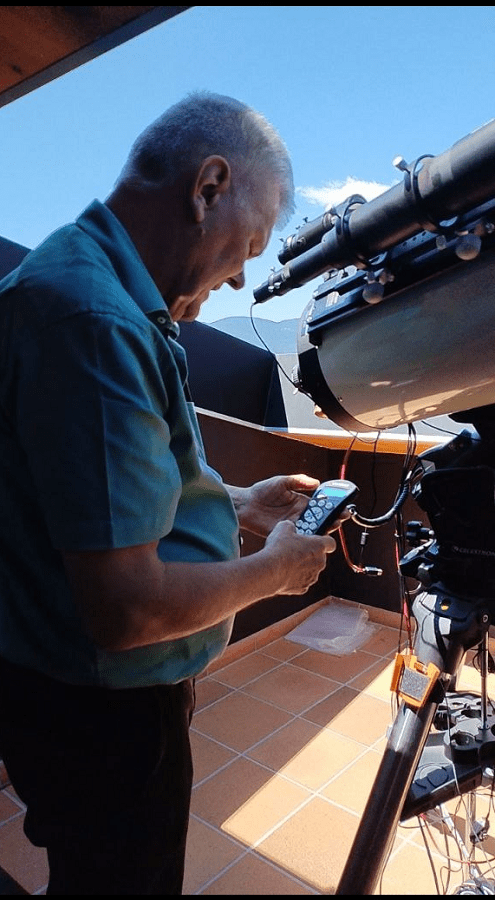
Many years later, in 2017, he planned a refurbishment of his chalet in Andorra, including a new roof to improve insulation. It was at this point that his wife, Angelina, suggested building a permanent observatory into the new roof. In 2018, this idea became a reality. Now he has a space where the telescope remains in place, and he just has to open the sliding roof to observe the sky. “The only element that can stop me is the clouds,” Alexander explains.
Also, he has created a small training course about astrophotography, with the goal of providing an understanding of the technology used to create photos of the universe. The course starts with the tripod and a camera, covers the practices of tracking, and ends with deep-sky photography using image processing tools.
See Alexander’s photos here
Interview: Irina Rybalchenko
Why are you interested in astronomy?
I studied a lot to learn more about astronomy and astrophysics. I had a special interest in the evolution of stars from hydrogen clouds, evolving into stars and ultimately ending as novae and supernovae. Also, I have developed volunteer experience as a guide at a public observatory in Hoeven, The Netherlands. There, I explained to people about the universe and showed visitors objects of interest, using the observatory’s large telescope (a 12-inch Maksutov).
My astro-hobby was put on hold between 1980 and 1996 when I had a lot of work as an industrial automation developer and project manager. Once established in Andorra, from 1990, we moved to a home in Juberri, in the south of Andorra, where the sky was very dark at an altitude of 1350 m. It was there that I restarted my hobby and purchased new equipment to pursue photography. The upcoming digital cameras with very sensitive sensors helped me to continuously improve the photos I took.
It is evident that an amateur can never reach the same quality and detail as, for instance, the James Webb Space Telescope or even the Hubble Space Telescope, but these instruments can only image one object at a time. On Earth, hundreds of thousands of amateurs like me capture photos of objects simultaneously. If we could organize ourselves, the value of all these images would be significant!
One fact is worth mentioning: about half of the new comets are discovered by amateurs.
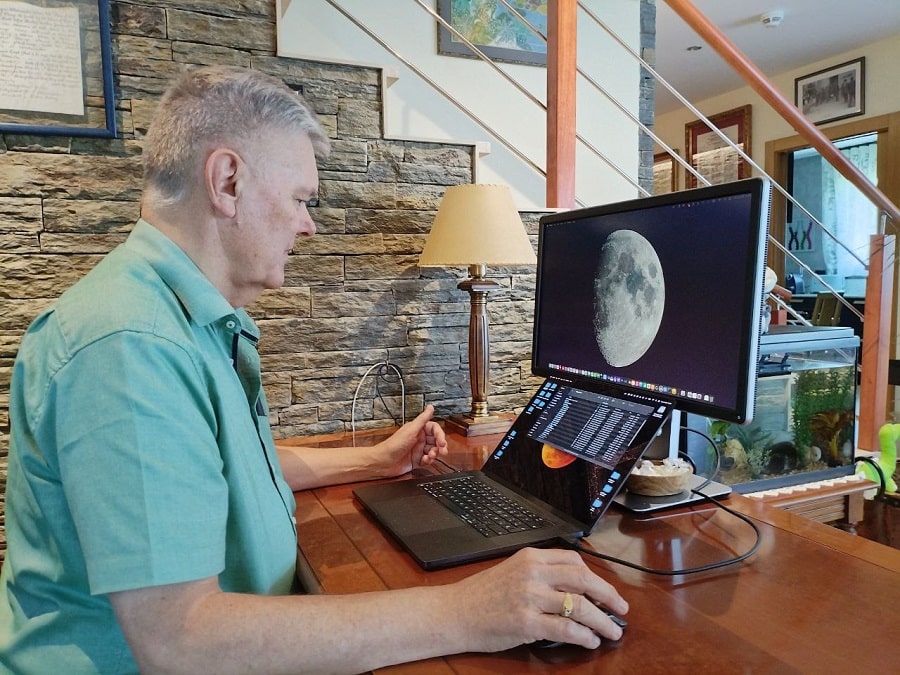
You used to work at Andorra Telecom – what exactly was your role there?
If you’re generous in your work, Andorra gives you the opportunity to grow and develop. At STA (now Andorra Telecom), I was able to develop information systems with a small team that gradually expanded over time. I was also involved in creating new services and eventually established my own center in Sant Julià, where we worked closely with students from the University of Andorra. It was in that environment that I began teaching, focusing on a specific software architecture designed to help companies become much more flexible in their business processes.
I’m almost 70 years old (or “young” – smiles). There’s something I always tell people: once you’re past 40, or even earlier, you should consider that you have enough knowledge and experience to share with others. I am retired, but I still teach at the University of Andorra. Until last year, I taught software design architecture in Java, specifically Java Enterprise Edition, a course I was able to develop at the university.
Light pollution and stargazing: how much do gadgets and artificial lighting hinder our ability to grasp the mysteries of the stars?
On Earth, light pollution is a big problem and worsens day by day. It is mainly caused by street lights, industries, agriculture (greenhouses), and cities, which severely spoil the visibility of the stars, the Milky Way, and other objects. Communities simply aren’t aware of what they are destroying for the public. Countries like the Netherlands, parts of Germany, and big cities like London, Paris, or Barcelona have effectively blocked the visibility of the sky.
But some countries, like Andorra, have regulated light pollution through formal laws. In Andorra, since 2021, a dedicated regulation outlines measures to reduce light pollution. Today, this regulation is showing its results. Street lights have almost everywhere been replaced by LED types, illuminating only downwards. I have noticed a significant improvement in the noise present in my images. Anti-pollution filters, initially necessary to achieve acceptable quality, are now only needed when the sky is not entirely dark.
Now I can truly see the Milky Way with the naked eye. When the sky is really clear, it’s easily visible without any equipment. Of course, this is amazing and creates excellent conditions to develop astrotourism. We should work harder to popularize and promote communication about space and meteorology!
The satellites orbiting Earth are another source of burden for astrophotographers. Since the deployment of Elon Musk’s Starlink project, photos of the sky are almost always polluted with satellite trails. In my case, for every 10 images I take through my telescope, about 2 or 3 have a visible satellite trail.
The professional organization IAU (International Astronomical Union) addresses this problem and has expressed their concerns to institutions like Starlink, but until now, few results have been obtained. My view is that we have to accept the problem but continue to complain. The more people raise awareness of this issue, the quicker we will see action.
Modern astronomy is currently unable to provide either direct evidence of planetary systems around stars through optical observation, or indirect confirmation of their existence. Do you believe in the existence of other civilizations? Why have we not received their signals, nor observed their wars in the form of extinguished constellations or other marvels of astroengineering? Is it that we have not yet learned to recognize such signs, or that these signals have not yet reached us due to the immense distances involved?
Looking at the size of our universe and the countless galaxies we can see, there must be life outside our solar system. The fact that we have never received any evidence about other civilizations is a point of worry. I refer to the “Fermi paradox,” which explains the discrepancy between the lack of this evidence and the likelihood of their existence. Fermi’s expression, “Where is everybody?” says enough.
Nevertheless, we as humans have five senses. This is what we use to observe the universe. Who can pretend that we are able to perceive everything? For example, an earthworm cannot see and will never be aware of the existence of light. Might we have the same problem with a missing 6th, 7th, or nth sense that we don’t have? That’s why I respect religious people who search for “higher powers”: we should not argue with these respectable people about whether “God does not exist.”
It is downright arrogant to think that human beings can observe everything that exists in the universe. That’s why I believe religion holds a very valid place in humanity. We have five senses, and we should use them to observe and understand what is happening. But at the same time, we must always remain open to other ways of knowing.
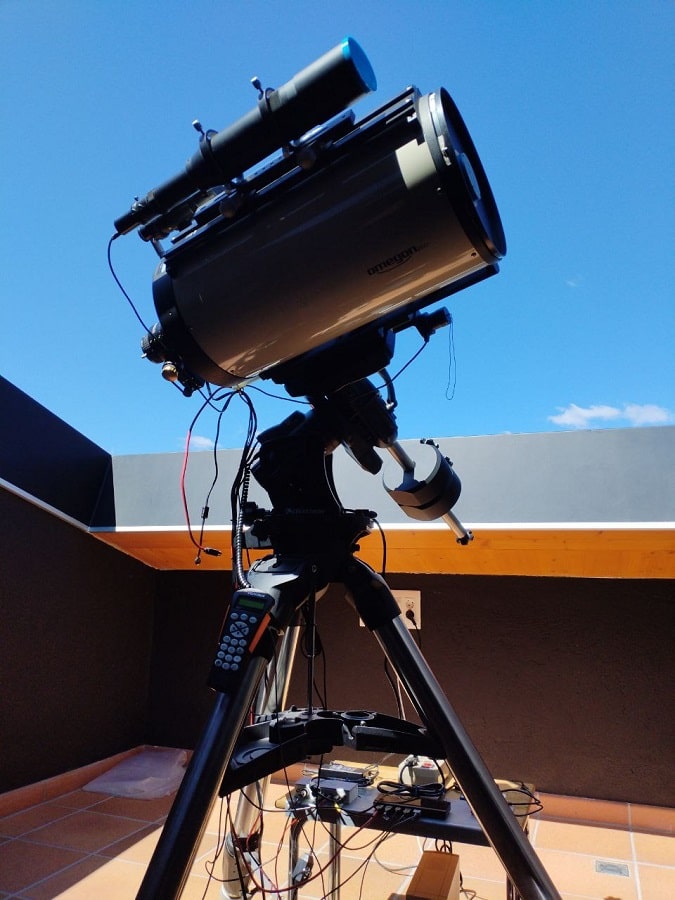
Telling it in other words — you believe in life on other planets, don’t you?
You said it right: life. But that’s one level. Another level is intelligent life. Still, when you look at how life started on Earth – beginning with molecules and amino acids that eventually managed to replicate themselves – that’s already the first form of life, like viruses.
I believe this process is happening in many places throughout the universe.
After that, life on Earth was able to evolve further, partly because our Sun is a very stable and relatively small star, with a life span of about 9 to 10 billion years. We needed that long period to reach the stage where we are today.
Think about Earth itself — formed around 4.5 billion years ago. At first, it was a fireball of lava and magma, which slowly solidified, creating the conditions for life. And yet, when you really consider how we ended up where we are now, it’s incredible.
There’s also another important point: life on Earth had to survive a series of “filters” or events that could have wiped it out entirely. For example, around 200 million years ago, there was an enormous volcanic eruption – what we now know as the Siberian Traps – which covered a large part of the Earth. It was so intense that it’s reasonable to wonder whether life could have survived at all, considering the gases and catastrophic changes it caused.
I don’t know all the details, but I know this happened. After that, probably, a meteorite tens of kilometers in diameter hit the Earth, causing the extinction of all the dinosaurs and many other forms of life. If that meteorite had been just a little bigger, life on Earth might have been completely wiped out, and we would never have existed.
These are the kinds of “filters” I’m talking about. I believe that if life develops elsewhere in the universe – on planets orbiting other stars, in other galaxies – those places must face similar filters.
Even today, Earth still faces risks. For example, if a large comet were headed toward us, we would have to act quickly. Sometimes there isn’t even a year to find a way to divert it or avoid catastrophe. So the risk of life on Earth ending is still present.
Let’s hope it never happens…
Of course, maybe humanity itself will bring about its own end, but that’s another subject…
What recent astronomical discoveries have made the biggest impact on you?
First, the exploration of the surface of Mars, using rovers and even a helicopter. It is clear that water has once flowed on Mars. What has happened since then? Could primitive life, like bacteria, have existed?
Second, the discovery of objects coming from outside our solar system, like Oumuamua in 2017 and now 3I/2025 N1 – ATLAS. What are they?
Finally, all the discoveries made with the James Webb Space Telescope. We are learning much more about the structure and the size of our universe.
Could some of the exoplanets orbiting other stars have developed life?
One possible answer to this question could be the behavior of the star Betelgeuse, which could go supernova at any time.
Do you follow developments in radio astronomy?
Not closely. I follow the discoveries in radio astronomy as part of the broader field of science.
Do you know what is required to officially name a star?
It depends on the size and visibility of the star. Anyone can name a star, and there are institutions that handle and manage this process. Today, only the faintest stars are still available for naming. As for the rest, I believe that organizations like NASA, the IAU, ESA, and others are responsible for assigning official names. Just one remark here: I’m very happy that an asteroid has been named after my wife, Angelina. I’m eager to capture a photo of this object!
Is there any scientific basis for helping us to assert that, when we gaze at the night sky, we are witnessing an abyss filled with worlds?
I think that humanity must continue to observe the universe and try to find explanations for the questions that arise from the results.
Who is your favorite science fiction author? Your favorite director and your favorite film about the stars?
Author: definitely Jules Verne. Film: when I was young, I was amazed by the adventures of The Thunderbirds.
How does your passion for astronomy help you in your life?
I’ve never really thought about that, but let me see. For me, astronomy is something mind-opening… People carry two or three main worries – often financial, sometimes political, and of course health-related. That last one, I believe, is very valid.
The problem with focusing too much on politics or money – your wallet, so to speak – is that you’re always looking down. And I think people should, from time to time, use that muscle in their neck… and look up.
Because when you look up – especially from a very dark place – what you see there doesn’t come with an invoice. It doesn’t have delivery delays, guarantees, or terms and conditions. And that fascinates me!